Note: This piece was prepared for the Clinical Trials Abundance initiative, a project by the Institute for Progress (IFP) with support from Renaissance Philanthropy, and presented at a policy workshop on October 7th, 2024
Summary
Despite recent increases in Food and Drug Administration (FDA) approvals for rare disease drugs (from 29% in 2010 of all drug approvals to 54% in 2022) significant challenges persist in rare disease research and drug development. Biopharma companies struggle to execute clinical trials cost-efficiently due to recruitment challenges, lack of qualified investigators, and limited specialized disease knowledge. Companies also find rare disease trials financially unattractive due to large research and development risks and small commercial opportunities, despite existing regulatory and economic incentives like orphan drug designation. A slew of recent cancellations of rare disease programs add urgency to this problem.
To overcome these obstacles, we propose that the FDA and National Institutes of Health (NIH) establish a “Rare Disease Master Protocol Clinical Trial Initiative” to create nationwide infrastructure for master protocol trials. This innovative approach combines the benefits of umbrella trials, which share control arms across multiple interventions, with platform trials that allow flexible addition and removal of study arms. By enabling multiple companies to share trial infrastructure and control groups, this initiative would significantly decrease costs per drug candidate while improving trial efficiency, ultimately allowing more promising rare disease drugs to be tested simultaneously.
Challenge and Opportunity
Rare diseases, while individually uncommon, collectively affect a significant portion of the population — around 10% of Americans. The economic consequences are substantial, with a recent study estimating the cost for 8.4 million patients affected by 373 rare diseases in the U.S. at $2.2 trillion per year. The lack of treatment is associated with a marked increase in total costs per patient annually. Despite this considerable economic and health burden, less than 10% of rare diseases have an approved treatment, and only about 22% have been studied in drug trials at all.
The challenges in developing drugs for rare diseases are multifaceted. By definition, these conditions present smaller market opportunities than common diseases like heart disease or diabetes, naturally limiting potential returns on investment. While legislative reforms like the 1983 Orphan Drug Act have helped to address this disadvantage and boost rare disease drug development, significant hurdles persist. Recent economic difficulties have hit this segment of the life sciences industry, with Pfizer and Takeda existing rare disease drug development and rare disease-focused firms experiencing sharper drops in valuation compared to other pharmaceutical sectors. This highlights their particular vulnerability to market uncertainties and limited access to capital.
Recent legislation has introduced additional complexities. The Inflation Reduction Act (IRA), while exempting orphan drugs from price negotiations, applies this exemption only to drugs with a single approved rare disease indication. This policy may inadvertently discourage the common and beneficial practices of developing multiple indications for orphan drugs and exploring rare disease opportunities for broad-indication drugs, potentially limiting treatment options for patients. Overall, more needs to be done to facilitate development in this challenging area of medicine. One way of achieving this is by making clinical trials less costly.
Clinical trials for rare diseases present unique challenges. The small size of patient populations and the lack of enthusiasm for patients with rare, life-threatening illnesses to be put on a control arm makes study execution particularly difficult. These factors lead to higher trial discontinuation rates compared to non-rare disease trials. About 30% of rare disease trials are discontinued before completion, compared with approximately 25% of non-rare studies, and about 30% of these premature stops are due to poor accrual (versus approximately 10–20% for non-rare indications). Additionally, the high per-patient costs of recruiting from within a small patient pool are especially burdensome for smaller biotech companies that focus on rare diseases. These factors contribute to the slower pace of drug development for rare conditions.
Platform and umbrella trials are a promising solution to many of these challenges. These innovative trial designs allow multiple drugs from several companies to be tested simultaneously for a single disease, usually with a shared control arm. Platform trials offer the additional flexibility to add or remove arms as new drug candidates become available or prove futile. By using a shared control group, these trials can increase the proportion of patients receiving experimental treatments, potentially improving recruitment. They also make more efficient use of resources, which can speed up the drug development process.
The HEALEY ALS trial is a prime example of the potential benefits of this approach. This platform trial for Amyotrophic Lateral Sclerosis (ALS), leverages a shared placebo group and central infrastructure to accelerate drug development. Estimates suggest that this approach could lead to finding a therapy more quickly (3.4 vs 8.5 years) and with fewer participants (880 vs 1400 on average), with most of this reduction coming from fewer patients on placebo.
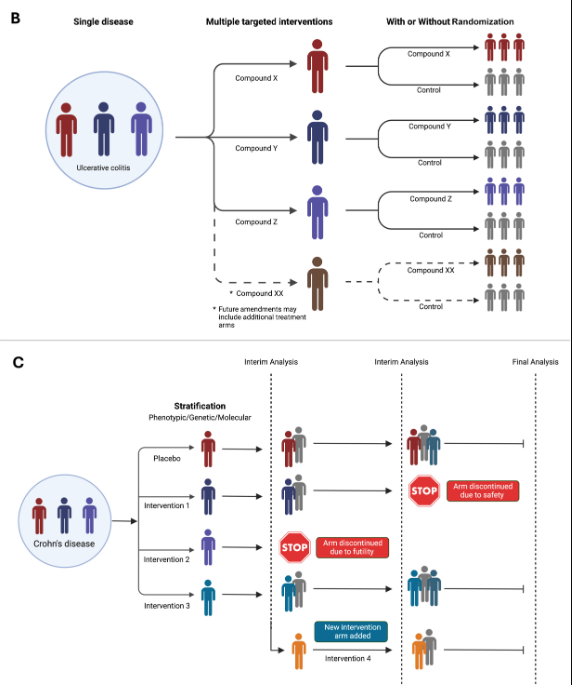
Caption: Graphic comparing umbrella (B) and platform (C) trials
Despite their potential benefits, platform trials are currently generally underutilized in rare diseases for two main reasons. First, these studies are complex to design and can require high expertise, personnel commitment, and upfront costs to initiate. This adds additional economic burden to drug developers for an indication area that is already fraught with economic concerns.
Second, the organizational structure of most large pharma firms makes it challenging to launch platform trials. Most drug companies center decision-making at the project team level, with each team focused on its own development plan and goals. The project-centric approach leaves no natural advocate for portfolio-level initiatives, and there are limited mechanisms for cross-team resource coordination. Thus, it is difficult to justify participation in broader, collaborative efforts that may seem tangential to core objectives. These barriers are strong even if the proposed collaboration is between projects in the company’s own portfolio — which is rare because few firms have multiple programs at the same stage of development targeting the same rare indication — if it involves setting up a customized collaboration with one or more external firms.
To address these challenges and facilitate the adoption of platform trials for rare diseases, a collaborative approach involving key stakeholders is necessary. One proposed solution is for the FDA and NIH to establish a “Rare Disease Master Protocol Initiative” that creates a nationwide infrastructure for these innovative trial designs. Such an initiative could address several key issues:
- Accelerated development timelines: The flexibility to add or remove trial arms quickly could speed up the overall drug development process for rare diseases. Individual assets could enter the already-running study whenever they are ready, without the sponsor having to initiate a brand new trial.
- Competition for a small patient pool: Currently, pharmaceutical companies often compete for the same limited pool of rare disease patients. Sharing a control group would limit the number of patients “wasted” in a control group.
- Infrastructure challenges for biotechs: Smaller biotech companies lack the resources and expertise to set up complex trial infrastructures on their own. In addition, setting up such infrastructure for a single drug would be inefficient.
- Patient antipathy to being in a control arm: A report from the American Cancer Society Cancer Action Network (ACS CAN) reports that one of the four reasons most often cited by patients when they decline to enroll in a trial is discomfort with being treated with a placebo.
- Expertise and standardization: Rare diseases often require specialized knowledge that only a handful of investigators and/or sites can pull together. A centralized platform could ensure consistent, high-quality trial execution by pooling expertise, and standardizing protocols across multiple studies.
Plan of Action
The NIH, with some assistance from FDA, should collaborate to establish a “Rare Disease Master Protocol Initiative” that creates a nationwide infrastructure for innovative master protocol studies in ten rare diseases.
This initiative would address the current challenges in rare disease research by:
- Creating a centralized platform: NIH would develop and maintain a sophisticated clinical trial infrastructure capable of supporting multiple umbrella and platform trials across various rare diseases. This platform would provide smaller biotech companies and large pharma firms with access to high-quality trial execution capabilities that might otherwise be out of reach or financially unattractive.
- Establishing a biotech/pharma working group: NIH would convene a working group comprised of industry stakeholders to gather insights from master protocol studies in rare disease (such e.g., as HEALEY ALS, PTP, NCI-MATCH, and RESULT) and cancer (e.g., NCI-MATCH), identify key issues and best practices, and prioritize rare diseases where this approach is feasible and there’s a critical mass of pipeline drugs to put into studies. This group would prioritize by treatment need and an available pool of promising therapeutics.
- Launching pilot studies: Based on the working group’s recommendations, NIH would initiate master protocol studies in 10 prioritized rare diseases as a pilot program. Each study might aim to include approximately 750 patients across five treatment arms, following the model of successful initiatives like HEALEY ALS, but this would be adjusted for different diseases
The FDA’s role would be to provide regulatory guidance and validation of study designs, ensuring they are suitable for Accelerated Approval pathways where appropriate. This would address concerns about regulatory acceptance of data from these innovative trial designs. effort would build on activities that already appears to already be underway to some degree through the FDA’s Rare Disease Innovation Hub, though details are scarce, and its START pilot program.
To implement this initiative, Congress would need to allocate approximately $300 million in funding. This estimate is based on benchmark clinical trial costs of $181,000 per patient for Phase 2 studies (adjusted for inflation from 2016 data), multiplied by 750 patients per disease across 10 diseases, plus additional funds for upfront strategy work and administrative infrastructure. Sponsors would contribute 80 percent of the total cost (to cover the patients in experimental therapy arms), with the government allocation supporting the control arms, upfront strategy work and administrative infrastructure. Note that this is a high-end estimate because total development costs per asset will likely be less than this amount due to the shared infrastructure and control arms (see above).
Conclusion
By creating this shared infrastructure and coordinating efforts across multiple stakeholders, the Rare Disease Master Protocol Initiative would improve the efficiency of rare disease trials, enable more promising drugs to be tested simultaneously, and address the current inefficiencies in rare disease clinical research. This approach would especially benefit both large pharma and smaller biotechs by reducing costs, streamlining patient recruitment, and accelerating development timelines.