This piece is part of IFP’s Transit Abundance Playbook, a collection of proposals for reducing American transit construction costs.
Summary
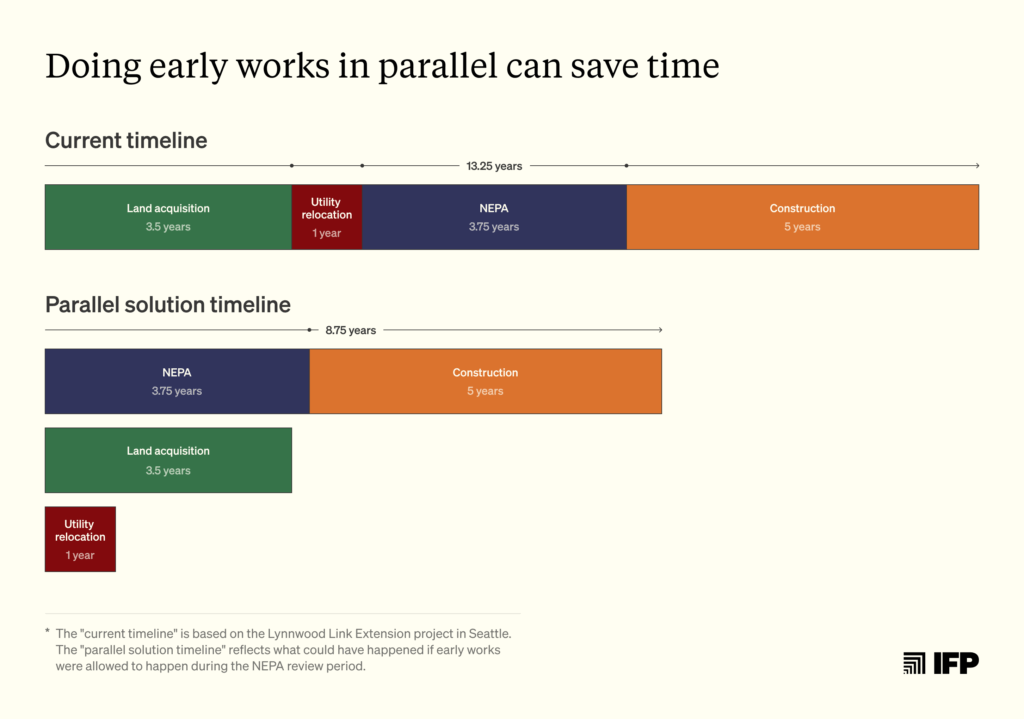
Under current federal regulations, transit agencies cannot buy land, prepare construction sites, move utility lines, enter into the engineering process, or conduct any other preliminary construction activities for transit projects until the Federal Transit Administration (FTA) completes a full review under the National Environmental Policy Act (NEPA). Barring transit agencies from acquiring land and preparing for construction until after NEPA review — which averages 5.7 years for transit projects — raises the price of land and adds years to project timelines.1 This prohibition on “early works” also distorts transit planning by preventing early technical development and incentivizing planners to choose suboptimal project routes to avoid land acquisition and minimize utility relocation.
There are two ways to cut this red tape: either Congress should update the statute to allow early works before or during NEPA review, or FTA should take administrative action and update its NEPA regulations to allow the same.
Problem
FTA’s NEPA regulations (23 C.F.R. 771.113(a)) prohibit land acquisition, utility relocation, engineering, and other pre-construction preparation prior to the completion of NEPA review. This means that transit agencies must wait years to acquire land for new rights-of-way, move utility infrastructure, and complete technical engineering.
It may come as a surprise that a regional or local transit agency buying private land with state money, or moving state-regulated utility lines, gets caught in a federal NEPA review. This overreach is grounded in an overly expansive interpretation of NEPA. Passed in 1970, NEPA requires federal agencies to prepare a comprehensive analysis of the environmental impacts of a project and its potential alternatives. The law applies to all “major federal actions,” encompassing any activities that the federal government undertakes or directly enables.2 FTA approving transit grants qualifies as one such action, so every transit project that receives federal funds requires review under NEPA.
A local or regional transit agency acquiring land is neither a federal action, nor does it create any environmental impacts; buying land is simply a paper transaction of money for a property deed. Nevertheless, FTA’s regulations do not allow it for FTA-funded projects; FTA even forbids transit agencies from using land purchased prior to the NEPA process.
Defenders of this expansive interpretation argue that NEPA’s directive to consider alternatives requires agencies to avoid any actions that might “prejudice” the federal agency’s choice among alternatives. In other words, federal agencies may not take or allow actions that would make one alternative more or less appealing while they complete their NEPA analysis. FTA applies this “no-prejudice” interpretation to state and local transit agencies, arguing that transit project sponsors acquiring land will prejudice FTA’s decision of which project alternative gets selected. This interpretation is based on the NEPA regulations created by the Council on Environmental Quality (CEQ) in 1978, which have since been repealed. However, FTA’s NEPA regulations still reflect the ban on all activities that might prejudice the selection of alternatives. This is ripe for an update.
These outdated regulations ultimately raise the cost of land for transit projects. Land gets more expensive over time and having to wait until after NEPA completion forces transit agencies to delay land acquisition by 5.7 years on average. Moreover, planners have to estimate future land costs years ahead of time, rather than pragmatically buying land when it becomes available; if planners underestimate land prices, project costs exceed expectations. For example, rising real estate costs and an underestimate contributed to a $101 million overrun on Sound Transit’s 8.5-mile Lynnwood Extension.3
Banning early land acquisition further increases costs by exacerbating landowner holdouts. To complete NEPA, agencies must commit to a particular route. By the time an agency has publicly selected their preferred alternative, they’ve completed years of review and changing the route would add years more. Landowners along the route know the transit agency has no other option than to acquire their property, giving them leverage to ask for more money. Even though transit agencies can invoke eminent domain, landowners can argue that future proximity to transit has increased their land value and, therefore, their compensation. Landowners can also threaten litigation — and because FTA’s policy effectively forces transit agencies to conduct a condensed land acquisition process in time for major construction to begin, agencies often have to acquiesce to landowner demands. Agencies often give in because the consequences for failing to complete land acquisition in time for construction are significant — for example, California High-Speed Rail went $64 million over budget because planners failed to acquire land ahead of tendering construction contracts. While this spending benefits local landowners, taxpayers bear the additional costs.
Transit agencies are similarly cornered into committing to specific designs before completing technical planning. Under the federal Capital Investment Grants (CIG) statute and FTA’s NEPA regulations, CIG-funded projects cannot enter the Engineering Phase and complete detailed technical planning — such as geotechnical investigations, subsurface utility mapping, and final design work like negotiations with contractors and utilities — until after FTA has made a decision under NEPA. But by the time FTA has done so, the project’s route is effectively final — choosing a different route would require a lengthy supplemental NEPA review or redoing the entire environmental review process, causing years of delay and risking cancellation of the project altogether. In practice this means that transit agencies must find a way to make the selected route work. Too often this entails paying to overcome unforeseen technical obstacles. For example, during the construction of the Second Avenue Subway Phase 1, crews encountered unexpected ground conditions, forcing $18.7 million in additional work. The construction of Hawaiʻi’s Skyline metro expansion to the airport resulted in a $60 million settlement with the contractor after utilities were not relocated on time.
FTA’s rigid sequencing requirements also complicate other types of preliminary work. Relocating utility lines can be an even more substantial cost driver than land acquisition: utility maps are often out of date, leading to conflicts over who is responsible for moving and upgrading outdated infrastructure. When relocation work cannot be done ahead of time, delays and conflicts push back construction of heavy transit infrastructure and create costs. For example, utility relocation on the Second Avenue Subway Phase 1 was delayed nine months because the New York City Department of Environmental Protection reopened a utility relocation issue in the middle of ongoing contracts. The nine-month delay added $6 million in costs for a total of $40.5 million, all for less infrastructure than initially proposed.
By driving up the costs of land and utility relocation, NEPA creates bad incentives for transit planners. Over time, transit agencies have learned that utility relocation and land acquisition can be burdensome and lead to massive budget overruns. This has led transit planners to choose projects that minimize the need for early works, in the process often undermining a project’s central value proposition: to provide reliable and fast transportation services to as many people as possible. For example, many recent transit projects are built within existing highway medians to utilize the highway’s right-of-way. While this sidesteps the burden of having to acquire land, it also reduces the economic value of new transit since the resulting stations sit in the middle of remote, pedestrian-unfriendly roads. WMATA’s Silver Line extension to Dulles Airport and Ashburn was largely built within the median of a four-to-eight-lane highway that takes several minutes to cross, severely limiting the amount of housing and jobs within the 10-minute walking distance that allows commuters to rely on transit.4 Similarly, the Boston Green Line Extension was located within the existing commuter rail right-of-way to avoid new property takings. The difficulty of utility relocation can create a similarly bad incentive for planners: after the $40.5 million utility relocation conflict during Second Avenue Phase 1, the MTA decided that for Phase 2 it would just spend significantly more to design deeper stations and tunnels to avoid utility conflicts.
Allowing for timely early works would encourage planners to select higher-value service routes, rather than incentivizing them to build less useful, more expensive projects in order to avoid regulatory burden.
Solution
There are two options for reversing FTA’s ban on early works:
- The first option is a legislative solution, wherein Congress passes a law to clarify that early works for transit projects are excluded from federal permitting requirements. This legislative change could resolve the issue without ambiguity.
- The second option is administrative: FTA could update its regulations to allow early works. This path is viable, though more burdensome — FTA has strong legal grounds to update its NEPA regulations given the recent repeal of CEQ’s regulations, but it would require a lengthy process and could incur legal risk.
Legislative solution
The optimal solution would be for Congress to update the statute to allow a list of exempted activities to proceed prior to applying for FTA funds and/or during the NEPA process. The covered activities should include: land acquisition, utility relocation, engineering, demolition and site clearance, advanced procurement, and construction of temporary structures, such as for access roads.
Early works would need to be paid for with state dollars when the activity occurs. Congress should also amend 49 U.S.C. § 5309(f) and specify that, if sponsors ultimately receive a grant, the spending on early works can count toward the local financing commitment for a transit project. This change would incentivize project sponsors to conduct early works when they are most cost-effective; without the possibility of reimbursement, project sponsors might wait until after a Fully Funded Grant Agreement (FFGA) is signed with FTA in order to pass the cost of early works onto federal funding.
Congress must extend the exemption to all common categories of early works. Recent proposals — like the US Department of Transportation’s 2024 budget request, and the Modal Parity in Permitting Act — merely proposed an exemption for early land acquisition. Prohibiting early utility relocation and other activities needed to prepare for transit infrastructure construction can be just as disruptive to project construction as deferred land acquisition. There is no reason for federal review to prevent states from moving utility lines or acquiring land — Congress should exempt all early works and establish that work carried out by states or localities with their own funds is in the jurisdiction of state regulators.
Administrative solution
If Congress does not act, FTA should abandon its expansive “no-prejudice” interpretation of NEPA and instead amend its regulation 23 C.F.R. § 771.113(a) to allow transit agencies to conduct early works before the completion of the NEPA process. FTA can justify this change because activities carried out by non-federal agencies are not subject to NEPA, provided they do not use federal funds and do not prevent FTA from completing analysis and making a reasoned, non-arbitrary decision under NEPA. To promote uptake of the new regulations, FTA should identify and update either regulation or guidance with a list of the actions allowed prior to the completion of NEPA, including: land acquisition, utility relocation, engineering, demolition and site clearance, advanced procurement, and construction of temporary structures.
Rejecting the no-prejudice interpretation is justified because the interpretation does not follow from a plain reading of NEPA. The statute requires that agencies analyze a “reasonable range of alternatives to the proposed action,” but it does not stipulate what agencies may not do during analysis, nor does it mention bias or prejudice. Transit agencies taking preliminary steps to prepare for construction do not force the FTA to select their preferred alternative — legally speaking, the FTA can choose another alternative or deny the grant if it chooses. Moreover, NEPA does not explicitly apply to actions by non-federal transit project sponsors during review; the text requires only that federal agencies analyze alternatives and make a reasoned decision based on accurate information.
By changing its NEPA regulations, FTA would clarify that early works on federally funded projects are not subject to NEPA review — effectively creating an exemption. This differs from establishing a categorical exclusion, which still requires months-long NEPA review and sign-off from FTA.5 Land acquisition requires quick turn-around times to negotiate prices for many individual parcels of land, a poor fit for the timelines needed to secure categorical exclusions. Full exemptions would remove this bureaucratic friction and allow transit agencies to proceed quickly.
While FTA has strong grounds for making this change, there is some risk that new regulations would be challenged in court. The no-prejudice interpretation has been in place for decades and is supported by case law. Although rejecting the interpretation is legally sound, given the removal of CEQ’s regulations and a plain reading of NEPA, the change is not without legal risk.
Further, FTA should reconcile newly allowed early works with FTA’s existing project sequencing regulations. FTA currently stipulates four project development stages: Project Development, Engineering, Construction, and Start-up. The Project Development Phase, which happens prior to the completion of NEPA, is when a transit agency plans, prepares environmental analyses, and decides on a particular project design. The Engineering Phase, which begins after NEPA is complete, is when the construction design is finalized. This creates a regulatory contradiction for early works that require construction. For example, an agency attempting to carry out early utility relocation pre-NEPA would need to complete detailed construction plans, secure contractors, and set a project schedule — all activities that are presently reserved for the Engineering Phase. Without clarification, a new policy to allow early works could be undermined by the regulations for order of operations.
Fortunately, there is a solution. While the CIG statute requires that the Engineering Phase cannot begin until after NEPA, it does not specify which activities must occur in each phase. FTA has authority to clarify which activities are allowed during which phases and should update its regulations to allow transit project sponsors to carry out final design work for early works during the Project Development phase.
Allowing early works to occur sooner is low-hanging fruit for lowering transit project costs. The current federally mandated sequencing is inefficient, costly, and incentivizes planning choices that compromise the design of transit projects. By allowing early works to be conducted in parallel with federal permitting, federal policymakers can make it easier for project sponsors to practice good project planning, lower costs, and improve project outcomes.
-
The 5.7-year average is based on the underlying data captured in the Council on Environmental Quality’s 2025 report, Environmental Impact Statement Timelines (2010–2024). We computed the average Environmental Impact Statement time for FTA projects by measuring the length of time from the Notice of Intent (NOI) to the Record of Decision (ROD).
-
The meaning of the term “major federal action” is currently in flux as the Trump administration seeks to redefine it following the passage of the Fiscal Responsibility Act in 2023.
-
This cost overrun was due to increased real estate costs, which planners underestimated by 19% (initial estimates expected a 25% increase; the actual increase was 44%), and project scope creep, which required taking an additional 190 properties. Sound Transit may have saved 44% on land had it purchased the land earlier, but it may still have had to acquire the additional 190 properties.
-
Research shows that commuters are far less likely to rely on transit if they have to walk more than 10 minutes to a station. For a view of the route of WMATA’s Dulles rail extension see this map.
-
Categorical exclusions are abbreviated NEPA reviews. They are expedited because preestablished categories of actions have been deemed to have no significant environmental effects and can therefore be excluded from NEPA review. However, categorical exclusions are still technically NEPA reviews and therefore require evaluation and sign-off from a federal agency. In the context of a transit agency buying land, coordination with a federal agency can be too time-consuming to be practical. See Jamey Tesler’s playbook piece for more on categorical exclusions and alternative solutions.