This piece is part of IFP’s Transit Abundance Playbook, a collection of proposals for reducing American transit construction costs.
Summary
The comprehensive environmental review process required by the National Environmental Policy Act (NEPA) is a common pain point for transit agencies, contributing to project delays and cost escalations. Categorical Exclusions (CEs), which streamline environmental review for categories of activities based on demonstrated evidence that the type of project will not “significantly affect the quality of the human environment,” can reduce infrastructure project costs, shorten permitting timelines, minimize uncertainty, and help projects avoid litigation risk.
However, CEs are implemented inconsistently across transportation modes and federal agencies. The Federal Transit Administration (FTA) requires transit project proponents to submit burdensome documentation to obtain pre-approval for a CE. By contrast, the Federal Highway Administration (FHWA) has streamlined the CE process through the use of programmatic agreements (PAs) that delegate the authority to self-certify CEs to state departments of transportation (DOTs).1 To improve transit project outcomes and mitigate a major cause of cost overruns and project delays, Congress should authorize the Federal Transit Administration (FTA) to enter into PAs with transit agencies.
Problem
Early transit project development can be a waiting game, and any delays in this initial phase, whether due to procedural hurdles or uncertainty regarding federal decisions, balloon project costs. The efficiency of the CE process matters: though CEs can eliminate unneeded environmental review, getting an FTA determination on a CE is an uncertain and sometimes demanding process that diminishes the time savings an exemption would otherwise create.2 Projects cannot proceed while waiting for a determination, adding unnecessary risk and cost — especially in an inflationary environment. Despite these downsides, CEs are used for 95% of FTA-funded transit projects.
Environmental impacts, mitigation strategies, and project consequences differ across transit project types, and CE review processes vary accordingly. To address this variation, FTA has developed review categories with varying documentation requirements. For example, CEs for “C-list” projects, which include some projects within existing transit right-of-way, and vehicle purchases, maintenance, and other projects at existing transit facilities (such as adding space for public safety or child care facilities), require minimal documentation. These projects are almost certain to get streamlined review and approval by FTA.
By contrast, “D-list” projects, which include bridge replacement projects, acquiring right-of-way, facility modernization, and “minor transportation facility realignment for rail safety purposes,” have less assured success. FTA guidance for this category states that projects “may be categorically excluded with sufficient documentation” (emphasis added). For many D-list projects, transit agencies are left to navigate the CE process with only tentative odds of securing a waiver.
Transit agencies often lack the in-house expertise needed to navigate the technical CE process. To advance a D-list project, transit agency staff must first determine whether they or outside consultants will prepare the filing. Even this preliminary decision extends the project timeline and may add an additional contracting step. If relying on a consultant to secure a CE, the agency then needs to: (1) identify initial funding, typically from planning budgets, to hire the consultant; (2) develop a scope for the engagement; (3) procure and contract with the consultant; and (4) await FTA’s approval of the CE. Even if an agency has the requisite in-house expertise and can avoid some of these steps, applying for a CE is time-intensive and requires preparing and submitting extensive documentation for FTA review.
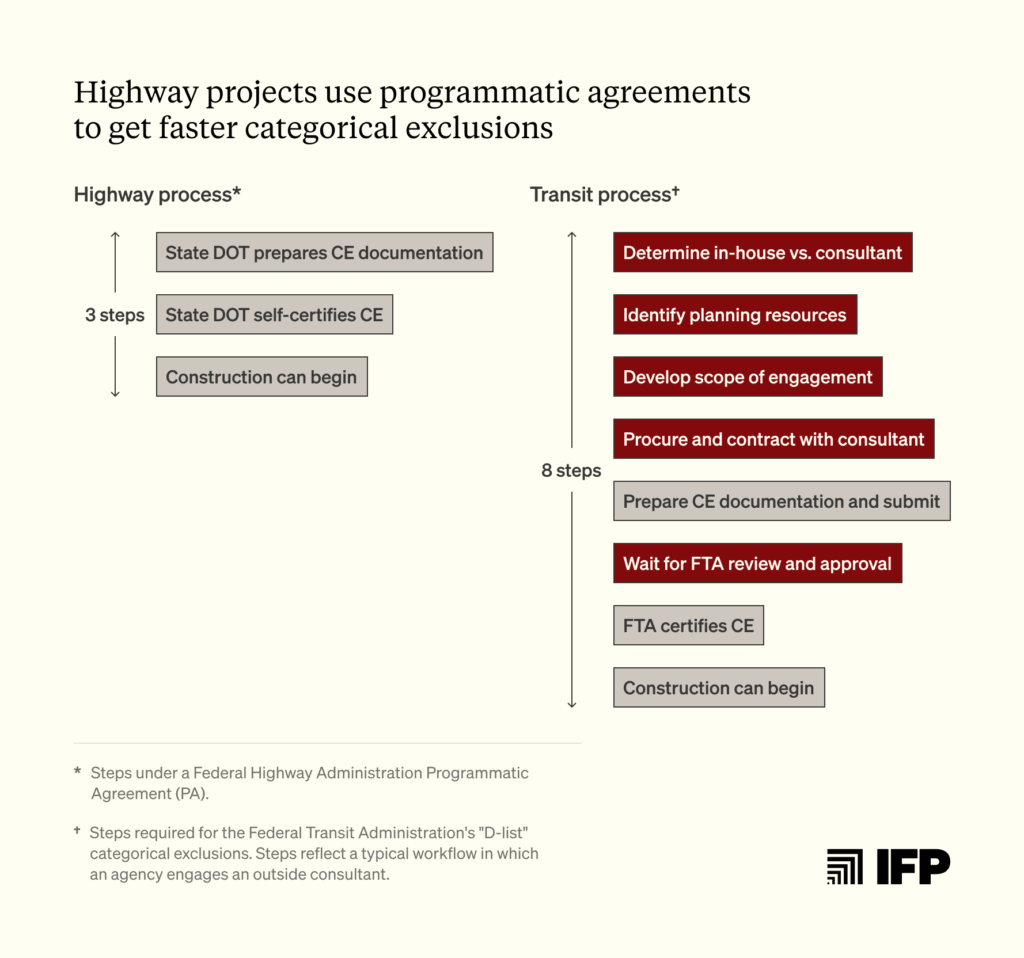
After applying for a CE from FTA, all implicated activities are on hold until review is completed. Because FTA requires strict project sequencing, transit agencies cannot advance procurement, contractor selection, or construction scheduling until the FTA issues its determination — for example, FTA guidance for right-of-way acquisition explicitly states that “[n]o project development on the acquired right-of-way may proceed until the NEPA process for such project development, including the consideration of alternatives, has been completed.” Unsurprisingly, project proponents are often discouraged by the hurdles and oversight required to secure an exemption, and simply defer (or even forgo) acquiring land for that right-of-way. This might lead an agency to build within an existing right-of-way, which avoids regulatory hassle but undercuts the value of the project by moving stations further from jobs and housing. And if the transit agency does pursue the CE, there is no guaranteed turnaround time. This unpredictability can stall projects, while inflation and cost escalations mean that even modest delays can significantly compound costs.
Modifying how CEs are administered can help more fully realize their benefits. One study conducted by the US Department of Transportation (USDOT) demonstrated that the process used by FHWA streamlines schedules and reduces costs, uncertainty, and litigation risk.
The FHWA process relies on Programmatic Agreements (PAs) to delegate portions of NEPA review — including CE approval — to state or local partners. PAs establish a formal agreement for a streamlined process for “handling routine environmental requirements for commonly encountered project types.” The FHWA uses PAs to great success; by 2016, all 50 states had at least one PA in place. An FHWA report notes that ‘[b]y considering repetitive actions on a program basis rather than individually by project, efficiency is increased while maintaining appropriate consideration for the environment.” PAs have reduced planning time, cut both program and project costs, and enhanced project delivery results. In one instance, FHWA found that a PA established between the Oregon DOT, National Marine Fisheries Service, and FHWA reduced review time by 85% and saved $1.23 million. Prior to this agreement, “projects required costly and complex biological assessments that took three to five months to prepare and another 200 days to reach a signed biological opinion.” The California Department of Transportation (Caltrans), which has delegated NEPA authority since 2007, found similar results: based on a review of time and cost savings from over 18,000 projects, delegating authority for CEs saved approximately one month of staff time, which amounts to over $2.8 million.
Self-certifying exemptions through PAs can help state DOTs build internal capacity that provides broader project delivery benefits to the DOTs.3 FHWA and state DOTs developed their PA program incrementally to build that expertise, starting out with narrow PAs before gradually expanding agreement scope.
Despite the advantages demonstrated in the FHWA context, PAs are not used in transit. Transit projects are typically implemented by a local or regional transit agency rather than the state DOT, and fall under FTA oversight. But unlike FHWA, FTA has not entered into PAs with transit agencies. One likely deterrent is the sheer number and diversity of transit agencies: based on 2023 reporting to the National Transit Database, the US has 3,000 transit agencies that vary in size, service, assets and project capacity, compared to the relatively similar 50 state DOTs. US transit ridership is highly concentrated — just a handful of transit agencies comprise most transit ridership, assets, and capital spending, while a long tail of small agencies maintain only modest bus fleets and ridership. And transit projects and their potential environmental impacts are much more varied, too.
Beyond accounting for agency variance, adopting PAs for transit projects would require developing in-house expertise, since transit agencies may have less internal capacity and competency to implement NEPA reviews than state DOTs do. Addressing these concerns and expanding the use of PAs in transit could help projects advance more efficiently.

Solution
Adopting PAs for transit projects would improve project timelines and reduce costs. This should be a relatively uncontroversial change: CEs are based on historical evidence that similar projects typically have little or no significant effect on the environment, and streamlining transit projects creates substantial environmental benefits. Recent reforms by the Trump Administration embraced CE expansion to reduce costs and improve permitting times. USDOT revised 23 CFR 771 in July 2025 to allow federal agencies to adopt existing CE categories authorized by another USDOT agency (such as FTA adopting from FHWA), rather than needing to conduct its own duplicative process. Expanding usage of PAs in transit would further advance this agenda.
To encourage continued expansion of CE use, Congress should direct FTA to implement FHWA’s model and adopt PAs to ease CE review and administration. More specifically, 23 CFR 771.118 should be revised to be consistent with 23 CFR 771.117(g), which enabled FHWA to use PAs to delegate CE approval of certain highway projects to state DOTs, allowing them to issue CE determinations on FHWA’s behalf.
Congress initially directed FHWA to authorize PAs in the Moving Ahead for Progress in the 21st Century Act (MAP-21), and this authority was clarified and expanded in the 2015 FAST Act. Following that precedent, the best path forward is for Congress to direct FTA to revise 23 CFR 771.118 to replicate the FHWA’s implementation. Although FTA has the authority to revise its regulation under existing law, it has been reluctant to do so historically. A bipartisan group of Senators has already introduced the Streamline Transit Projects Act, which would delegate CE determinations to authorized transit agencies acting on FTA’s behalf.
FTA should replicate FHWA’s incremental adoption of PAs. After authorization in 2012, FHWA gradually entered into PAs with very limited scopes, tight reporting requirements, and short durations. Upon successful fulfillment of the PA requirements, state DOTs added scope and entered into more PAs with FHWA, eventually resulting in every state DOT having a PA of varying scale, coverage and scope.
FTA can build confidence in the efficacy of PAs through a similarly incremental implementation. Granting the FTA this authority does not mandate that all transit agencies receive a PA; in fact, since ridership and transit capital spending is concentrated in the largest transit agencies, FTA should initially focus this new authority on limited PAs with the ten largest transit agencies. Moreover, PAs are most effective when agencies are able to build skill and capacity through repeated CE documentation and approval in-house, making large agencies the best initial proving ground. FHWA guidance notes that a PA is an ongoing relationship that needs support, time, and opportunities for recalibration — as PAs build capacity in newly-empowered agencies transit, they allow for increased trust and efficacy.
For effective implementation, PAs should be defined around specific topics, programs, or issues. Specificity allows agencies to build capacity and expertise in PA management. The 2016 FHWA report — which included analysis of PAs for environmental compliance tasks beyond NEPA — identified a few specific focus areas for delegation, establishing individual PAs for Endangered Species Act (ESA) Section 7, National Historic Preservation Act (NHPA) Section 106, and NEPA/Clean Water Act (CWA) Section 404 merger processes. FTA and transit agencies would also benefit from a similarly limited scope for PAs on the ESA or NHPA to develop PA know-how. Under this new model, the FTA should retain full authority to audit, amend, and revoke any PAs that do not advance policy goals or result in other policy consequences.
The American Association of State Highway and Transportation Officials (AASHTO) has a comprehensive library of PAs to use as examples of potential models, which can be adapted as needed for transit. Since CEs are used for approximately 95% of FTA-funded projects, even a fraction of the time savings that FHWA has achieved through its use of PAs would make for meaningful gains in program efficiency, in turn saving on project costs.
Further reading
- U.S. Department of Transportation, Office of the Assistant Secretary for Transportation Policy, “SEC. 1317. Modernization of the Environmental Review Process: Report to Congress,” 2016.
- U.S. Government Accountability Office, “Highway and Transit Projects: Evaluation Guidance Needed for States with National Environmental Policy Act Authority,” 2018.
- Federal Highway Administration and Federal Transit Administration, “Environmental Impact and Related Procedures—Programmatic Agreements and Additional Categorical Exclusions,” Federal Register, 2014.
- Federal Highway Administration, “A Practitioner’s Guide to FHWA Programmatic Agreements for Categorical Exclusion.”
- Evergreen Collaborative, “Report on Four Key Risks and Opportunities for Sustainable Transportation.”
-
Programmatic Agreements are agreements with other government agencies for classes of regulatory compliance that are routine or repetitive. In the context of NEPA they are used to allow state DOTs to apply categorical exclusions, but they also exist in other formats for other compliance tasks.
-
CEs are categories of federal actions that an agency has determined normally do not significantly affect the quality of the human environment. When a proposed action fits within an applicable CE — and no extraordinary circumstances indicate that the action may have significant effects — the agency generally need not prepare an environmental assessment or environmental impact statement.
-
See Paul Lewis’s playbook piece for more information on the benefits of increasing in-house capacity at transit agencies.