Executive Summary
Before a new drug reaches patients, it must be tested in clinical trials. Perhaps the most crucial milestone in drug development is the Phase I trial — when a new drug candidate is first tested in humans. Today, these trials are much too difficult to initiate.
The Phase I trial is often the critical milestone for biotechnology companies, which can either develop enough data to attract capital or stop an unpromising program. Yet before these trials can begin, sponsors must clear a series of administrative, regulatory, and scientific hurdles that in the United States collectively take roughly 18–24 months. Too often, promising drugs fail to complete this stage of drug development because of these lengthy timelines.
The FDA’s formal IND review (which is bounded by a 30-day regulatory waiting period) is not the main source of this slowdown. Rather, the current requirements and expectations around the Investigational New Drug (IND) application are often ambiguous, not risk-proportionate, or both. In particular, US-based trials are slowed by burdensome and ambiguous manufacturing requirements that may not be appropriate for these early-phase studies. In peer countries like Australia, trials begin sooner and at lower total estimated cost, while preserving safety. The Australian example shows us how various reforms could help make US-based clinical trials faster and more globally competitive.
Policymakers in the US have begun to address the challenge of reforming our Phase I trial system. The administration’s recent clinical trials initiative, Operation TrialBlazer, including the FDA’s proposed Expedited IND pilot, takes real steps toward the promise of faster, cheaper, and no less safe Phase I trials — and is explicitly inspired by Australia’s clinical trials system. The United States should use the opportunity created by Operation TrialBlazer to help usher in an age of clinical trial abundance by creating a new regulatory pathway to start clinical trials more quickly and providing greater regulatory clarity to reduce unnecessary barriers to initiating Phase I studies.
Introduction
Most new medicines — about 90% — fail on the way from the lab to the market. The ones that succeed are more expensive than ever, costing between one and six-plus billion dollars and taking about a decade to reach approval.
The greatest bottleneck, in both cost and time, for new medicines is clinical development: the regulated, FDA-supervised process of testing medicines in patients through clinical trials, and associated processes like manufacturing. This journey begins with a Phase I trial, the moment the promise of a laboratory discovery collides with clinical reality, when a new drug is administered to a small group of humans for the first time to see if it is safe to continue testing.
A company can begin testing the same drug in humans months sooner and at meaningfully lower cost by running its first trial in Australia. American companies have noticed this opportunity: a plurality (42%) of Australian Phase I oncology trials are now sponsored by North American biotechs. Phase I trial reform deserves more attention than it gets, for four reasons:
1. Phase I trials generate the most valuable kind of data: in-human performance.
Every data point generated before a drug reaches Phase I, whether from in vitro assays or animal models, is ultimately used as a proxy for human biology. These models are directionally suggestive, but often they do not translate; in-human data is a step-change in evidential quality.
In-human data provides critical insights about drug candidates, including information about their pharmacokinetics and dose-exposure relationships, whether the drug binds and modulates the intended target in human tissues, and whether human immune systems mount responses to the substance. Human populations are also much more heterogeneous than inbred animals or cells raised under controlled conditions; exposing a human study participant to a drug provides information that simply cannot be generated upstream right now.
All these insights — and more — give researchers invaluable pointers to next steps in drug development. If the drug clearly engages its target but patients don’t improve, that may mean that the target is wrong. If the drug never reaches the target, then the molecule in question might need to be re-engineered. If the exposure to the drug varies widely, then subsequent trials can investigate what similarly affected patient groups had in common. Very little of this is possible to sort out preclinically1. One common misconception is that Phase I trials are only informative about safety. This is not true: in disciplines like oncology, well-designed Phase I trials can offer important signs of efficacy, too. Some of the most successful cancer drugs, including cell therapies like Kymriah and Carvykti, were developed after early-stage trials showed strong efficacy signals.
2. Phase I trials are a decision point for investment: when biotechs reach Phase I more quickly, they can fail sooner — and try a different approach — or succeed and rapidly unlock a flywheel of investment. Both will ultimately benefit patients.
Small biotechs, which now generate the majority of pharmaceutical innovation, operate on limited capital, since they often do not generate any revenue yet. Many exhaust their funding in the translational “valley of death” before producing the first evidence that a drug is safe and might work in a patient. At this stage, speed matters disproportionately, and early in-human results are often make-or-break moments for a biotechnology company.
Reaching Phase I faster and getting encouraging results unlocks capital for the next step of the clinical development journey. Crossing from preclinical to clinical research was associated with an average 87% increase in valuation. On the one hand, promising in-human data can generate a flywheel effect in which biotechs can get more funding for further trials. On the other hand, getting there sooner also means learning sooner when a drug won’t work. Failing fast lets a company stop pouring money into a dead end while it still has capital to redirect toward something with a real chance of eventually helping patients. This spares the biotech, its investors, and ultimately society from bankrolling projects that were never going to succeed.
3. Personalized medicine can’t scale until Phase I does.
Precision medicine holds the possibility of curing a patient’s exact disease. Precision medicine approaches include therapies designed for a single patient with a rare mutation or tailored to the molecular profile of one particular tumor. By definition, treatments built for a single patient cannot be validated in a large randomized trial. Structurally, they will always resemble Phase I studies — and if these approaches are to live up to their promise, we will need to run far more of them.
Yet the current system is not compatible with scaling these approaches, for two main reasons:
First, the time taken to start such a trial is too long. The long lead times required to open a Phase I study are fundamentally at odds with the reality of being a cancer patient whose disease progresses on the scale of weeks or months.
Second, the costs are not reasonable. Traditional biopharmaceutical development is able to rationalize the costs of some trials because of the many thousands of patients who will eventually take the drug. Conversely, a therapy made for one person has no population to amortize costs against. The scientists who developed the custom, patient-specific CRISPR gene-editing therapy that cured baby KJ’s otherwise-fatal disease have warned that it cannot easily be scaled, precisely because of the therapy’s demanding manufacturing requirements, which are designed with commercial manufacturing in mind.
The same regulatory infrastructure that would make Phase I trials faster and more efficient would also make affordable personalized medicine a reality. Speeding up the first-in-human pathway and unlocking bespoke, one-patient cures are two goals that converge on very similar solutions.
4. Phase I trials aren’t being choked just by formal rules but also by ambiguity.
Phase I studies are not regulated by a set of prescriptive rules but rather by broad — and sometimes vague — requirements and guidelines. Because of the risk and cost of drug development, drug developers take a compliance-centric approach, and maximum caution has become the only safe reading in the face of a lot of ambiguity. Both the organizations running clinical trials and the FDA itself tend toward excessive caution: organizations adhere to stringent requirements and templatized formats that are not technically required by agency regulations. Often, FDA review teams enforce these practices as de facto requirements across trials. The lack of opportunity for applicants to receive cheap, iterative agency feedback makes this worse: executives who have to approve plans don’t know how the FDA itself or review teams tasked by the agency will react to even conservative adjustments to historical practice.
Australia’s Phase I Process Is Faster — and No Less Safe
The goal for an improved Phase I system is one that is both faster and safe, not a regime in which we trade speed for patient protections. We know such a system is possible, because one already exists: when it comes to Phase I trials, Australia does it better. Depending on drug modality, the Australian model lets trials begin 6 to 12 months earlier than in the US, and it can cost roughly half as much. And while serious adverse events are very rare in early-stage trials, Australia has run more than 18,000 trials since 2006 with no evidence of differences in safety outcomes.
The savings come from two sources. The first is direct: Phase I trials in Australia can run $1.2–2.5 million, compared to a range of $1.4–6.6 million in the US, depending on modality. Australia’s costs are roughly 28% lower before tax incentives, and pre-revenue biotechnology companies there also benefit from a 43.5% refundable R&D rebate that includes the cost of Phase I trial activities.
The second, and even more important, source of savings is indirect and happens through speed. Biotechnology companies repeatedly cite the Australian system’s faster path to the clinic as a primary reason for running early-stage trials there rather than in the United States. Australian trials do not face the same extensive regulatory requirements at the earliest stages of development. For a biotechnology company with typically only about two years of cash runway and an average burn rate of roughly $2 million per month, time itself is capital. Every month shaved off the path to the clinic reduces cash burn and increases the odds that a promising company survives. From a scientific perspective, speed shortens the iterative feedback loops through which therapies are tested and refined.
Starting a Phase I Trial in the United States Compared to Australia
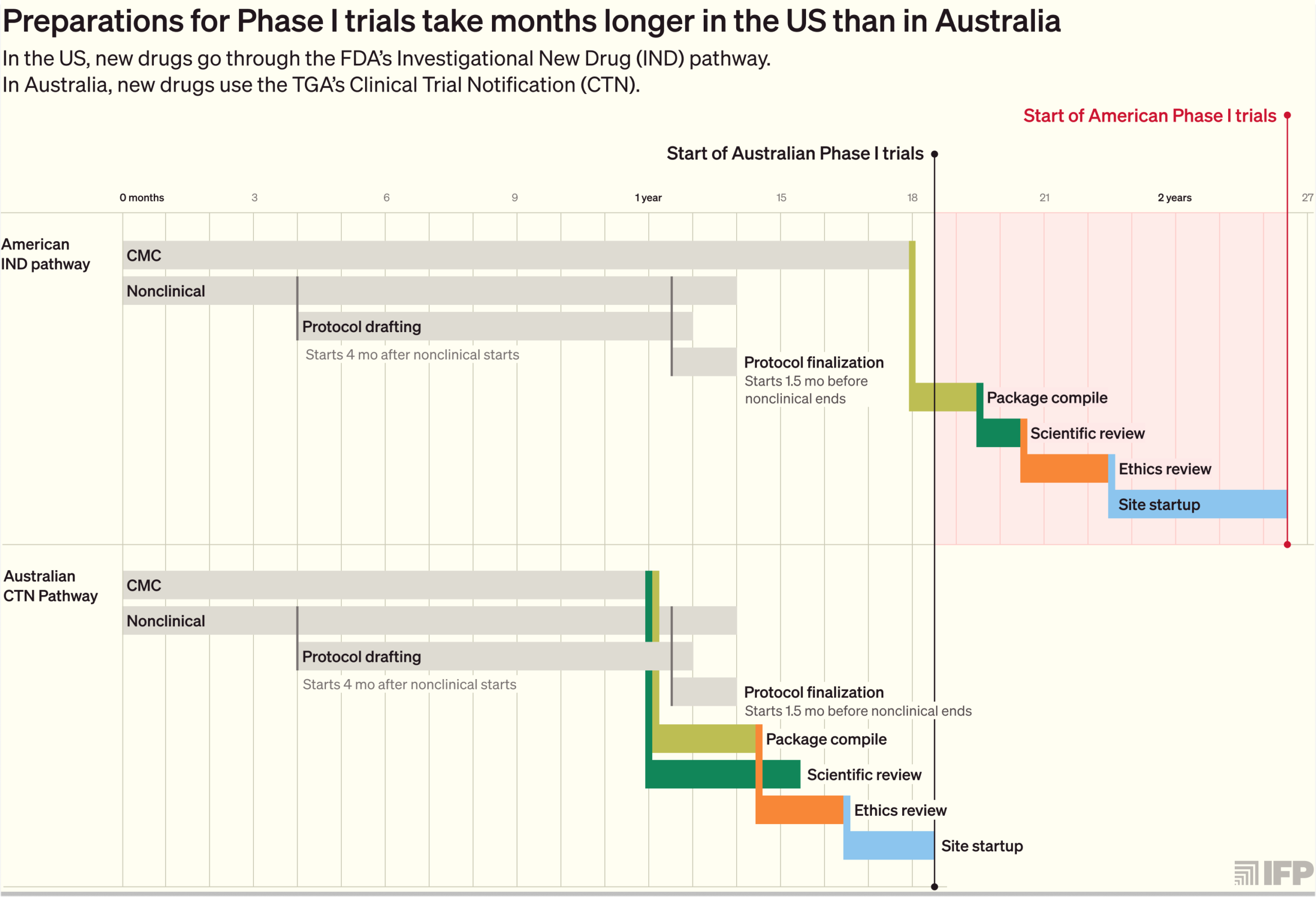
Before a new therapy can be tested in a human patient, it must clear a sequence of preclinical, manufacturing, and regulatory requirements that, in the United States, collectively consume between eighteen months and two years. But the Australian model highlights opportunities to reduce costs and shorten timelines at each stage. There is wide variation in the precise steps that must be taken to launch a clinical trial and the amount of time each step takes, but all trials follow a similar model. Below, we provide an overview of some of the key steps involved in launching a Phase I trial and how these steps are streamlined in Australia.
Due to the lack of transparency that characterizes interactions between drug developers and the FDA, there is very little publicly available information on exactly what the requirements for Phase I trials are in practice and, consequently, how much delay they introduce. To estimate these timelines, we relied on a combination of extensive interviews with industry professionals, including biotechnology executives and investors who have experienced both systems, as well as the limited publicly available information that exists2.
Preparing Data for IND Submission
The pipeline to get to Phase I from preclinical discovery work in the lab has four major segments, which, in the United States, culminate in the submission of a keystone document known as the Investigational New Drug (IND) application. INDs range in length from a few hundred to a few thousand pages and are composed of four parts: administrative/regulatory information; nonclinical pharmacology and toxicology data; Chemistry, Manufacturing, and Controls (CMC); and the clinical trial protocol and investigator materials. The information needed to complete each section of the IND must be generated before a Phase I trial can begin. This information constitutes what is known as the pre-IND requirements.
Chemistry, Manufacturing, and Controls
CMC involves all the steps required to physically manufacture the drug chemical. To produce it, researchers run production in batches in a lab, testing different conditions and writing detailed protocols for every step. This alone can take several months.
In the US, preparing a robust CMC module means navigating Current Good Manufacturing Practice (CGMP) standards, which govern everything from manufacturing facilities and equipment to the personnel training and documentation required for compliance.
CGMP compliance exists on a spectrum: for example, companies might ensure that every upstream component traces back to a CGMP-certified facility. At the other end of the spectrum, they might ensure only that the final manufacturing steps meet CGMP conditions. The FDA formally permits a “phase-appropriate” approach for Phase I trials when it comes to CGMP compliance. However, its guidance is vague enough that clinical trial sponsors tend toward overengineering at this step out of caution, applying near-commercial standards even for small early-stage trials.
While the FDA does not formally require that analytical tests used to characterize the potential drug be formally validated before the IND is submitted3, the applicants that we spoke to described full early validation as a widespread practice. This means that biotechs have to demonstrate, experimentally, that each assay they’re using is specific, sensitive, accurate, and precise. For a novel biologic or cell therapy, developing and validating even a single new potency assay can take six months to a year, costing hundreds of thousands of dollars. Much of the validation work is relevant for commercial-scale manufacturing, where the same assay will be run thousands of times over years of production, but is often inappropriate for smaller-scale early-stage trials.
Stability assays share this issue. Stability assays are tests that measure whether a drug substance maintains its properties over time under defined storage conditions, like temperature and humidity. Sponsors report that FDA reviewers typically require several months of stability data for Phase I trials4. For commercial products that are shipped around the world and stored for years in varying conditions, gathering long-term stability data is an entirely appropriate measure to protect patients. But at Phase I, drugs are usually manufactured specifically for near-term use, stored under known conditions, and administered to a relatively small number of people. Practically (though not explicitly) requiring months of real-time stability data before trial start is therefore a mismatch between regulatory burden and actual necessities. Other regulatory regimes, including Australia’s and Belgium’s, address this by accepting short-term or accelerated stability data covering only the actual clinical dosing period, paired with a commitment to continue monitoring during the trial.
Australia’s regulatory framework accepts the use of research-grade upstream components in assays without the layers of rigor and uncertainty that characterize the US CMC process, and its documentation requirements for Phase I trials are considerably more streamlined than those for an IND submission. Overall, the reduced burden of CMC requirements allows companies to move 6 to 9 months faster to trial start in Australia.
Nonclinical Studies, Including Animal Studies
While the FDA does not technically require efficacy data from animal models as part of the IND package, companies often see this as a de facto requirement for an IND application5. In particular, companies look for evidence that the proposed drug produces a meaningful biological effect.
Conversely, most peer regulators (including Australia’s) require safety and biodistribution data but do not mandate evidence of efficacy. This distinction is especially relevant for biologics and cell and gene therapies, where animal models are sometimes species-specific and have limited predictive value for human disease6. Requiring efficacy data from systems that may not faithfully model the human condition adds months of work for what is, scientifically, a questionable return.
Submitting and Reviewing the IND
Once the CMC module is prepared and nonclinical studies are complete, prospective trial operators must compile all this data into the IND application. The writing itself takes only a few weeks once the underlying work is done — but that work must be complete before compilation can begin, which means every upstream delay cascades directly into the submission timeline.
A common misunderstanding about drug development is that the majority of delays that occur in getting a new drug to market are because of lengthy review periods for applications that drug companies submit to the FDA; when it comes to delays that hold back Phase I trials, this is decidedly not the case. Per FDA regulations, “[a]n IND goes into effect [t]hirty days after the FDA receives the IND, unless the FDA notifies the sponsor that the investigations described in the IND are subject to a clinical hold…” Accordingly, the weight of delays is borne by the stages surrounding the review gate at the FDA.
In Australia, the equivalent submission step is filing a Clinical Trial Notification. Clinical trial notification forms are streamlined, consisting of a slim structured online submission accompanied by the Investigator’s Brochure (which contains the body of evidence on a drug) and a description of the clinical protocol for the trial. The forms don’t contain a separate CMC module, as in the United States. In Australia, scientific review of trials is conducted by a Human Research Ethics Committee (HREC), which is like an Institutional Review Board7. These HRECs are tasked with assessing the ethical and scientific dimensions of the application, including preclinical data, dosing rationale, and manufacturing considerations.
Post-IND: Kicking Off a Phase I Trial in the US
In the United States, once FDA clearance is obtained, two further independent processes must be completed before the investigational drug can be administered to trial enrollees. Either one can take six months or more.
The first of these processes is acquiring approval from an Institutional Review Board (IRB). Enrollment in clinical trials cannot begin until one of the relevant IRBs8 has conducted a review. And in the United States, IRBs will typically not initiate their review until the FDA has finished its review of the IND. By contrast, in Australia the HREC conducts ethical and scientific review concurrently, saving weeks or more of drug development time.
The second process is site contracting. Each participating hospital or clinical site in a trial must negotiate its own contract with the trial sponsor, covering indemnification, payment terms, and liability allocation. The fragmented structure of the US healthcare system — combined with HIPAA liability concerns and risk-averse institutional legal processes — means that each contract is effectively bespoke. By contrast, Australia mandates that all sites use a common clinical trial research agreement, limiting delays related to contract negotiations. Together, IRB approval and site contracting account for roughly six months of post-IND delay.
Protocol Amendments
Adjusting a trial once it has started running can be an arduous process in the United States. Any protocol modifications (such as adjusting dosages, adding a biomarker measurement, or refining eligibility criteria) require that the trial sponsor file a formal amendment, submit it to the FDA, wait for feedback, and get approval from every IRB at every participating site. This cycle can take months9. By contrast, in Australia the clinical trial handbook indicates that a sponsor’s amendment “should be submitted to the HREC only” (and not to the regulator as well), and the sponsor need only update its notification if details such as the site or the product change.
In the United States, these constraints mean that sponsors have a systematic disincentive to make informed changes; this is unfortunate because the Phase I trial is precisely the period when learning from human signals is most important. One concrete illustration has to do with dose escalation, the process by which “the dose of the test drug is increased a little at a time in different groups of people until the highest dose that does not cause harmful side effects is found.” Traditionally, dose escalation in Phase I trials has required three patients per dose level before stepping up the dose. This leaves trial sponsors with a bad choice if they see that a particular dose level has, after two patients, been too low to produce any biological activity. Or they can enroll a third patient at a dose known to be ineffective, or they can seek an amendment. Neither option is in the best interest of the trial.
For oncology in particular, the FDA has recognized that early studies should do more exploration of effective dosage levels for investigational drugs. Through Project Optimus, the FDA’s Oncology Center of Excellence has created opportunities for sponsors to develop a “dose-finding and dose optimization paradigm across oncology that emphasizes selection of a dose or doses that maximizes not only the efficacy of a drug but the safety and tolerability as well.” To date, the initiative has not changed the rules for starting a Phase I trial, and its guidance applies only to specified oncology products. But it is instructive for future efforts through which the FDA can create opportunities for experimentation to develop evidence that can improve the trial process without avoidable delay.
How Australia Improves on the US Model
Researchers have noticed the advantages of the Australian model of clinical trial regulation: Australia now boasts a far higher per capita trial rate than the United States: 18.5 trials per million people in Australia versus 8.5 per million people in the United States as of 2022.
Australia’s speed and cost advantage comes from three key design approaches:
First, and most important, is Australia’s Clinical Trial Notification Pathway. Instead of submitting an IND package to their national drug regulator, sponsors simply notify the regulator that they are starting the study. Studies are then overseen by HRECs, which are independent oversight committees similar to IRBs that provide both scientific and ethical guidance.
Under the clinical trial notification pathway, documentation requirements are simpler: In the US, the entire submission hinges upon FDA approval of the lengthy and time-intensive IND application. By contrast, Australian ethics committees expect sponsors to submit only summary information about the planned study, along with the Investigator’s Brochure and study protocol. The clinical trial notification pathway therefore makes it possible to streamline the entire study startup process: Australian sponsors can share components of their proposed study design (pharmacology, clinical protocol, manufacturing) when they’re ready, rather than waiting until everything is compiled. Amendments are simplified as well, with the ethics committee that reviews the study also being responsible for overseeing amendments to the study.
This speeds up multiple aspects of the clinical trial, because feedback is faster and more iterative. The ethics committees are able to meet with sponsors weekly, allowing for iterative feedback and adjustments. Since ethics review and scientific review are handled by a single committee, those reviews typically proceed in parallel. Unlike trials in the US, Australian trials do not need to wait until scientific work is complete before the IRB can begin its review. In some cases, study startup activities may take place even as the ethics committee is completing its review.
Second, Australia embraces a more risk-proportionate approach to study oversight. On paper, Australian and US regulations regarding clinical trials are similar: both follow global standards set by the International Consortium on Harmonisation, and both emphasize risk-proportionate approaches in which studies, validations, and documentation may be less intensive for lower-risk studies.
The difference comes down to practice and expectations. In the US, the flexibility granted by the regulations is not consistently applied in practice; both FDA reviewers and sponsors often default to a one-size-fits-all approach. This is driven in part by the structure of the review process in the US, where sponsors face high risks and unclear expectations. They have limited opportunity to interact with FDA before their IND submission, and there is little publicly available information about what the FDA expects in an IND — existing guidance often lacks specific detail, and sponsors from smaller biotechs have limited experience to draw upon. Yet any concerns that arise during FDA’s review can delay a sponsor’s study significantly. To forestall the possibility of delay, sponsors often default to a conservative approach, submitting everything that the FDA might conceivably want, rather than submitting only what is necessary to ensure the safety of participants. They also tend to choose approaches — like obtaining six months of stability data — that FDA has found acceptable in the past, even if those approaches are more costly and less scientifically justified than alternatives.
By contrast, Australian review committees embrace more risk-proportionate approaches. Proportionality is easier to achieve in Australia’s review process: sponsors have the ability to meet as often as weekly with ethics committees to iteratively address concerns and come to agreement on risk-proportionate approaches to ensuring the safety of study participants.
The culture and practice of Australian ethics committees also differ: risk-proportionate approaches receive greater emphasis, and there is far less emphasis on extensive documentation. This risk-proportionate approach, refined over decades of experience, is one that FDA struggles to duplicate today.
Third, while the guidance and legal standards for early-phase trials are largely similar across both countries, there is one crucial difference: in Australia, Phase I studies are formally exempt from CGMP requirements. In the United States, the situation is more complicated. According to US law, all drugs, including those used in Phase I studies, must comply with CGMP. FDA has said that its formal regulations regarding CGMP compliance do not apply to Phase I studies — and has offered an alternative approach — but the continued existence of the statutory requirement imposes upon early-stage studies a framework for manufacturing compliance that may not be appropriate for the small scale of production that occurs at this stage. Even with FDA’s flexibilities in place, the existence of the statutory CGMP requirement causes both sponsors and FDA to take a more conservative approach to manufacturing and compliance, which increases study timelines.
Blazing New Trials
The challenges facing early-phase trials in the United States have not gone unnoticed by the administration. In response, in June the Department of Health and Human Services formally launched Operation TrialBlazer: a whole-of-government initiative to improve the speed and efficiency of trials in the United States — particularly first-in-human trials. This initiative gives the United States a chance to build a faster first-in-human pathway, incorporating best practices from Australia’s Clinical Trial Notification scheme alongside innovations. The initiative has several components, including greater clarity on CMC requirements for early-phase trials, new FDA guidance, and increased FDA support and feedback for sponsors conducting these trials.
The centerpiece of the initiative is FDA’s proposed Expedited IND pilot, which borrows efficiencies from Australia’s clinical trial notification model. Under the Australian clinical trial notification pathway, the national regulator does not evaluate the trial proposal at the time of initial notification; rather, an HREC assesses the trial’s scientific validity, risks, and ethical acceptability on an ongoing basis. Under the proposed pilot, a similar approach will be tried in the United States. New drug sponsors would work with Qualified Research Institutions (QRIs) to help them prepare the nonclinical, clinical, and CMC components of a Phase I IND. These QRIs will often sit in the very same research institutions (e.g., academic medical centers and contract research organizations) that conduct ethical review of the study, creating opportunities for the scientific and ethical review to be conducted in parallel.
While the expedited IND pilot borrows some features from the Australian model, there are crucial differences. Most significantly, FDA would continue to review every application and would remain the sole regulator with authority to allow the study to proceed or place it on clinical hold. This introduces the risk that the new pilot simply becomes an additional layer of review that extends study timelines. Despite this limitation, the pilot remains an opportunity to import desirable features from the Australian system, including rolling review of different components of the IND, parallel scientific and ethical review, and iterative feedback that could produce higher-quality and more risk-proportionate IND submissions.
The success of the TrialBlazer Expedited IND Pilot — and its ability to move us closer to an Australian model — will depend on the approach FDA takes to implementation: FDA must ensure that the new review process does not simply introduce an extra layer of oversight but rather helps streamline and simplify the review process. FDA must ensure that the QRIs do not counsel excessive caution and “oversubmission” of data, and that they instead encourage risk-proportionate submissions. FDA and QRIs must also ensure that the proposed procedural benefits of the pilot are realized. Ideally, the early review from a QRI should allow FDA itself to review INDs more quickly and iteratively and allow research institutions to conduct ethical and scientific review in parallel to reduce study startup timelines.
A number of reforms will have to be codified in statute.
There is a lot that the FDA can do on its own to help speed up the path toward Phase I trials. In particular, the current Expedited IND Pilot, clearer published review standards, parallel startup, and single-IRB rulemaking can all be implemented through agency action. But a voluntary pilot and nonbinding guidance cannot, by themselves, create a durable legal process for phase- and risk-appropriate manufacturing standards or the introduction of a clinical trial notification system in the United States. To introduce new best practices and correct existing inefficiencies in the statute, Congress will have to act.
First, Congress should take further steps toward permitting an Australian-style clinical trial notification system in the United States. The FDA’s expedited IND pilot has taken initial steps in this direction, but to advance a formal clinical trial notification pathway similar to Australia’s, the FDA will need explicit authorization to rely on the judgments of QRIs to determine whether a trial may proceed. Congress also has the opportunity to ensure that these reform efforts continue with proper oversight and a clear mandate: Congress should instruct the FDA to establish risk-based criteria for determining which trials may use the new pathway, and develop new rules and programs to oversee QRIs.
Second, Congress should formally amend the statutory CGMP manufacturing requirements currently codified in section 501(a)(2)(B) of the FD&C Act (21 U.S.C. § 351(a)(2)(B)) to exempt early-phase trials. It should instead instruct the agency to create a distinct risk-based Phase I manufacturing standard designed for the particular needs and risks of early-stage studies. This would create a clear pathway for risk-proportionate early-phase CMC submission and remove legal ambiguity that leads to conservative interpretations of CMC requirements.
Conclusion
Phase I studies represent the crucial moment at which we begin to validate that treatments are safe and effective in humans. By making Phase I trials faster, we speed up the iterative learning process that enables scientific discovery and new breakthroughs.
Today, launching a Phase I study in the US requires too much time and effort. Thankfully, we know that reform is possible. Australia has shown us that it is possible to initiate Phase I studies far more quickly without compromising patient safety. And Operation TrialBlazer shows that the political will exists to advance similar approaches in the United States. Now, the challenge is to ensure that these efforts are successful and lead to genuine and lasting reform that can usher in an age of clinical trial abundance.
The stakes of success are high: by speeding up the initiation of Phase I studies, we ensure that the United States remains the best place in the world to develop new drugs. Equally importantly, in an era of unprecedented scientific innovation, faster Phase I trials will allow more groundbreaking treatments to reach patients sooner and at lower cost.
The authors would like to thank Matthew Esche and Joseph Fridman for their feedback on earlier drafts of this piece, as well as Dr. David Hong, Dr. Alison Schram, Dr. Jacob Becraft, Dr. Jason Luke, and others who wish to stay anonymous for their comments and willingness to be interviewed.
-
Research shows that upstream phases are rather well-optimized along the dimensions of data they can collect. One study from 1988 shows that, of the 300-plus compounds first given to humans by a set of UK drug companies from 1964–1985, the largest single cause of termination for the programs — 39% — was pharmacokinetics: the drug did not behave in a human body the way it had in other environments. Since then, preclinical science has gotten much better at predicting pharmacokinetic failures, which by 2000 accounted for only 10% of failures. Since then, efficacy and safety factors have come to account for roughly 60% of failures, which are exceedingly difficult to solve for in the laboratory.
-
These include, most prominently, a recent Reagan-Udall Foundation report that highlights some of the same issues, a C&EN article analyzing trials in Australia, an industry blog, and the HHS announcements themselves, which also acknowledge some of the problems.
-
Current guidance notes that the CMC component must contain “[t]he acceptable limits and analytical methods used to ensure the identity, strength, quality, and purity of the drug substance, with a brief description of the test methods used (e.g., Nuclear Magnetic Resonance, Infrared, UV spectra to prove the identity, and High Performance Liquid chromatograms to support the purity level and impurities, etc). Submission of certificates of analysis is also suggested.”
-
The Reagan-Udall Foundation’s report, Enhancing Early-Stage Drug Development in the United States, notes that “stability requirements for study material often far exceed study duration.”
-
The Reagan-Udall Foundation reports that “participants noted unnecessary, chronic, repeat-dose toxicology studies in two species were often conducted by sponsors because they were included in a previous New Drug Application for a different compound in the same class. This is an example where FDA guidance is not mandating such behavior; rather, the culture of default among sponsors (and FDA reviewers) is driving these potential redundancies.” (p. 13)
-
As the FDA’s guidance has noted, “Potential limitations of preclinical animal models can … include:
i. Inherent variability of the model.
ii. Limited historical/baseline data for the model.
iii. Technical limitations with the physiological and anatomical constraints of the model.
iv. Animal care issues.
v. Limited fidelity in modeling human pathophysiology of the disease/injury of interest.” -
These HRECs are often composed of scientific and medical experts, academics, healthcare experts, members of the community, legal experts, and a pastoral care representative, and are headed by a chairperson who leads the group and manages the meetings.
-
As one study put it, “[r]esearch institutions differ in their willingness to defer to a single, central institutional review board (IRB) for multicenter clinical trials, despite statements from the FDA, OHRP, and NIH in support of using central IRBs to improve the efficiency of conducting trials.” FDA regulations certainly permit a centralized IRB review, but fall short of requiring a centralized review for multicenter trials regulated by the FDA. Conversely, multisite studies subject to the Common Rule (such as studies funded by the NIH) are typically required to rely on a single IRB of record.
-
The Tufts Center for the Study of Drug Development found that “[t]he time from identifying the need-to-amend to last oversight approval now takes an average of 260 days and the mean duration during which investigative sites operate with different versions of the clinical trial protocol spans 215 days.”