This piece is part of IFP’s Transit Abundance Playbook, a collection of proposals for reducing American transit construction costs.
Summary
Empowering agency staff and moving more planning functions in-house is a demonstrated strategy for reducing transit project costs. The Federal Transit Administration (FTA) should follow the lead of other federal agencies and develop a centralized data repository of past planning reports and an AI-backed platform to let transit agency staff access project insights. These investments would cut duplicative data wrangling, build in-house transit agency expertise, enable teams to manage their own projects, and help agencies anticipate cost drivers. Growing transit agency capacity will improve returns on FTA-funded transit construction projects by allowing more iterative learning between one project and the next.
Problem
Although FTA supports transit agencies in adopting technologies to ease transit operations, agencies have struggled to adopt tools for planning and construction, missing an opportunity to build in-house capacity and cut costs.
FTA currently provides development capacity, research, standards guidance, and funding that include the following technology tools:
- General Transit Feed Specification (GTFS): FTA’s GTFSEd program assists agencies with the graphical editing of GTFS-formatted transit service plans. This helps agencies digitize their transit schedules, which makes them accessible to riders through trip planning applications, such as Google Maps and Transit App.
- Simplified Trips-on-Project Software (STOPS): STOPS makes transit demand forecasting accessible to transit agencies of all sizes. FTA developed the tool in partnership with the transportation consulting firm RSG in 2013. FTA currently maintains STOPS and provides user guides to help agencies use the tool to estimate transit project ridership using census data, transit ridership and schedule information, and demographic growth forecasts.
- National Transit Database (NTD) Reporting: FTA maintains a digital portal through which transit agencies submit their annual reports, and provides a user guide to help agencies use the portal.
High US transit construction costs and cost overruns suggest a need for comparable tools to facilitate project planning. AI is well-suited to address three cost generators in transit construction projects:
- Overreliance on consultants for planning tasks more efficiently completed in-house;
- Construction delays stemming from data limitations; and
- Limited access to insights from past projects.
Overreliance on consultants
Our planning careers have shown that if you want to actually do transit planning, you should become a consultant.
To make up for lack of in-house capacity and mitigate political risk for complex projects, many transit agencies have small in-house teams and rely on consultants to plan, design, and engineer major transit construction projects. The continued outsourcing shrinks transit agency capacity and bloats project costs — according to a Transit Costs Project interview, heavy and inefficient use of consultants increased the cost of projects like New York City’s Second Avenue Subway and Boston’s Green Line Extension by 10%. Outsourcing also means agencies are unable to build institutional knowledge that can be leveraged for future projects.
Consulting fees on US transit projects make up an outsized portion of overall contract costs relative to peer countries.1 In Phase 1 of New York City’s Second Avenue Subway project, project management and design contracts — which are typically executed by white-collar consultants and supervisors — amounted to 21% of construction costs, as compared to a typical range of 7–8% in France.
Construction delays stemming from data limitations
One of the major contributors to transit construction delays is unexpected subsurface issues, such as foundation weakness, geotechnical constraints, and utility conflicts. Utility coordination challenges are particularly acute: transit projects often require excavation, tunneling, or surface disruption in urban environments where underground utilities (such as water, sewer, power, and telecommunications) can be dense, undocumented, and controlled by multiple private and public entities. Utility relocations, in which a water, gas, electrical, or fiber optic line must be moved to accommodate new transit lines, are among the most common causes of delay and cost escalation in transit construction.
Most of the information needed for transit project planning (e.g., zoning laws, surveys, engineering drawings, and past reports) is splintered across many PDF-formatted and paper documents. Because utility mapping and documentation are often inaccurate and fragmented across multiple owners and jurisdictions, conflicts routinely go unflagged during planning, leading to redesigns, stoppages, contract claims, and even lawsuits. For example, inaccurate documentation of ground conditions along the Second Avenue Subway route in New York City led to major delays and cost increases. While digging starter tunnels, engineering contractor S3 determined that the ground conditions on the east side of Second Avenue were not hard rock as described in the geotechnical baseline report, requiring the contractor to employ a ground-freezing technique to complete the tunnel. This unanticipated intervention cost an additional $27.9M and required design changes, project re-sequencing, and contract modifications, which had their own unenumerated costs.
Delays cascade, multiplying costs and weakening the economic or political viability of projects. Every month of delay on Boston’s Green Line rail extension after construction started cost an estimated $1-2M.
There are sizable potential returns on thorough early access to accurate data for planning. One oft-cited statistic suggests that every dollar invested in early utility identification saves $4.62 in future delays, scope changes, and re-excavation.
Limited access to insights from past projects
Federally funded transit construction projects require extensive reporting and analysis throughout the project, which is captured across Project Management Oversight Contractor (PMOC) reports, risk analyses, Environmental Impact Statements, and Full Funding Grant Agreements (FFGAs). These reports require significant effort to produce and contain a wealth of information about project scopes, construction activities, and roadblocks. However, they are difficult to access and typically PDF-formatted, which makes it challenging to review them in bulk and identify common takeaways that could guide future projects.2

Solution
To help transit agencies better leverage available but inaccessible reports and data, FTA should develop an AI-backed platform that uses a Large Language Model (LLM) to synthesize the information captured in those reports. This two-part solution would consist of (1) a centralized report repository that standardizes existing transit project data, and (2) an LLM-powered platform through which agency staff can query the repository to support planning and construction.
Potential use cases could include:
- Planning and alternatives analysis: Planners could research comparable past projects for more information on construction decisions, including typical station design and spacing, tunneling design, utility risks, and mitigation strategies. The platform should link to specific source reports and documents.
- National Environmental Policy Act (NEPA) procedure and risk assessment: Agency staff could use templates and retrieval tools to pre-populate risk registers and mitigation plans based on past projects, reducing reliance on consultants to prepare Environmental Impact Statements.
- Grant applications and Full Funding Grant Agreements (FFGA): Agencies could generate standardized cost and risk summaries from platform data, and review successful projects, making it easier for agencies to complete required documentation.
- Construction monitoring: Construction managers could review risk analyses and change orders from past projects, allowing early detection of common failure modes.
This platform could help transit agency staff plan projects and anticipate and avoid risks, improving operational efficiency and reducing the cost of planning and construction. At the federal level, this platform would increase the returns on funds allocated to transit construction.
An AI-enabled platform aligns with the Trump administration’s AI Action Plan, which seeks to expand AI adoption in government and make AI training and tools available to federal employees.
Precedents at the FDA, the Department of War, and Caltrans
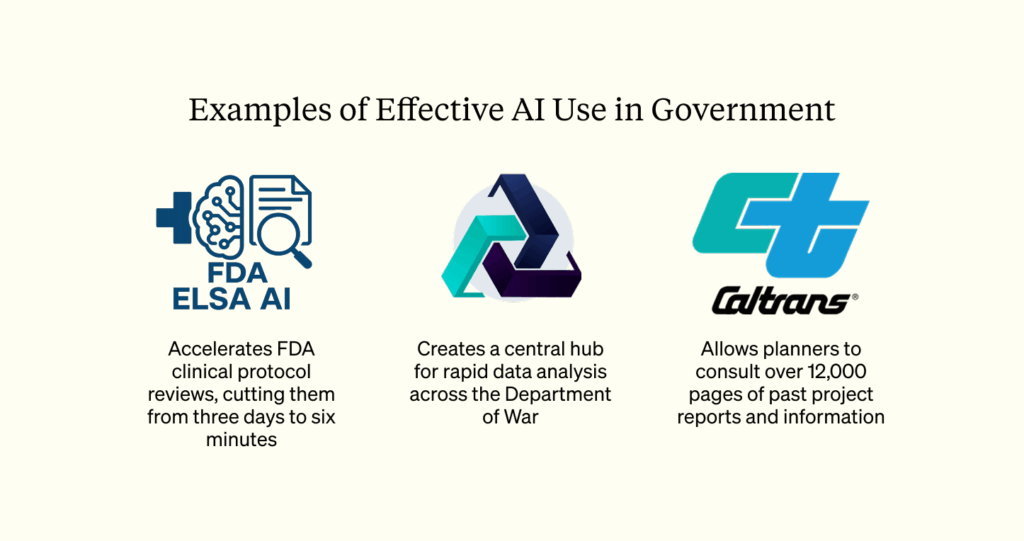
The Food and Drug Administration’s (FDA) AI tool Elsa is an example of a similar federal effort that could be a model for FTA. Elsa assists FDA staff with reading, writing, and summarizing to accelerate clinical protocol reviews, shorten the time needed for scientific evaluations, and identify high-priority inspection targets. Developed in partnership with Deloitte and Anthropic, Elsa demonstrates how AI use at government agencies can streamline operations; the tool has been shown to reduce review times from three days to six minutes.
Another precedent is the Department of War’s Advana platform. Launched in 2019, the platform standardizes access to thousands of data sources, automating internal review and allowing for comprehensive, accessible analytics.
While Elsa and Advana are for use by federal agencies rather than by grantees, Caltrans and UCLA are currently prototyping an AI tool similar to the one this solution proposes. For a recent San Diego trolley extension, the tool ingested roughly 12,000 pages of PMOC reports, along with San Diego Association of Governments (SANDAG) quarterly updates and board materials, and made them queryable with AI. The tool allows users to extract useful data from an otherwise unwieldy corpus of reports. For example, a user can ask about past right-of-way acquisitions and negotiations, and the AI tool returns citations to relevant passages from PMOC reports; a user planning timelines for a new rail electrification project can query the month-by-month of a past project’s installation of catenary pole foundations.
Potential data sources
Building this platform and the underlying repository requires first identifying and compiling relevant data from existing transit projects. Potential sources include Project Management Oversight Contractor (PMOC) reports, risk analyses, Environmental Impact Statements, Full Funding Grant Agreements (FFGAs), and other documents that transit agencies already submit to the FTA or otherwise create over the course of a project.
AI tools can review and summarize a large volume of documents, making it easier for practitioners to use them. After integrating FTA’s existing documents, the repository could be expanded to include valuable data owned by other federal agencies (such as the Environmental Protection Agency or Army Corps of Engineers) and state or local data sources (such as utility, zoning and land use documents and maps, agency charters, and Metropolitan Planning Organization reports).
Future versions could also incorporate a broader range of data sources that could improve outcomes and reduce costs. FTA could work with state and local jurisdictions and contract with providers of private data sources to contribute additional data to the repository. For example, FTA could partner with the National Zoning Atlas to integrate local land use information into the platform, which would inform project selection, construction management, and analyses of the value created by future transit projects.
Implementation
FDA’s Elsa was built in partnership with Anthropic. FTA’s AI tool could similarly be based on an LLM from one of the frontier American AI labs.
One potential solution is a retrieval-augmented generation (RAG) implementation, which would allow for easy querying of the wide corpus of documents already available to the FTA. A RAG-based system pulls from a curated set of documents, rather than the model’s training data, which helps mitigate the risk of AI “hallucination,” the phenomenon in which AI models present incorrect information as fact. This implementation would establish the corpus of FTA reports as the authoritative data source, grounding LLM responses in existing documents. A RAG-based system can cite the source of an answer, allowing users to trace and verify guidance that the platform provides. While a RAG-based system is not the only possible implementation for this tool, it is one way to support the desired use cases. Caltrans and UCLA’s prototype AI tool is RAG-based, and demonstrates how AI can be safely and reliably used to surface information from existing project documents.
Building and managing the platform
To implement the proposed tool, the FTA Office of Research and Innovation should assign a single internal owner with technical expertise to procure and manage collaboration with a consulting firm, technology company, or academic institution. The team will source reports and data from across FTA and the US Department of Transportation (USDOT); if ingesting local data, the team will reach out to local transit agencies for additional information. Depending on the software and systems chosen, implementation may require handling data ingestion, building a user interface, and other development. The development team should perform comprehensive testing before releasing the tool for use.
As the maintainer of the report repository, FTA should monitor performance, ensure consistent uptime, and solicit feedback on the utility of the tool. FTA may need to procure technical support to standardize report formats and create a common data model that can be accessed by agencies across the country to quickly and easily capture insights from past planning processes. To keep the repository current and ensure it is useful for transit projects, FTA should partner with a working group of planners from key transit agencies to identify the data necessary to support planning.
Platform benefits
Curb the need for consultants
This centralized planning platform would be an accessible source of institutional knowledge for transit agencies nationwide, compiling rich data sources that are currently collecting dust. Due to the considerable effort needed to review and parse through these existing reports, understaffed agencies typically delegate this work to consultants.
Ready access to this data would reduce transit agencies’ need to outsource that work. The proposed AI tool would let internal agency staff leverage insights from past projects; extending the repository to include other data sources, such as utility and other local information, would further enhance its value. The tool would also mean that less staff capacity and external expertise would be needed to analyze proposed projects, make project planning decisions, prepare materials for public meetings, and execute planning tasks. Moreover, some tasks that may be new for one agency but are common across all FTA-supported projects would be easier to perform. These functions would allow for efficiency gains and help staff build expertise, cutting costs by reducing the need for outsourcing.
Preempt construction delays
Synthesizing documentation of comparable past projects (such as PMOC reports) would help practitioners identify project risks and potential roadblocks before construction starts, supporting timely and cost-effective delivery. Future versions of the platform that ingest local data such as zoning regulations, utility information, and community engagement reports can further preempt construction delays. This data can help agencies better select construction sites, sequence project phases, and plan how to mitigate construction impacts.
Centralized data management
Rather than requiring individual agencies to contract with individual data providers (or worse, contract with consultants who have licenses with data providers), this model employs a “buy once, use many” strategy to develop one shared tool that many can use.
The FTA can also contract with providers to contribute new data sources to the repository, or conduct a prize challenge for firms and research institutions to develop new technologies to standardize disparate data sources.
Legislative and administrative pathways
Congress should create a National Transit Planning Data & AI Program in the Surface Reauthorization Bill to pilot this proposal.
To stand up the platform, we recommend the following actions:
- Amend the National Transit Database (NTD) statute (49 U.S.C. § 5335). NTD requires FTA to maintain a reporting system of financial, operating, geographic, and asset-condition data using uniform categories and accounts. Congress can extend this mandate to include project lifecycle data: PMOC reports, risk registers, environmental documents, utility coordination records, change orders, grant close-out reports, and any data sources relevant to planning.
- Authorize a National Transit Planning Data and Analytics Program under FTA’s existing research authority (49 U.S.C. § 5312). This would empower FTA to standardize and integrate project data with external sources, and authorize streamlined procurement or development of AI tools that retrieve, summarize, and analyze it for grantees.
- Assign a clear project owner. One suitable candidate is the FTA Office of Research, Demonstration, and Innovation, given its experience developing innovative technology and AI-based projects. Other potential owners include the FTA CIO or USDOT Chief AI Officer.
By implementing these steps, the USDOT and FTA would help fulfill the Trump administration’s AI Action Plan, which calls on federal agencies to build AI-ready data infrastructure, accelerate AI adoption in government, and use AI to improve service delivery.
-
For more on how excessive consultant use can undermine projects, see Paul Lewis’s playbook piece.
-
See Philip Plotch’s playbook piece for more on lessons learned in transit construction.