Dear Chair Allen and Members of the Committee,
Thank you for the opportunity to comment on Bill 26-684, the “Autonomous Vehicle Deployment Authorization Amendment Act of 2026.” We write on behalf of the Institute for Progress (IFP), a nonpartisan think tank based here in Washington, DC, focused on scientific, technological, and industrial policy. IFP has written extensively about how to make transportation more accessible and affordable. We recently published the “Transit Abundance Playbook,” showcasing 15 ideas to build public transportation more quickly and cost-effectively.1 We believe the District, as a leader in public transit, can also be a leader in reaping the benefits of Autonomous Vehicles (AVs).
Autonomous vehicles are an opportunity to make DC’s roads safer for pedestrians, cyclists, transit users, and drivers. The passage of Bill 26-684 would be a major step towards ending traffic fatalities in our city and meeting the goals of the city’s Vision Zero campaign. We applaud several forward-thinking provisions in the bill that will help better integrate AVs and ensure they benefit the city as a whole:
- We applaud the bill’s extensive data-sharing and incident-reporting provisions, which will ensure the rollout of AVs is transparent to the public and equip DDOT with the information it needs to properly enforce guardrails on providers.
- We appreciate the bill’s requirements that autonomous rideshare providers report infrastructure defects detected by their sensors to DDOT, which will enable quicker identification and repair of potholes, damaged pavement, or broken signage across the District.
- Finally, we commend the bill’s allocation of funds to support public transit, which will help ensure that AVs serve as a complement rather than a replacement to transit.
While we support this groundbreaking legislation, we also recommend that the Council implement changes before passage to maximize the benefits of AV adoption, including:
- Ensure that the bill’s proposed per-mile tax applies uniformly to all rideshare trips, whether human-operated or autonomous;
- Raise the proposed AV fleet cap to at least 600 and produce transparent, outcome-based thresholds for further expansion; and
- Simplify efforts to help drivers displaced by AVs.
Background on the Potential Benefits of AVs to the District
Autonomous Vehicles can make DC’s roads safer.
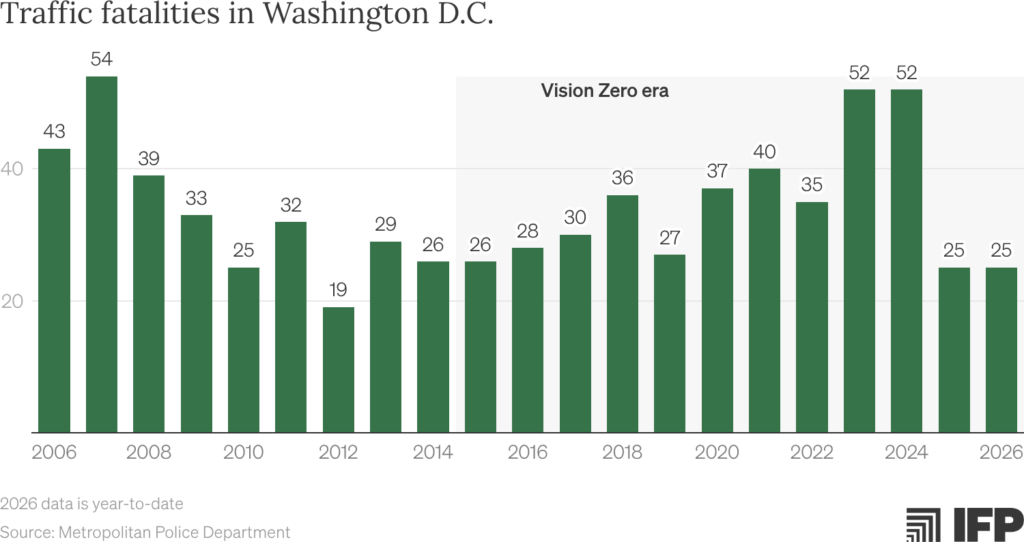
As you know, tragedies on our streets are a regular occurrence. Dozens of DC residents die on our roads annually, contributing to the grim statistic of 40,000 Americans who die from traffic fatalities each year. This is an unacceptable crisis. Since Mayor Bowser launched the city’s Vision Zero campaign in 2015 with the goal of ending traffic violence, DC traffic deaths have not budged. In just the first seven months of 2026, DC has seen as many traffic fatalities as in the entirety of 2025.
Shifting more of the District’s vehicle miles traveled (VMTs) to autonomous vehicles will make our streets safer and help reduce traffic deaths. A large-scale study from reinsurer Swiss Re of 25 million miles driven by Waymo’s fully autonomous system found that Waymo’s vehicles resulted in far fewer incidents than comparable human drivers: Compared with the overall driving population, Waymo’s vehicles resulted in 92 percent fewer bodily-injury and 88 percent fewer property damage claims resulting from collisions.2 As a reinsurance firm that pays out based on risk, Swiss Re’s data is a reliably unbiased source. Waymo’s own safety data, compiled across more than 220 million driverless miles, shows 94 percent fewer serious-injury incidents and 82 percent fewer injury-causing incidents overall than an average driver in the cities in which it operates.3 Replacing a fraction of miles driven on DC roads, even in a scenario in which AVs modestly increase citywide VMT, will save lives.
AVs will improve mobility for DC residents with disabilities.
While an important source of access for many, the District’s public transit system is difficult to navigate for a substantial share of DC residents with disabilities. Legalizing autonomous ridesharing services will increase mobility for these residents. Door-to-door service is particularly important to riders with disabilities, yet data shows that they adopt existing rideshare services such as Uber and Lyft at lower rates than the general public.4 One reason for this disparity is discrimination, for example, against riders with guide dogs. As advocates have argued throughout deliberations over this bill, AVs offer another option that will not refuse service to riders with guide dogs or visible disabilities.5 Over time, as fleet sizes expand, AV providers can (and should be compelled to) provide wheelchair-accessible vehicles to riders who use wheelchairs, supplementing the city’s MetroAccess program.
Passing this bill, even with much higher caps on AV fleets, will not materially increase congestion.
Some opponents of the bill have raised concerns that legalizing autonomous rideshare service will increase traffic congestion in the District. In principle, we agree that the mass adoption of AVs may lead to overall increases in vehicle miles traveled, and we urge the Council to further develop plans for congestion pricing in the District. But in the meantime, AVs would account for a minimal share of car trips within the District, even with a cap multiple times higher than the bill proposes. The “Mobility Mayor” tool produced by the Innovation Majority Institute estimates that even in a scenario in which four AV operators are permitted to operate 600 vehicles each, AVs would still account for less than 0.5 percent of cars in the District at midday.
Recommendations
- The bill should provide equal tax treatment across vehicle types.
We appreciate the intent behind the bill’s 15-cent per-mile VMT tax to address the externalities associated with driving. However, we believe that subjecting only autonomous vehicles to such a tax will unfairly discourage much safer AV technologies.
The District should equalize any VMT tax across human and autonomous rideshares, all of which add to the city’s congestion and contribute to wear and tear on city infrastructure. As written, the bill would impose a much higher tax burden on autonomous vehicles, all of which are electric, than on gas-powered, personally owned vehicles or rideshares. As one commenter points out, the District’s gasoline tax of 35.7 cents per gallon translates to approximately 1.4 cents per mile, less than one-tenth the tax burden imposed on AVs by the bill.6 We encourage the Council to continue exploring more comprehensive road pricing options, especially targeted fees to manage congestion, which will become increasingly important as AVs are deployed at a larger scale. We believe that broader adoption of AVs will make the eventual rollout of congestion pricing easier, as their sensor systems can directly measure congestion in real time, potentially enabling road pricing that varies with traffic. In the meantime, we encourage the Council to apply any rideshare VMT tax equally across human-driven and autonomous rideshare trips to avoid penalizing a technology with real safety benefits. - The bill should raise the cap on AVs and lay out performance-based metrics for further expansion.
The bill’s proposed cap of 200 vehicles per operator is too low to provide reliable, timely service to all eight wards. Under this cap, residents will face wait times exceeding 30 minutes on average, likely longer in Wards 7 and 8.
AV operators have already proven they can safely scale beyond 200 vehicles in similarly sized US cities. For example, Waymo has successfully scaled to more than 700 vehicles in San Francisco, a city with a roughly similar population to the District.7 The Council should raise the cap to 600 vehicles per operator, allowing a maximum fleet size in line with other cities. A cap of this size could achieve approximately 15-minute wait times on average across the city, assuming two licensed providers.8
As written, DDOT can permit larger fleets on a discretionary basis, but the bill does not provide any transparent, outcomes-based framework for approving or denying expansion requests. The Council should direct DDOT to publish transparent, quantitative benchmarks that qualify operators for fleet expansion. These could include maximum incident-per-mile rates, minimum service requirements to and from transit deserts, and service benchmarks for residents with mobility issues. - The bill should simplify assistance for displaced drivers and provide it as cash.
As written, the bill earmarked half of revenues raised from fees and its VMT tax (after subtracting costs for implementation) to support “education, vocational training, and workforce development programming aimed at ride-share drivers who have been or are at-risk of job displacement due to the adoption of commercial autonomous vehicles.” This is a worthy goal, as the widespread adoption of AVs could result in displacement and job loss for some part of the workforce — although many rideshare drivers only drive for a relatively short period of time.9
However, the history of targeted aid and training for a segment of the workforce displaced by technological or economic shocks is checkered. For example, the federal Trade Adjustment Assistance program meant to help workers who have lost their jobs due to trade failed to adequately respond to the so-called “China Shock.” This failure was in part due to complicated processes for determining eligibility and months-long wait times for benefits.10 The District should heed the lessons from past failures and ensure eligibility for assistance is transparent and easy to verify. Rideshare drivers displaced by AV expansion should not have to wait months for benefits meant to help them transition to new opportunities.
Further, because the needs, skills, and backgrounds of rideshare drivers are so varied, the Council should consider shifting assistance for displaced drivers away from publicly provided education and vocational training programs and towards simpler cash assistance. A large majority of rideshare drivers are part-time, likely working in a wide variety of occupations and industries the rest of the week. Retraining programs that fit one driver may not work for others. Cash assistance would instead allow drivers to seek retraining or work opportunities that best fit their career goals and needs. Such aid should also have backward-looking eligibility criteria to avoid subsidizing additional entrants and should be targeted towards drivers who have relied on rideshare work for a majority of their income.
Conclusion
As experts in urban infrastructure and transportation policy, we believe the introduction of autonomous vehicles will yield large benefits to the District and its residents, making our streets safer and expanding mobility options for our neighbors with disabilities. We strongly urge you to pass this bill and to include the suggested recommendations.
Sincerely,
Institute for Progress (IFP)
-
The Transit Abundance Playbook, Institute for Progress (June 17, 2026).
-
Di Lillo et al., Do Autonomous Vehicles Outperform Latest-Generation Human-Driven Vehicles? A Comparison to Waymo's Auto Liability Insurance Claims at 25 Million Miles, Swiss Reinsurance Company Ltd.
-
See: Waymo Safety Impact.
-
Eisenberg et al., Rideshare Use Among People with Disabilities: Patterns and Predictors Based on a Large Nationally Representative Survey, Travel Behaviour and Society (October 2022).
-
Marc Scribner, D.C.’s Autonomous Vehicle Deployment Authorization Amendment Act of 2026 Has Room for Improvement, Reason Foundation (July 13, 2026).
-
Greg Wong, Waymo Says Its SF Fleet Has Tripled in Size Since Last Public Disclosure, San Francisco Examiner (August 27, 2025).
-
Mischa Young et al., Unveiling Inequalities in the Gig Economy: Analyzing Driver Earnings in Toronto’s Ridehailing Industry, Case Studies on Transport Policy (June 2025).
-
Will Raderman & Alex Mechanick, Lost in Transition: How Trade Adjustment Assistance Came Up Short (and Where It Succeeded), Searchlight Institute (April 6, 2026).