- Download PDF
Executive summary
The National Environmental Policy Act (NEPA) has become one of the most frequently litigated federal environmental statutes, and the current framework for judicial remedies contributes significantly to the “litigation doom loop” — a cycle of agency review, litigation, vacatur, and re-review that traps infrastructure projects in legal limbo for years. This article presents several options for reforming the judicial remedies available in NEPA cases, with the goal of breaking the “doom loop” while preserving NEPA’s benefits to informed agency decisionmaking and the environment.
The problem
NEPA is a purely procedural statute. It does not mandate that agencies choose environmentally friendly alternatives or prohibit projects with significant impacts. It requires agencies to analyze and disclose environmental consequences before acting. Yet when courts find NEPA violations, the default remedy under the Administrative Procedure Act (APA) is vacatur — nullifying the agency’s ultimate decision, not its environmental review. This remedy was designed for substantive violations; it is not always appropriate for procedural errors.
The costs of this mismatch are substantial. Empirical research shows that agencies prevail in approximately 80% of NEPA cases involving the most thorough review, an Environmental Impact Statement (EIS). But even in cases where the agency wins, the median time from final agency approval to final court decision is nearly two years.
This dynamic imposes an tax on all infrastructure investment. Developers cannot predict whether litigation will occur, how long it will last, or whether projects will be halted while it is ongoing. The uncertainty increases the cost of capital, discourages marginal projects from being proposed, and redirects resources from construction to litigation defense.
Current reform efforts
The SPEED Act, which passed the House of Representatives in December 2025, would categorically bar vacatur and injunctions as remedies for NEPA violations. If a court finds a NEPA violation, the only available remedy would be remand with instructions for the agency to correct the error within 180 days. The project would continue operating in the meantime.
This approach has the virtue of simplicity but has downsides, and faces significant criticism. At a recent Bipartisan Policy Center roundtable, participants argued that without vacatur or injunctions, courts would lack any ability to hold agencies to account for NEPA noncompliance — even in extreme cases. The categorical nature of the reform also means it applies equally to minor technical errors and fundamental failures of environmental analysis.
The Supreme Court’s May 2025 decision in Seven County Infrastructure Coalition v. Eagle County offered dicta suggesting that NEPA deficiencies should not necessarily require vacatur “absent reason to believe that the agency might disapprove the project if it added more to the EIS.” This may appear, at first, to solve the problem. However, this language is not binding precedent and provides limited implementation guidance. Moreover, both Seven County and the SPEED address only final remedies — not preliminary injunctions that can halt projects for years before any merits determination.
Reform options
This article describes four options for reforming NEPA remedies at the final judgment stage:
- Option 1: The SPEED Act Approach. Categorically bar vacatur and injunctions, leaving remand with instructions and a 180-day deadline the only remedy for NEPA violations. This provides maximum predictability for permittees but at the cost of reducing courts’ ability to hold agencies accountable for NEPA violations even in extreme cases, and reducing agency incentives for compliance.
- Option 2: Statutory Default of Remand Without Vacatur. Establish remand without vacatur as the presumptive remedy, with vacatur available only in exceptional circumstances. This preserves judicial discretion for the worst cases, while right-sizing the remedy for less consequential errors.
- Option 3: Non-Prejudicial Error Standard. Require plaintiffs to demonstrate in their comments that a NEPA error was prejudicial — meaning it likely would have changed the agency’s substantive decision — before obtaining vacatur or injunctive relief.
- Option 4: Liability Rules and Bonding. Allow project sponsors to continue permitted activities during remand by posting bonds sufficient to cover remediation costs if the agency’s revised analysis identifies environmental harm. This approach maintains financial consequences for NEPA violations while allowing projects to proceed, drawing on the precedent of wetland mitigation banking under the Clean Water Act.
The article also discusses reforms specific to the preliminary injunction stage including:
- Implementing a “Prompt Filing” Requirement: Creating a rebuttable presumption that alleged harm is not “irreparable” if a preliminary injunction is sought more than 30 days after a final agency action. This prevents “ambushes” designed to maximize economic leverage once construction has begun.
- Establishing a Multiplicative Merit Standard: Codifying the mathematical framework a recent circuit court decision to require that “likelihood of success” be calculated as the product of probabilities across all dispositive issues (e.g., standing, finality, and merits). This ensures injunctions are only granted when a plaintiff is statistically likely to prevail on the entire case, rather than just a single high-profile issue.
- Strengthening Thresholds for Relief: Requiring plaintiffs to demonstrate a likelihood of “prejudicial error” — proving that a procedural mistake likely changed the project’s outcome — and enforcing bonding requirements under Rule 65(c) to ensure plaintiffs have “skin in the game” for the costs of delay.
Each of these reforms addresses remedies for NEPA-only violations. They do not address challenges that bundle NEPA claims with substantive environmental claims under statutes like the Endangered Species Act or Clean Water Act, where the logic of limiting remedies for procedural violations does not apply. They also do not address state-level environmental review statutes like California’s CEQA, which create independent grounds for litigation that federal reform cannot reach. Finally, remedial reform does not address the chronic underinvestment in agency capacity that causes delays before litigation ever begins.
NEPA’s remedial framework needs reform. A procedural statute should not produce remedies that halt beneficial projects for years based on non-prejudicial errors. The best reform package may be one of the proposals outlined below, or perhaps combine elements from multiple options. For instancce: establishing remand without vacatur as the default, preserving stronger remedies for egregious violations, requiring plaintiffs to demonstrate actual prejudice in cases where the agency has already undertaken the most demanding environmental review, and limiting injunctions when not sought promptly or when the ultimate likelihood of success on the merits is low. Through reforming remedies in NEPA cases, Congress has an opportunity to upload its environmental policy goals while making it easier to build the infrastructure America needs.
I. Introduction
In February 2019, Dominion Energy flipped the switch on a transmission line that had taken more than seven years to permit. The Surry-Skiffes Creek project — 7.76 miles of high-voltage cable crossing Virginia’s James River — began delivering carbon-free nuclear power to 600,000 people, replacing electricity from coal plants whose closure was required by clean air regulations.1 The line was complete, energized, and serving customers.
Three days later, the D.C. Circuit Court of Appeals ruled that the Army Corps of Engineers had violated the National Environmental Policy Act (NEPA) in permitting the line to cross the James River.2 Though the Corps “studied the Project’s environmental impacts and considered nearly thirty alternatives” the Court found that more study of environmental impacts was needed.3 One particular issue the Court identified was the “series of photo simulations that superimposed mockups of the proposed towers over the existing landscape”4 which commenters had criticized as insufficient to evaluate visual impacts. (The simulation appears below on the right and the line as constructed on the left; you can draw your own conclusions).
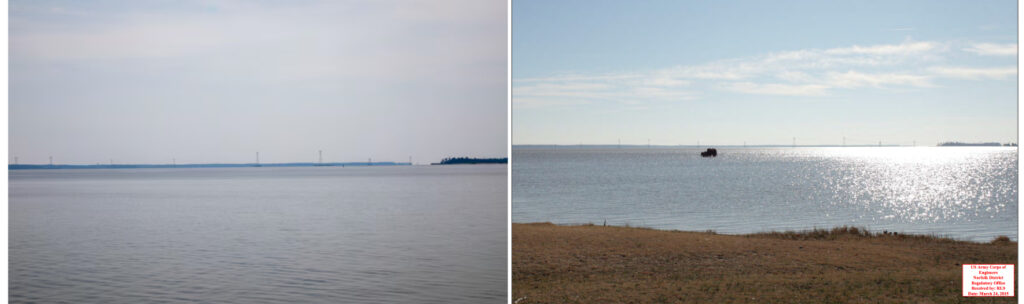
The Court vacated (set aside) the permit, which meant Dominion no longer had legal authorization for the 17 steel-lattice towers — some as tall as 295 feet — standing in navigable waters of the United States. Environmental groups argued that because the court had declared Dominion’s permit invalid, “the towers must come down.”5
Dismantling the transmission line would have required months of work and tens of millions of dollars. It would have left 600,000 customers — and two major military bases — without reliable power, potentially requiring emergency measures to prevent blackouts. And for what? The ruling did not find that the power line would harm the environment. The entire purpose of the court-ordered EIS was to analyze environmental impacts of building a line that was now already constructed. If the Corps again concluded the selected alternative was indeed the best route — as their original analysis had found — the towers would need to be rebuilt in exactly the same place, but at considerable additional cost.
After an amended order, the question of remedy was before the district court.6 There, the Judge chose to allow remand without vacatur while the Corps conducted additional environmental review.7 The transmission line would keep running. But the decision was discretionary, not required — a different judge might have ruled differently. And the underlying litigation had already consumed years and millions of dollars and review remains ongoing today, more than five years later.8 When the review is complete, the same groups who first challenged it may do so again.
Last year, my colleagues described what they called the “litigation doom loop” — a cycle of agency review, litigation, vacatur, and re-review that traps infrastructure projects in legal limbo for years or decades.9 They documented how the Cardinal-Hickory Creek transmission line, designed to connect 161 renewable energy projects to the grid, had been enjoined (judicially stopped) twice in five years despite completing an EIS, the most comprehensive form of environmental review. They warned that this doom loop “not only halts projects in court, but also makes it difficult to convince investors to hazard the trillions of dollars necessary to build new infrastructure for a clean energy economy.”10
Like the Cardinal-Hickory Creek project, the James River transmission line has so far escaped “doom” — but its story illustrates why the current NEPA remedial framework is a major contributor to the difficulty and expense of building infrastructure in America. The James River project avoided the worst outcome only because a district court judge exercised discretion to grant remand without vacatur. A different panel, a different judge, a different day, and 600,000 Virginians might have faced blackouts while workers dismantled a transmission line that would likely later be rebuilt in the same spot.
This is not how a functioning permitting system should work. NEPA, one of the most frequently litigated federal environmental statutes,11 has become a tool for imposing massive costs on infrastructure development — costs ultimately borne by ratepayers, taxpayers, and the country at large.
Dissatisfaction with this state of affairs has reached a tipping point. After staying largely unchanged since its passage in 1970, NEPA — sometimes called the “Magna Carta” of environmental law — underwent its first textual changes in decades with the 2023 Fiscal Responsibility Act. Even larger changes are proposed in the Standardizing Permitting and Expediting Economic Development (SPEED) Act, which passed the House in December 2025 by a vote of 221-196.12
The SPEED Act contains many provisions codifying prior regulations and established caselaw. But its most consequential provision concerns what happens when a court decides the agency erred in its NEPA analysis. Under current law, courts can vacate permits, issue injunctions, or remand the matter for correction. The SPEED Act provides that the only remedy would be to “remand, without vacatur or injunction, the final agency action to the agency.”13 The SPEED Act also sets strict time limits: federal judges must reach a final judgment within 180 days at the district court level and 180 days at the appellate level.14 This approach (indirectly) limits the time a preliminary injunction could remain in place before a case is resolved to about 18 months — but only if courts diligently follow these timelines (a questionable assumption).
The SPEED Act’s approach would help break the doom loop in NEPA cases — but not without significant costs to NEPA’s underlying goals, as it reduces accountability for genuine failures to consider environmental impacts. And, not coincidentally, it faces significant political opposition. At a recent Bipartisan Policy Center roundtable, participants identified this as the bill’s most controversial provision.15 Critics argue that without vacatur or injunctions, agencies would have little incentive to comply with NEPA in the first place.
Consider the “Alligator Alcatraz” lawsuit. In a preliminary ruling, the district court judge found the government constructed an immigration detention facility, paving 20 acres of the sensitive Big Cypress National Preserve, with no environmental review under NEPA.16 If the court held thusly at the final merits stage the SPEED Act would radically alter the outcome. Rather than enjoin the facility’s construction or vacate its permits, the Judge would only have been able to order environmental consideration of the impact of the facility — not to halt the project while that review continued.
This article explores alternative approaches that could help break the NEPA litigation doom loop while preserving meaningful judicial review at each stage of litigation. Each involves tradeoffs. None is perfect. But all represent improvements over both the status quo and an all-or-nothing approach.
The article proceeds as follows. Part II provides background on NEPA’s procedural framework and explains the “uncertainty tax” that NEPA litigation imposes on infrastructure development. Part III discusses the legal standards that govern judicial review of NEPA cases. Part IV discusses the most recent and consequential Supreme Court case addressing NEPA, and in particular its implications for NEPA remedies. Part V presents options for reforming remedies, ranging from the SPEED Act’s categorical bar on vacatur to more calibrated approaches including a non-prejudicial error standard with a requirement for potential plaintiffs to articulate the error they believe is prejudicial. Part VI acknowledges what these reforms will not solve: mixed substantive and procedural claims, state-level NEPA analogues like California’s CEQA, and the chronic underinvestment in agency capacity that causes delays before litigation ever begins.
II. Background
A. NEPA: a procedural law with substantive goals
The National Environmental Policy Act was signed into law on January 1, 1970, making it the first major federal environmental statute of the modern era.17 Its purpose, as stated in Section 2, is “to declare a national policy which will encourage productive and enjoyable harmony between man and his environment.”18 To achieve this goal, NEPA requires federal agencies to “include in every recommendation or report on proposals for legislation and other major Federal actions significantly affecting the quality of the human environment, a detailed statement” analyzing environmental impacts.19
That “detailed statement” — now known as an environmental impact statement (EIS) — must address five categories of information: reasonably foreseeable environmental effects, adverse effects that cannot be avoided, reasonable alternatives that are technically and economically feasible, the relationship between short-term uses and long-term productivity, and irreversible commitments of federal resources.20
Critically, NEPA is “a purely procedural statute.”21 It does not mandate that agencies choose the most environmentally friendly alternative or prohibit projects with significant environmental impacts. Rather, it requires agencies to “stop, look, and listen” before acting — to consider and disclose environmental consequences so that both decisionmakers and the public are informed.22 As the Supreme Court emphasized in its recent Seven County decision “NEPA does not mandate particular results, but simply prescribes the necessary process for an agency’s environmental review of a project.”23
NEPA, as amended, establishes three tiers of environmental review. For actions that normally do not significantly affect the environment, agencies may apply a “categorical exclusion” (CE), exempting the action from further NEPA review absent extraordinary circumstances.24 If an agency is uncertain whether impacts will be significant, it prepares a shorter “environmental assessment” (EA) to make that determination.25 If the EA concludes that impacts will not be significant, the agency issues a “finding of no significant impact” (FONSI) and proceeds.26 Only if an EA concludes that impacts may be significant — or if the agency determines from the outset that significant impacts are reasonably foreseeable — must the agency prepare a full EIS.27
The overwhelming majority of federal actions subject to NEPA receive categorical exclusions. According to the Council on Environmental Quality, approximately 95% of NEPA analyses are CEs, less than 5% are EAs, and less than 1% are EISs.28 But that less-than-1% of actions requiring EISs includes most major infrastructure projects: interstate highways, pipelines, power plants, transmission lines, airports, and large federal land management decisions.
B. The Fiscal Responsibility Act amendments and other recent developments
For over five decades, NEPA’s procedural requirements were implemented primarily through regulations issued by the Council on Environmental Quality, which agencies and courts treated as authoritative.29 This practice ended in 2025, when CEQ rescinded its regulations following Executive Order 14154 and judicial decisions questioning CEQ’s regulatory authority.30
Before CEQ’s rescission, however, Congress amended NEPA directly in the Fiscal Responsibility Act of 2023 (FRA).31 These amendments codified several concepts previously found only in CEQ regulations and added new requirements designed to expedite the NEPA process. Key FRA provisions include:
- Page limits: EISs may not exceed 150 pages (or 300 pages for projects of “extraordinary complexity”), and EAs may not exceed 75 pages (notably, in each case excluding citations and appendices).32
- Time limits: Agencies must complete EISs within two years and EAs within one year from specified triggering events, with extensions permitted only if the project sponsor agrees.33
- Codified review tiers: The statute now expressly defines categorical exclusions, environmental assessments, and environmental impact statements.34
- Limits on required analysis: Agencies need not undertake new scientific or technical research unless it is “essential to a reasoned choice among alternatives” and the costs and timeframe are “not unreasonable.”35
- Sponsor preparation: Agencies must prescribe procedures allowing project sponsors to prepare EAs or EISs under agency supervision.36
The FRA also added a narrow judicial review provision allowing project sponsors to petition courts for orders requiring agencies to meet statutory deadlines.37 But it did not address the broader question of what remedies courts may impose when they find NEPA violations — the question at the heart of this article.
III. Judicial review and remedies in NEPA cases
NEPA itself contains no provision for judicial review. Plaintiffs challenging agency compliance with NEPA instead rely on the Administrative Procedure Act, the 1946 statute that establishes the general framework for judicial review of federal agency action.
The APA provides that any person “adversely affected or aggrieved” by agency action may seek judicial review in federal court.38 This broad grant of review authority has made the APA the default vehicle for challenging virtually any federal agency decision, from permit approvals to rulemaking to enforcement actions. For NEPA litigation specifically, the APA provides the cause of action that allows plaintiffs to bring claims that would otherwise have no statutory basis.
Under Section 706 of the APA, courts review agency action under the “arbitrary and capricious” standard, a deferential test that asks whether the agency considered the relevant factors, made a clear error of judgment, or failed to articulate a rational connection between the facts found and the choice made. Under this standard, Courts are not meant to substitute their judgment for that of the agency, but rather to ask whether the agency’s decision falls within a “zone of reasonableness.” In NEPA cases, this standard applies to questions like whether an agency adequately considered alternatives, sufficiently analyzed environmental effects, or appropriately responded to public comments.
The critical provision for present purposes is what happens when a court finds that an agency has failed the arbitrary and capricious test. Section 706 directs reviewing courts to “hold unlawful and set aside” agency action found to be arbitrary, capricious, an abuse of discretion, or otherwise not in accordance with law. This language has traditionally been interpreted to require vacatur — nullification of the agency’s decision — as the default remedy for unlawful agency action.39 When a court vacates an agency’s action on the basis of non-compliance with NEPA, it nullifies the legal basis for the project’s approval. If the project requires a federal permit, the vacatur of the underlying NEPA analysis means the permit itself is no longer valid.
Courts do not always vacate agency action based on NEPA errors, however. Though vacatur is the “normal” remedy, courts have discretion to leave the agency action in place while the agency considers the issue on remand. A remand simply instructs the agency to reconsider its analysis in light of the court’s ruling. It does not disturb the agency’s underlying decision or halt the project.
A. How do courts decide whether or not to vacate?
Courts that expressly consider whether to vacate and remand or order remand without vacatur — either following briefing on the topic from the parties, or sua sponte (on their own accord) — will typically consider the precedent in their jurisdiction on the question for guidance. A leading and oft-cited case is Allied-Signal, Inc. v. U.S. Nuclear Regulatory Commission, which instructs courts to weigh two factors in deciding whether vacatur is appropriate.40
The first Allied-Signal factor is “the seriousness of the order’s deficiencies (and thus the extent of doubt whether the agency chose correctly).”41 This factor asks whether the error was significant enough to cast doubt on the agency’s ultimate decision. A minor procedural lapse that plainly did not affect the outcome weighs against vacatur. A fundamental analytical failure that calls the entire decision into question weighs in favor of it.
The second factor is “the disruptive consequences of an interim change that may itself be changed.”42 This factor asks what harm vacatur would cause to the parties and the public. If vacating an agency decision would strand billions of dollars in investment or delay critical infrastructure, those consequences weigh against vacatur. If the decision has not yet been implemented and vacatur would simply return the parties to the status quo ante, the disruptive consequences are minimal.
While these factors are reasonable on their face, they do not meaningfully restrict judges’ discretion. As one Yale Law Journal analysis observed, the Allied-Signal framework fails to provide courts with much guidance and is liable to lead to conflicting outcomes.43 The factors are sufficiently open-ended that judges can emphasize whichever consideration supports the result they prefer. A judge sympathetic to environmental plaintiffs can stress the seriousness of the agency’s error; a judge sympathetic to development can stress the disruptive consequences of vacatur. The framework allows discretion for either approach.
Moreover, the inquiry can miss more dispersed or systemic harms. Courts readily grasp the disruption to project sponsors and their investors. They are less attuned to broader public harms: the energy security implications of delaying a pipeline, the emissions consequences of postponing a transmission line that would connect renewable generation to load centers, or the economic ripple effects of stalled construction. These harms are real, but they are diffuse and difficult to quantify, and courts (as people generally do) often discount what they cannot easily measure.
B. Injunctive relief
Federal courts are not limited to vacatur or remand: they can also grant injunctive relief in NEPA cases. An injunction (from latin “to command”) is a broad type of relief, essentially anything the court orders that restricts a party from committing specific actions or requires a party to complete specific actions. Injunctions can be anything from a prohibition on planting genetically modified seeds,44 using sonar in naval exercises,45 or, in the most common situation in NEPA cases, prohibiting or limiting construction activity.
Federal courts derive their authority to issue injunctive relief from Article III of the Constitution and the Judiciary Act of 1789, which empowers courts to issue traditional “equitable” remedies, of which injunctions are a type.46 Because injunctions are considered an extraordinary exercise of judicial power, they are governed by long-standing equitable principles that require a balancing of hardships and a consideration of the public interest.
NEPA cases often begin with a plaintiff’s request for a preliminary injunction.47 A preliminary injunction is an emergency remedy that is intended to maintain the status quo while litigation proceeds. In the NEPA context, plaintiffs typically seek preliminary injunctions to stop construction from beginning or continuing until a court can determine whether the agency’s environmental review was adequate.
To obtain a preliminary injunction, a plaintiff must satisfy the four-factor test set forth in a case called Winter v. Natural Resources Defense Council.48 The plaintiff must demonstrate: (1) a likelihood of success on the merits; (2) a likelihood of irreparable harm absent an injunction; (3) that the balance of equities tips in the plaintiff’s favor; and (4) that an injunction is in the public interest.49 A preliminary injunction is “an extraordinary remedy never awarded as of right.”50
The most critical factor in NEPA cases is typically the second: irreparable harm. In Winter, the Supreme Court rejected the Ninth Circuit’s “possibility” standard for irreparable harm, holding that plaintiffs must demonstrate that irreparable injury is “likely” absent an injunction.51 The Court also rejected any suggestion that a NEPA violation automatically constitutes irreparable harm, emphasizing that “environmental injury” must be “actual and imminent,” not merely “speculative.”52
This holding resolved a circuit split over whether NEPA violations warrant a presumption of irreparable harm. Some courts had reasoned that because NEPA’s core function is to ensure informed decisionmaking before irreversible commitments are made, a NEPA violation inherently causes irreparable procedural harm — the risk that a bureaucratic “steamroller” will generate momentum that makes later correction politically or practically impossible.53 Winter rejected this reasoning, at least for preliminary injunctions: a procedural violation alone does not establish the kind of imminent, concrete harm that warrants pre-judgment relief.
Even with these limitations, preliminary injunctions in NEPA cases are not uncommon, and create significant delay risks and costs. For plaintiffs, the cost of seeking a preliminary injunction is relatively low: attorneys’ fees and the risk of an adverse decision. For project sponsors, the cost of an erroneous preliminary injunction can be catastrophic: months or years of delay, millions in carrying costs, and potentially fatal damage to project economics. This asymmetry can encourage strategic preliminary injunction motions even when plaintiffs suspect they are unlikely to prevail on the merits.
Courts can also order injunctive relief after deciding the merits or while the case is on appeal, on essentially the same factors at issue in Winter.54 Stays pending appeal are more difficult for plaintiffs to obtain because by the time an appeal is filed, a district court has already rejected the plaintiff’s claims on the merits. The appellant must therefore show not only that they will be harmed pending appeal, but that the district court likely erred — a heavier burden than the preliminary showing required before any merits decision.
C. NEPA status quo: An “uncertainty tax” on infrastructure
Even with the FRA’s time limits, NEPA imposes substantial costs and delays on infrastructure development.55 According to CEQ’s most recent data, the median time to complete an EIS from notice of intent to final EIS exceeds four years.56 But this figure understates total project delays because it excludes pre-scoping activities, the time between the final EIS and record of decision, and any litigation that follows. The FRA changes discussed above are likely to reduce the time it takes to produce an EA or EIS. But, paradoxically, this may actually increase the overall delay and uncertainty associated with NEPA compliance by making the environmental reviews more vulnerable to litigation.
Empirical evidence suggests that NEPA litigation is a major source of project delays. A 2024 study by the Breakthrough Institute analyzed 387 NEPA cases that reached federal appellate courts between 2013 and 2022.57 The study found that agencies prevailed in approximately 80% of cases — meaning that in the vast majority of litigation, the agency’s environmental review was ultimately upheld as lawful.58 But even in those cases, the median time from final agency approval to final court decision was nearly two years.59 And a meaningful subset of projects — 7% — remained in litigation for more than six years.60
The Breakthrough study also documented a striking concentration of litigation by a small number of organizations. Just 10 groups filed 67% of challenges to forest management projects and collectively won only 23% of those cases, “adding 3.7 years on average to the process of implementing the 77% of projects on cases they lost.”61 Similarly, 10 organizations were responsible for 48% of challenges to energy projects.62
These findings suggest that for many litigants, NEPA is a tool used in practice at least as much for delay as for the correction of genuine environmental oversights. As the Breakthrough study concluded, “NEPA litigation overwhelmingly functions as a form of delay, as most cases take years before courts ultimately rule in favor of the defending federal agency.”63
The costs of this delay are not limited to individual projects. Permitting uncertainty imposes what might be called an “uncertainty tax” on all infrastructure investment. Developers cannot predict whether or when litigation will occur, how long it will last, or what remedies courts will impose. This uncertainty increases the cost of capital, discourages marginal projects from being proposed at all, and redirects resources from construction to litigation defense.
The uncertainty is particularly acute because of the discretionary nature of NEPA remedies. When a court finds a NEPA violation, it has broad discretion over what to do next. It might remand the matter to the agency for correction while allowing the project to continue. Or it might vacate the agency’s approval entirely, revoking the project’s legal authorization. Or it might issue an injunction halting all construction until the agency completes additional review. The choice among these remedies can mean the difference between a project that is delayed by months and one that is killed entirely.
IV. The Seven County decision is no solution
In May 2025, the Supreme Court issued its most significant NEPA decision in years. Seven County Infrastructure Coalition v. Eagle County, Colorado addressed the scope of effects agencies must analyze under NEPA — but the Court’s reasoning also spoke directly to the remedial problems described above.64 Understanding what Seven County did and did not resolve is important to evaluating whether legislative reform remains necessary.
A. The Decision
The case involved a proposed railway that would transport crude oil from Utah’s Uinta Basin to a connection with the national rail network. Environmental groups challenged the Surface Transportation Board’s EIS, arguing it should have analyzed the downstream effects of burning the transported oil and upstream effects of increased oil production the railway would enable.
The Court rejected this argument. Writing for the majority, Justice Kavanaugh emphasized that NEPA has transformed from a “modest procedural requirement into a blunt and haphazard tool employed by project opponents (who may not always be entirely motivated by concern for the environment) to try to stop or at least slow down new infrastructure” and that this tool can “paralyze agency decisionmaking.”65
The Court held that an agency’s NEPA analysis need not trace out all indirect effects of a proposed action, particularly effects “remote in both time and place” or outside the agency’s regulatory authority. Reviewing courts, the Court stressed, should afford agencies “substantial deference” in determining what effects to analyze and how detailed the analysis should be.66
Most relevant for present purposes, the Court addressed remedies. After explaining that judicial review of an EIS is “only one component” of reviewing the agency’s final decision, Justice Kavanaugh observed that “even if an EIS falls short in some respects, that deficiency may not necessarily require a court to vacate the agency’s ultimate approval of a project, at least absent reason to believe that the agency might disapprove the project if it added more to the EIS.”67
This language suggests courts should consider whether NEPA errors were prejudicial — whether they actually affected or could have affected the agency’s substantive decision — before imposing remedies that halt projects. Read broadly, Seven County could substantially limit vacatur in NEPA cases, restricting it to situations where additional analysis might change the outcome.
B. The limits of Seven County: dicta and precedent
There is reason for caution, however, in predicting how lower courts will apply Seven County’s remedial guidance. There are two relevant questions: whether the relevant language constitutes binding precedent, and whether it represents a departure from prior law.
i. Dicta
The remedial language in Seven County is nonbinding dicta. “Dicta” — short for obiter dictum (“said in passing”) — refers to statements in a judicial opinion that are not necessary to resolve the case at hand. Unlike holdings, dicta do not bind lower courts, though courts may find such statements persuasive.
Seven County’s discussion of remedies is dicta for a straightforward reason: the Court held that the Surface Transportation Board’s EIS complied with NEPA.68 Because there was no violation, there was no occasion to fashion a remedy. The Court’s observations about when vacatur might or might not be appropriate were hypothetical — the opinion frames them as such, noting that “even if the EIS drew the line on the effects of separate upstream or downstream projects too narrowly, that mistake would not necessarily require a court to vacate.”69 The conditional phrasing underscores that the Court was not deciding a remedial question actually before it.
This matters because lower courts are not obligated to follow dicta. A district judge facing a NEPA challenge could acknowledge Seven County’s statements about remedies while concluding that the binding precedent remains the D.C. Circuit’s Allied-Signal framework or the general APA default of vacatur. Some judges will generally treat the Supreme Court’s dicta as highly persuasive; others may give it less weight, particularly if they view the statements as inadequately reasoned or inconsistent with the facts of the case before them.
ii. Precedent
The second question is whether Seven County’s remedial language represents new law or merely restates existing doctrine. The answer is that it is the latter, which paradoxically suggests the language may have limited practical effect.
Seven County’s remedial language breaks no new ground. When suggesting that EIS deficiencies “may not necessarily require a court to vacate,” the Court cited Section 706 of the APA — the provision instructing courts that “due account shall be taken of the rule of prejudicial error.”70 But the Supreme Court already interpreted this provision in cases such as Shinseki v. Sanders (2009), holding that Section 706 requires courts to apply “the same kind of ‘harmless-error’ rule that courts ordinarily apply in civil cases” — meaning that errors without a “substantial bearing” on the outcome should not require reversal.71 If Shinseki had solved the problem, there would be no need for Seven County’s remedial dicta in the first place. Yet as Professor Nicholas Bagley has documented, the rule of prejudicial error is not widely used in administrative law, with courts continuing to reflexively vacate agency actions for procedural violations without inquiring whether those violations actually affected the outcome.72 Seven County adds little to what Shinseki already established — and if binding precedent from 2009 failed to change lower court behavior, there is little reason to expect that dicta from 2025 will succeed where that precedent did not.
Moreover, the Supreme Court has previously indicated that NEPA’s procedural nature should inform remedial analysis. In Monsanto Co. v. Geertson Seed Farms, the Court reversed a sweeping injunction that a district court had issued after finding a NEPA violation in the deregulation of genetically modified alfalfa.73 Justice Alito’s majority opinion emphasized that even when a NEPA violation is established, courts cannot assume that vacatur or injunction is the only appropriate remedy. If a “less drastic remedy” suffices to protect the environment while the agency corrects its error, the court must use it.74This reasoning parallels Seven County’s suggestion that deficiencies need not require vacatur absent reason to believe the agency would decide differently.
Seven County reiterates principles the Supreme Court has articulated before. And despite the existence of cases articulating these principles, lower courts have continued to vacate agency actions and enjoin projects based on NEPA violations that appear unlikely to be outcome-determinative. The persistence of this practice despite existing precedent suggests that additional Supreme Court dicta will prove insufficient to durably and reliably change judicial behavior.
iii. Legislation remains necessary
Seven County provides a clear signal from the Supreme Court that NEPA’s procedural nature should inform remedial choices and that vacatur is not automatic upon a finding of noncompliance. This signal is valuable: it provides ammunition for arguing against vacatur in individual cases and may influence some judges at the margin. But signals are not rules, and dicta is not law. This larger perspective suggests that legislative reform remains necessary to address the remedial dysfunction described in this article.
First, as discussed above, Seven County’s remedial language is dicta, and lower courts are not bound to follow it. But, second, even if lower courts treat Seven County’s dicta as persuasive, the opinion provides limited guidance on implementation. The Court suggested that vacatur is inappropriate “absent reason to believe that the agency might disapprove the project if it added more to the EIS” — but it did not explain how courts should assess this counterfactual.
Must the plaintiff demonstrate a reasonable possibility that additional analysis would change the outcome? Or must the agency affirmatively show that its decision would remain unchanged? Who bears the burden of proof? What quantum of evidence suffices? And how would this approach apply in a case where the agency had decided not to do an EIS, and thus it was unknown whether that more detailed review would reveal prejudicial error? These questions remain open, and their resolution will significantly affect how the prejudicial error inquiry operates in practice.
Third, Seven County addresses only final remedies — the question of what courts should do after ruling on the merits. It says nothing about preliminary injunctions, which can halt projects for a significant time before any merits determination. A project sponsor who successfully defeats a preliminary injunction, wins at summary judgment, and then faces a stay pending appeal gains no protection from Seven County’s remedial dicta until the appellate court rules — a process that can take years.
For these reasons, Seven County represents a helpful course correction but not a complete solution. The decision may reduce vacatur at the margins by providing additional rhetorical support for project sponsors arguing against disruptive remedies. But it does not establish a binding rule, does not address preliminary relief, and does not resolve the uncertainty that imposes costs on infrastructure investment regardless of ultimate litigation outcomes.
Legislative reform remains the most reliable path to breaking the NEPA litigation doom loop. Congress can do what the Supreme Court’s dicta cannot: establish clear, binding rules, address all stages where projects can be halted, and provide the predictability that infrastructure investment requires.
V. Reform options
This Part presents four reform options for NEPA remedies, ranging from the categorical approach in the SPEED Act to more nuanced proposals that preserve some judicial discretion while limiting the most disruptive remedies. Specific legislative text is available for each; contact the author for more information.
Reform options at the merits stage
Option 1: The SPEED Act bar on vacatur and final injunctions
The most substantial reform to NEPA remedies currently before Congress is the SPEED Act (H.R. 4776), which passed the House of Representatives on December 18, 2025, by a vote of 221–196.75
Under the SPEED Act, if a court finds that an agency’s NEPA review does not comply with the statute, “the only remedy the court may order . . . is to remand, without vacatur or injunction, the final agency action to the agency.”76 The remand must include: (1) specific instructions identifying the errors or deficiencies the court has found; and (2) a “reasonable schedule and deadline” for the agency to correct those errors, which may not exceed 180 days.77 The agency’s decision “shall remain in effect while the Federal agency corrects any errors or deficiencies found by the court.”78 This means that project construction can continue even after a court finds a NEPA violation.
This approach has the benefit of simplicity. But at the BPC roundtable mentioned previously, “most participants opposed this policy option as written,” with several arguing that “if courts cannot vacate permits or issue injunctions, NEPA would be left without any real enforcement power.”79
In other words, if agencies know that even egregious NEPA violations will result only in remand with instructions, they would have reduced incentive to conduct thorough environmental reviews in the first instance. The SPEED Act’s approach assumes that agencies will comply with NEPA in good faith, but experience suggests that time and resource pressures often lead to shortcuts.
There is also reason to question whether 180 days is sufficient time to correct serious NEPA deficiencies. A court finding that an agency failed to consider reasonable alternatives, for example, may require substantial new analysis that cannot realistically be completed in six months. If agencies routinely miss the deadline, the provision may become meaningless.
Moreover, the categorical nature of the SPEED Act’s approach means that it applies equally to minor technical errors and to fundamental failures of environmental analysis. A project approved without any consideration of significant environmental impacts would receive the same remedy as a project whose EIS contained a single inadequate response to a comment.
Finally, the SPEED Act limits injunctive relief — but only at the final remedies stage, not at the preliminary injunction stage.
Option 2: Statutory default of remand without vacatur absent exceptional circumstances
A second option would be to reverse the APA’s default (vacatur) in NEPA cases and instead have remand be the default remedy — with judicial discretion for vacatur in exceptional cases. Under this approach, when a court finds a NEPA violation, the presumptive remedy is remand without vacatur or injunction. The agency’s decision remains in effect while the agency corrects the identified deficiencies, unless the court expressly finds vacatur to be warranted due to exceptional circumstances or because the agency committed a fundamental procedural error — such as skipping the required environmental review entirely, shutting out public participation, or ignoring a major, obvious environmental risk.
Unlike the SPEED Act as passed, this approach preserves vacatur and injunctions for cases involving egregious agency misconduct or genuine environmental harm. It recognizes that some NEPA violations are more serious than others and that a categorical bar on vacatur may be overkill for the vast majority of cases while being insufficient for the worst cases.
This approach provides substantially more predictability than the current Allied-Signal framework, where the balancing of “seriousness” and “disruptive consequences” is essentially standardless. By establishing remand without vacatur as the default and limiting exceptions to specified categories, the statute would cabin judicial discretion and reduce uncertainty.
At the same time, the approach preserves meaningful enforcement for the most serious violations. An agency that willfully ignores NEPA or whose analysis is fundamentally irrational would still face vacatur, and a project causing documented, ongoing environmental damage would still be subject to injunction.
Option 3: Non-prejudicial error standard with comment requirement
A third option would preserve vacatur and injunctions as available remedies but restrict their use to cases where the plaintiff can demonstrate that the NEPA error actually affected — or should have affected — the agency’s substantive decision. As discussed above, this approach draws on the APA’s instruction that courts shall take “due account . . . of the rule of prejudicial error”80 and the recent dicta from Seven County.
Under this approach, a court finding a NEPA violation would ask: Is there a reasonable possibility that the error would have changed the agency’s decision on the underlying final agency action at issue? If the answer is no — if the agency would have reached the same conclusion — then the appropriate remedy is remand without vacatur. If the answer is yes — if the error would likely have changed the outcome — then vacatur or injunction remains available.
This framework codifies the Supreme Court’s suggestion in Seven County that a NEPA deficiency may not warrant vacatur “absent reason to believe that the agency might disapprove the project if it added more” to an EIS.81 It also aligns with the APA’s general non-prejudicial error rule, which has been underutilized in NEPA cases.82
This approach requires the court to engage in counterfactual reasoning — attempting to judge from the administrative record whether correction of the alleged deficiency would have caused the agency to change its decision. In order to make this inquiry as concrete as possible, Congress should require potential plaintiffs to provide a clear statement of the alleged prejudicial error during the public comment period as a prerequisite for being eligible to obtain vacatur. The comment should be specific enough to show the alleged error is prejudicial — and should thus change the agency’s decision to one of the considered alternatives, the “no action” alternative, or a new alternative proposed in sufficient detail during the comment period.
This proposal builds on existing precedent. The Supreme Court’s decision in Vermont Yankee and its progeny, such as Department of Transportation v. Public Citizen,84 establish that parties challenging an agency’s environmental review must structure their participation so as to alert the agency to their positions. This “issue exhaustion” doctrine prevents a party from remaining silent during the public comment period only to later “spring” a technical objection upon the agency during judicial review.
The penalty for failing to comply with Vermont Yankee is typically the forfeiture of the claim. If a plaintiff fails to raise an issue with “reasonable specificity” during the administrative process, the court generally declines to consider the merits of that argument entirely. However, as discussed above, if a plaintiff does satisfy this threshold and proves a substantive NEPA violation, the default remedy APA is vacatur — setting aside the agency action — regardless of whether the error was arguably “harmless” or non-prejudicial.
This proposal departs from this framework by introducing a bifurcated approach to judicial remedies. Unlike Vermont Yankee, which serves as a gatekeeper to the courtroom, the proposal serves as a gatekeeper to certain remedies. It provides that even if a plaintiff successfully exhausts their claims under Vermont Yankee and proves a legal error, they are not entitled to relief beyond remand unless they have provided a clear statement of the alleged NEPA deficiencies and demonstrated that the error was prejudicial (i.e., outcome-determinative).
This proposed reform is most applicable to cases where the dispute concerns the adequacy of an environmental analysis that was actually conducted — for example, challenges alleging that an EIS failed to consider a reasonable alternative, inadequately analyzed impacts, or insufficient response to comments. In these cases, there is an administrative record against which a court can evaluate whether the alleged error would have changed the agency’s decision.
The proposal applies less cleanly to cases where a plaintiff argues that the agency should have prepared an EIS rather than an EA, or should have prepared an EA rather than relying on a categorical exclusion. In these cases, for one thing, there may have been no public comment period, which is only required by law for an EIS. Therefore, the first time for a plaintiff to voice their concern may be in litigation. Additionally, if a plaintiff is arguing that an agency made an error in determining a project would not have a significant impact on the environment such that an EIS is required then the framework of evaluating whether there was a prejudice to the ultimate final agency decision is less applicable.
Option 4: Liability rules — an alternative framework
The fourth option represents a more substantial reconceptualization of NEPA remedies. Rather than debating whether courts should vacate an agency decision, this approach would replace vacatur and injunctive relief — in whole or in part — with an option for compensatory remedies for NEPA violations cause substantive environmental harm.
This approach draws on the distinction between “property rules” and “liability rules” in law and economics, articulated in Calabresi and Melamed’s seminal 1972 article.85 Under a property rule, a party cannot proceed without the other side’s consent, giving the other side effective veto power. Under a liability rule, a party can proceed but must compensate the other side for any harm caused. The current NEPA framework operates as a property rule: plaintiffs who identify procedural errors can effectively veto projects, or at least halt them for considerable time periods. A liability rule approach would allow projects to proceed while requiring compensation for any procedural noncompliance that results in substantive environmental harm — the outcome NEPA ultimately seeks to prevent.
At the final remedy stage, a liability rule option approach could function as an alternative to vacatur. When a court finds a NEPA violation, rather than vacating the agency’s decision or enjoining the project, the court could permit the project to continue on the condition that the project sponsor post security sufficient to cover remediation costs. If the agency’s revised NEPA analysis — prepared on remand — results in a different substantive environmental outcome (such as additional mitigation, or a new decision entirely) the bond would be available to fund mitigation or remediation of impacts that occurred while the analysis was being prepared.
This differs from the SPEED Act’s categorical bar on vacatur in an important respect: it maintains a financial consequence for NEPA violations that result in actual environmental harm. A project sponsor who went forward despite allegedly inadequate NEPA review would bear the cost of addressing resulting environmental harm, rather than externalizing it to the public or the environment.
This approach has some similarities to the wetland mitigation banking system administered by the Army Corps of Engineers under Section 404 of the Clean Water Act. When a project will result in unavoidable impacts to wetlands, the permittee may be required to purchase “credits” from a mitigation bank — a site where wetlands have been restored, enhanced, or preserved specifically to compensate for wetland losses elsewhere.86 The mitigation bank system allows development to proceed while ensuring that the overall stock of wetland resources is maintained.
The analogy is imperfect — wetland mitigation banking addresses known, quantified impacts to a specific resource type, while NEPA violations involve procedural deficiencies whose substantive consequences may be uncertain. But the underlying principle is similar: rather than blocking activity entirely, the regulatory system requires compensation for environmental harm, with the compensation amount determined by the nature and extent of the impact.
A NEPA liability rule system could function similarly. Project sponsors could be required to post bonds or pay into an environmental mitigation fund as a condition of proceeding where a court has found NEPA deficiencies. If the supplemental NEPA analysis identifies impacts that warrant mitigation, or a new decision with lesser impacts, the funds would be available to compensate for the harm done in the interim. If the supplemental analysis confirms that no significant impacts were overlooked, and the decision remains the same, the bond could be released.
Reforms at the preliminary injunctions stage
The reforms discussed above do not uniformly address injunctive relief issued at the outset of the lawsuit, rather than after the merits are decided. More targeted reforms aimed at preliminary injunctions are needed.
SPEED Act: Strict deadlines on the length of a suit
The SPEED Act indirectly addresses the problem of preliminary injunctions (and injunctions pending appeal) by imposing strict deadlines for courts to decide cases. Under Section 110B, courts must resolve NEPA claims within 180 days of the agency filing the administrative record (which must be lodged within 60 days), and appeals must be resolved within 180 days of filing. If courts actually adhered to these deadlines, preliminary injunctions would be in force for a maximum of around 18 months; the merits would be resolved before preliminary relief could cause additional delay.87
However, this reform depends on statutory deadlines for courts which are notoriously difficult to enforce. Courts have existing dockets; judges have discretion over case management; complex cases take time to brief and decide. The SPEED Act’s approach would allow NEPA cases to potentially “jump the line” ahead of, for example, criminal cases where defendants have a constitutional right to a speedy trial, and other cases judges may wish to prioritize for other reasons. The few examples of Congress imposing such timelines does not show uniform adherence by the judiciary.88
Moreover, it’s also unclear what happens in a situation where an agency’s action on remand is challenged as still arbitrary and capricious even after remand. If this kicks off a new 18 month injunction period then the reform may do little.
Ultimately, whether a 180-day deadline will meaningfully constrain preliminary relief in practice is an open question. Moreover, giving agencies only 60 days to produce an administrative record and then district courts only 180 days to reach final judgment may be suitable for some cases, but could result in rushed records and decisions in particularly difficult cases.
Codifying caselaw on calculating the likelihood of success on the merits
As discussed above, one of the factors a plaintiff must demonstrate to obtain preliminary injunctive relief is a likelihood of success on the merits. In the 2025 decision American Federation of Teachers v. Bessent,89 the Fourth Circuit introduced a mathematical framework for evaluating a plaintiff’s “likelihood of success on the merits.” Judge Richardson, writing for the majority, identified what he termed the “multiplicative problem.” He argued that when a plaintiff must prevail on several independent, dispositive issues to win a case (such as establishing standing, proving final agency action, and overcoming statutory preclusions), their overall likelihood of success is not merely the probability of winning their strongest argument, but rather the product of the probabilities of succeeding on every individual issue.
As the court illustrated, even if a plaintiff is a “3:1 favorite” (a 75% chance) on five distinct legal hurdles, the statistical probability of “running the table” on all five is only approximately 24%. Consequently, a plaintiff who is likely to win any single issue can still be a “3:1 underdog” in the case overall. To resolve the current imprecision in how courts weigh these competing probabilities, a potential reform could codify this “Multiplicative Merit Standard” into law. By requiring courts to explicitly perform this probabilistic calculation, the reform would ensure that preliminary relief — an “extraordinary remedy” after all — is reserved for cases where the plaintiff is statistically likely to prevail on the entire gauntlet of legal obstacles, rather than just a single high-profile issue.
Codifying caselaw requiring preliminary injunctions to be sought promptly
Preliminary injunctions can be especially damaging when they are brought months or even years after the challenged decision, often when construction has begun or even concluded. To address the strategic timing of lawsuits, a reform could codify the “prompt filing” principle found in cases like Quince Orchard Valley Citizens Association v. Hodel.90 In that case, the Fourth Circuit affirmed that a plaintiff’s “unexcused delay” in seeking a PI is strong evidence that the alleged harm is not actually “irreparable.”
The court’s logic is intuitive: if an injury is truly “irreparable” and “imminent,” a diligent plaintiff would not sit on their rights for months, aware that their interests are “irreparably” being harmed. However, because “promptness” is currently just one of many discretionary factors a court can consider in deciding whether to grant injunctive relief, plaintiffs may strategically delay preliminary injunction motions to maximize the leverage of a last-minute work stoppage. In Quince Orchard, the plaintiffs waited six months after the project’s final approval to seek an injunction — a delay the court found inconsistent with the claim of an urgent environmental threat.
To solve this preliminary injunction “ambush” problem, Congress could codify the rule from cases like Quince Orchard, requiring that any motion for a preliminary injunction filed more than 30 days after the challenged final agency action carries a rebuttable presumption that the harm is not irreparable. Plaintiffs should be able to rebut the presumption by showing the alleged irreparable harm was newly discovered or other good caused existed for their delay.
By turning a discretionary judicial factor into a clear deadline, this reform would force opponents to bring their challenges forward immediately, providing project sponsors with greater certainty at the start of construction and ultimately preventing truly irreparable harms.
Requirement to show prejudicial error to obtain preliminary injunctive relief
The requirement to demonstrate prejudicial error discussed above could also be applied at the preliminary injunction stage. Under current law, plaintiffs can obtain injunctions halting construction based on a likelihood of sucess on demonstrating alleged procedural errors that may not change the agency’s ultimate decision. Requiring plaintiffs to show a likelihood of success of demonstrating a prejudicial error forces them to articulate, at the outset, not just that the agency made a procedural mistake, but that correcting the mistake could plausibly change the outcome (thus resulting in a substantive environmental benefit). This helps screen out claims where the plaintiff’s real goal is delay rather than environmental protection, while preserving preliminary relief for cases where the NEPA violation genuinely calls the agency’s decision into question.
Bond requirement to obtain a preliminary injunction
Senator Mike Lee’s NEPA Legal Reform Act, introduced in previous Congresses, included mandatory bonding requirements for plaintiffs seeking preliminary injunctive relief.91 Under Federal Rule of Civil Procedure 65(c), courts already can issue preliminary injunctions “only if the movant gives security in an amount that the court considers proper to pay the costs and damages sustained by any party found to have been wrongfully enjoined or restrained.”
But courts have often waived this requirement in environmental cases, on the theory that plaintiffs are vindicating public interests rather than seeking private gain.92 Senator Lee’s bill would have required courts to apply Rule 65(c) in all NEPA cases, shifting risk to plaintiffs.
This is consistent with the White House memorandum, “Ensuring the Enforcement of Federal Rule of Civil Procedure 65(c),”93 directing all federal agencies to demand that courts require plaintiffs to post a bond equal to the government’s full expected costs.
Time limit on vacatur and injunction
Another approach advocated for by my colleagues at IFP is a hard time limit — four years from the start of an agency’s environmental review — after which courts would lose the authority to vacate a permit issued in violation of NEPA or enjoin a permitted project on that basis.94 This reform would ensure construction could eventually proceed, after four years, and has the advantage of clarity.
VI. Limitations: What these reforms won’t change
The reforms proposed in this article focus on remedies in NEPA cases. But the litigation doom loop has other components that these reforms do not directly address.
A. The substantive and procedural claims of other laws
The reforms proposed in this article focus on NEPA-only violations — cases where the sole legal deficiency is procedural. But many infrastructure projects face challenges under multiple statutes simultaneously. A pipeline might be challenged for both inadequate NEPA analysis and violation of Clean Water Act permitting requirements. A transmission line might face both NEPA claims and Endangered Species Act claims. A highway project might be attacked on NEPA grounds and under Section 4(f) of the Department of Transportation Act, which protects parks and historic sites.
When NEPA claims are bundled with substantive claims, the remedial calculus becomes more complex. The logic of limiting remedies for procedural violations does not extend to substantive violations. If a project genuinely violates the Endangered Species Act — if it will jeopardize the continued existence of a listed species or destroy critical habitat — there is a strong argument that the project should be halted until the violation is cured. The same is true for Clean Water Act violations that would result in unlawful discharges or Clean Air Act violations that would cause prohibited emissions.
B. State-level NEPA analogues
Federal NEPA reform, however comprehensive, will not solve the permitting problems in states with their own environmental review requirements. California’s Environmental Quality Act (CEQA), enacted in 1970 shortly after NEPA, requires state and local agencies to prepare environmental impact reports for projects that may have significant environmental effects. New York’s State Environmental Quality Review Act (SEQRA) imposes similar requirements. More than a dozen other states have enacted “little NEPAs” of varying scope and stringency.
These state statutes create independent grounds for litigation that federal reform cannot reach. A solar project in California that escapes vacatur on federal NEPA claims may still face years of CEQA litigation. A housing development in New York that requires no federal permits at all is nonetheless subject to SEQRA. The litigation doom loop can operate at the state level just as effectively as at the federal level — and in some states, more so.
This is not an argument against federal reform. Federal NEPA applies to an enormous range of projects, and fixing its remedial framework would yield substantial benefits even if state-level problems persist. But advocates for permitting reform should recognize that federal action is only part of the solution. State-level reform efforts — which require engagement with state legislatures, governors, and state courts — are a necessary complement to the federal reforms proposed here.
Some states have begun this work. California has enacted narrow CEQA exemptions for certain housing projects and streamlined review for projects consistent with approved plans. But these reforms have been incremental and have not fundamentally altered CEQA’s litigation dynamics. More ambitious state-level reform remains a critical component of the broader permitting challenge.
C. Agency resources, state capacity, and permitting complexity
Finally, it is worth noting that reform of remedies in NEPA cases addresses only one part of a large and complex permitting system administered by an increasingly depleted federal workforce. This system emerged over time through successive laws passed by numerous Congresses to address discrete problems. Unsurprisingly, then, these laws are not always harmonized. The same project can (and often is) subject to numerous permits from different agencies with different timelines, different requirements, and different processes.
Imagine you are trying to repair a small bridge over a coastal stream. To the casual observer, it’s one project. To the trained legal observer, it is a complex web of overlapping jurisdictions and permitting requirements. An 1899 statute, the Rivers and Harbors Act, requires a permit from the Army to build a structure in navigable water. The Army also administers a separate permitting process under the Clean Water Act that is implicated if the bridge project would result in discharge of “fill” material into the water. Another provision of the Clean Water Act requires a separate approval, this time from a state agency. The Secretary of Transportation (delegated to the Coast Guard) must also permit the bridge under the General Bridge Act. If the stream has endangered fish, say, Chinook Salmon and bull trout, then that likely triggers consultation requirements between the Army and other federal agencies to ensure the project will not harm those fish. Each fish species requires a consultation process with a different agency. The National Marine Fisheries Service (NMFS), part of the National Oceanic and Atmospheric Administration (NOAA), itself part of the Department of Commerce regulates “anadromous” fish (those that spend part of their lives in the ocean) such as salmon. The United States Fish and Wildlife Service (USFWS), part of the Department of the Interior, manages freshwater fish such as trout. The parade of complexity continues: National Historic Preservation Act, Coastal Zone Management Act, Magnuson-Stevens Act, and Migratory Bird Treaty Act could also be implicated.
This is all distinct from NEPA compliance. Even if courts never vacated another permit due to NEPA, compliance with NEPA and the suite of permitting statutes still tax infrastructure development.
Remedial reform will not hire more staff to work on NEPA compliance or the suite of other statutes discussed above. Nor will it train existing staff to work more efficiently. It will not modernize the information technology systems that agencies use to manage environmental reviews or integrate time-saving AI tools such as PermitAI, developed by the Pacific Northwest National Lab. It will not streamline the interagency consultation processes that add months or years to project timelines. These are executive branch management challenges that require appropriations, investment, and sustained attention from agency leadership.
The SPEED Act and the reforms proposed in this article focus on what happens when agencies are imperfect in their NEPA compliance — or at least are alleged to be. But a complete solution to the broader permitting issues discussed here must also address why agencies take so long to complete reviews and larger permitting compliance in the first place, and that requires attention to agency resources and processes that goes beyond litigation reform.
VII. Conclusion
The Supreme Court’s decision in Seven County and Congress’s passage of the Fiscal Responsibility Act amendments signal bipartisan recognition that NEPA has drifted from its original purpose. What began as a “modest procedural requirement” has become a tool for strategic delay, imposing an “uncertainty tax” on infrastructure investment that harms economic competitiveness, energy security, and — paradoxically — environmentally beneficial projects such as the James River power line project discussed in the introduction.
The SPEED Act would address this problem through categorical limits on NEPA remedies. Whether the SPEED Act’s particular approach is optimal is debatable. But the underlying diagnosis is sound: NEPA’s remedial framework needs reform.
This article has proposed several options to address both final and preliminary remedies in NEPA cases, ranging from the SPEED Act’s categorical approach to more nuanced alternatives that preserve judicial discretion for exceptional cases. The best reform package will likely combine elements from multiple options — establishing remand without vacatur as the default, preserving stronger remedies for egregious violations, requiring plaintiffs to act promptly when requesting injunctive relief, and requiring plaintiffs to demonstrate prejudicial error in cases where the agency has already conducted the most fulsome review.
With the right reforms, Congress can make an incremental improvement to our nation’s permitting system, limiting unpredictable costs that discourage the very infrastructure — transmission lines, clean energy projects, forest restoration — that environmental protection requires.
-
Dominion Energy. “Surry-Skiffes Creek 500 kV Transmission Line.” DominionEnergy.com. https://www.dominionenergy.com/projects-and-facilities/electric-projects/surry-skiffes-creek
-
Nat'l Parks Conservation Ass'n v. Semonite, 916 F.3d 1075 (D.C. Cir. 2019).
-
Id. at 1077.
-
Id.
-
Press Release, Nat'l Parks Conservation Ass'n. “Parks Group Files Opposition Brief in Lawsuit Over Illegally-Permitted Dominion Transmission Line at Historic Jamestown.” September 20, 2019. https://www.npca.org/articles/2275-dominion-energy-has-played-loose-and-fast-with-the-courts-and-prioritized
-
Nat'l Parks Conservation Ass'n v. Semonite, 925 F.3d 500, 502 (D.C. Cir. 2019) (per curiam) (remanding to the district court to consider whether vacatur remained the appropriate remedy given that the project had been completed).
-
Nat'l Parks Conservation Ass'n v. Semonite, 422 F. Supp. 3d 92 (D.D.C. 2019).
-
U.S. Army Corps of Engineers, Norfolk District. “Dominion Power Surry-Skiffes Creek-Whealton EIS.” nao.usace.army.mil (last updated November 1, 2024) (indicating Final EIS anticipated Summer 2025). https://www.nao.usace.army.mil/Missions/Regulatory/SkiffesCreekPowerLine.aspx
-
Datta, Arnab & Coleman, James. “We Must End the Litigation Doom Loop.” Institute for Progress. May 29, 2024. https://ifp.org/we-must-end-the-litigation-doom-loop/
-
Id.
-
See Cong. Rsch. Serv., IF11932, National Environmental Policy Act: Judicial Review and Remedies (updated June 26, 2025) (noting NEPA is “one of the most frequently litigated federal environmental statutes” with “a historical average of 100-150 NEPA cases heard annually in federal courts”).
-
H.R. 4776, 119th Cong. (2025); see Press Release, Rep. Jared Golden, “Golden's Bipartisan Permitting Reform Bill Passes House” (Dec. 18, 2025). https://golden.house.gov/media/press-releases/golden-s-bipartisan-permitting-reform-bill-passes-house
-
H.R. 4776, 119th Cong. § 110B(b)(1) (2025).
-
Id. § 110B(b)(1)(B) (180-day deadline for agency correction on remand); id. § 110A (establishing timelines for judicial review).
-
Bipartisan Policy Center. “NEPA, Judicial Review, and SPEED Act Roundtable Takeaways” (Nov. 20, 2025) (“Although many in the room favored the increased use of remand with instructions over injunctions or vacating permits, most participants opposed this policy option as written. Several said that if courts cannot vacate permits or issue injunctions, NEPA would be left without any real enforcement power.”). https://bipartisanpolicy.org/issue-brief/nepa-judicial-review-and-speed-act-roundtable-takeaways/
-
Friends of the Everglades, Inc. v. Noem, No. 1:25-cv-22896-KMW (S.D. Fla. Aug. 21, 2025) (Omnibus order); see also Friends of the Everglades, Inc. v. Noem, No. 25-12873 (11th Cir. Sept. 4, 2025) (setting aside district court injunction).
-
National Environmental Policy Act of 1969, Pub. L. No. 91-190, 83 Stat. 852 (codified as amended at 42 U.S.C. §§ 4321–4370m).
-
42 U.S.C. § 4321.
-
Id. § 4332(2)(C).
-
Id. § 4332(2)(C)(i)–(v).
-
Seven Cnty. Infrastructure Coal. v. Eagle Cnty., 145 S. Ct. 1497, 1507 (2025).
-
See Calvert Cliffs' Coordinating Comm., Inc. v. U.S. Atomic Energy Comm'n, 449 F.2d 1109, 1115 (D.C. Cir. 1971) (NEPA's procedural requirements are “action-forcing”).
-
Seven Cnty., 145 S. Ct. at 1510 (quoting Robertson v. Methow Valley Citizens Council, 490 U.S. 332, 350 (1989)).
-
42 U.S.C. § 4336e(1) (defining “categorical exclusion” as “a category of actions that a Federal agency has determined normally does not significantly affect the quality of the human environment”).
-
Id. § 4336(b)(2).
-
Id. § 4336e(7) (defining “finding of no significant impact”).
-
Id. § 4336(b)(1).
-
U.S. Gov't Accountability Off., GAO-14-369, National Environmental Policy Act: Little Information Exists on NEPA Analyses 9 (2014).
-
See Cong. Rsch. Serv., IF12960, Council on Environmental Quality Rescinds NEPA Regulations: Legal and Policy Considerations 1 (2025) (“NEPA does not expressly direct CEQ to issue regulations that agencies would be required to follow. Nevertheless, over the course of nearly five decades, CEQ maintained — and agencies and courts routinely applied — government-wide regulations implementing NEPA.”).
-
See Iowa v. CEQ, No. 3:24-cv-00149 (D.N.D. Feb. 2025) (invalidating CEQ's Phase 2 Rule); Marin Audubon Soc'y v. FAA, 121 F.4th 902 (D.C. Cir. 2024) (questioning CEQ's authority to issue binding regulations).
-
Fiscal Responsibility Act of 2023, Pub. L. No. 118-5, § 321, 137 Stat. 10.
-
42 U.S.C. § 4336a(e).
-
Id. § 4336a(g)(1).
-
Id. § 4336e.
-
Id. § 4336(b)(3)(B).
-
Id. § 4336a(f).
-
Id. § 4336a(g)(3).
-
5 U.S.C. § 702.
-
See Cong. Rsch. Serv., IF11932, National Environmental Policy Act: Judicial Review and Remedies 2 (2025) (“In NEPA cases, courts have recognized that vacatur is the ‘ordinary’ remedy for an APA violation.”).
-
Allied-Signal, Inc. v. U.S. Nuclear Regulatory Commission, 988 F.2d 146 (D.C. Cir. 1993). This is an example; a given judicial district may have a different case with different factors.
-
Id. at 150 (quoting Int'l Union, United Mine Workers of Am. v. Fed. Mine Safety & Health Admin., 920 F.2d 960, 967 (D.C. Cir. 1990)).
-
Recent Case, Standing Rock Sioux Tribe v. U.S. Army Corps of Engineers, 135 Harv. L. Rev. 1860, 1860 (2022).
-
Slottje, Andrew. Remand Without Vacatur in a Changing Environment , 132 Yale L.J. Forum 932 (2023).
-
Monsanto Co. v. Geertson Seed Farms, 561 U.S. 139 (2010).
-
Winter v. Natural Resources Defense Council, Inc., 555 U.S. 7 (2008).
-
See Trump v. CASA, Inc., 606 U.S. 831 (2025).
-
Technically, a temporary restraining order could come first, but I am not addressing those in depth since under Federal Rule of Civil Procedure 65(b)(2), a TRO expires at the time the court sets, which cannot exceed 14 days, with one 14-day extension. After that, if the TRO is extended beyond 28 days without the opposing party’s consent, it is typically treated as a preliminary injunction, which I address above.
-
555 U.S. 7 (2008).
-
Id. at 20.
-
Id. at 24.
-
Id. at 22.
-
Id. at 23 (holding that the Ninth Circuit's “possibility” standard was “too lenient” and that plaintiffs must demonstrate irreparable injury is “likely”).
-
See Sierra Club v. Marsh, 872 F.2d 497, 500 (1st Cir. 1989) (“The harm consists of the added risk to the environment that takes place when governmental decisionmakers make up their minds without having before them an analysis (with prior public comment) of the likely effects of their decision upon the environment.... [B]ureaucratic decisionmakers (when the law permits) are less likely to tear down a nearly completed project than a barely started project.”).
-
556 U.S. 418, 426 (2009) (quoting Hilton v. Braunskill, 481 U.S. 770, 776 (1987)).
-
See, e.g., James W. Coleman, Permitting the Energy Transition, 75 Case Western Res. L. Rev. 69 (2024), available at https://scholarship.law.umn.edu/faculty_articles/1154 .
-
Council on Envtl. Quality, Environmental Impact Statement Timelines (2010–2024) 3 (2025), https://ceq.doe.gov/docs/nepa-practice/CEQ_EIS_Timeline_Report_2025-1-13.pdf .
-
Breakthrough Institute, Understanding NEPA Litigation (2024), https://thebreakthrough.org/issues/energy/understanding-nepa-litigation .
-
Id. (agencies prevailed in approximately 80% of cases).
-
Id. (median time to decision was nearly two years).
-
Breakthrough Institute, How NEPA Litigation Obstructs Critical Infrastructure (2025), https://thebreakthrough.org/issues/energy/the-procedural-hangover .
-
Breakthrough Institute, supra note 42.
-
Id.
-
Id.
-
Seven Cnty. Infrastructure Coal. v. Eagle Cnty., 145 S. Ct. 1497 (2025).
-
Id. at 1513.
-
Id. at 1513–14.
-
Id. at 1514.
-
Id. at 1518 (“We conclude that the Board's EIS complied with NEPA.”).
-
Id.
-
Id.
-
Shinseki v. Sanders, 556 U.S. 396 (2009).
-
Nicholas Bagley, Remedial Restraint in Administrative Law, 117 Colum. L. Rev. 253, 259 (2017)
-
561 U.S. 139 (2010).
-
Id. at 165–66 (holding that the district court abused its discretion by enjoining any future deregulation and ordering destruction of already-planted crops when narrower relief would have sufficed).
-
See Final Vote Results for Roll Call 720, Office of the Clerk, U.S. House of Representatives (Dec. 18, 2025).
-
SPEED Act, H.R. 4776, 119th Cong. § 2 (proposing new NEPA § 110B(b)(1)) (as passed by House, Dec. 18, 2025).
-
Id. § 110B(b)(1)(B).
-
Id. § 110B(b)(2).
-
Bipartisan Policy Center, NEPA, Judicial Review, and SPEED Act Roundtable Takeaways 3 (Nov. 2025).
-
5 U.S.C. § 706.
-
Seven Cnty. Infrastructure Coal. v. Eagle Cnty., 145 S. Ct. 1497, 1514 (2025).
-
See Nicholas Bagley, Remedial Restraint in Administrative Law, 117 Colum. L. Rev. 253, 259 (2017) (arguing that the APA's harmless error rule has been underutilized and that courts should more frequently excuse minor agency errors as harmless).
-
Vermont Yankee Nuclear Power Corp. v. NRDC, 435 U.S. 519 (1978).
-
Dep't of Transp. v. Pub. Citizen, 541 U.S. 752 (2004).
-
Guido Calabresi & A. Douglas Melamed, Property Rules, Liability Rules, and Inalienability: One View of the Cathedral, 85 Harv. L. Rev. 1089 (1972).
-
See 33 C.F.R. § 332.2 (defining mitigation bank); EPA, “Background about Compensatory Mitigation Requirements under CWA Section 404,” https://www.epa.gov/cwa-404/background-about-compensatory-mitigation-requirements-under-cwa-section-404 .
-
SPEED gives the district court 180 days to reach a final judgment. This indirectly limits the time in which a preliminary injunction can be in place to 180 days as well. Then the appeal must also be decided within 180 days, after 60 days in which the plaintiffs have to file it. That means the maximum length of time of an injunction is 480 days, or approximately 18 months.
-
Although Congress has previously mandated that federal courts adjudicate specific matters within fixed timeframes — such as the 70-day trial window in the Speedy Trial Act or the 30-day review period for habeas petitions under the Anti-terrorism and Effective Death Penalty Act (AEDPA) — these deadlines are generally construed as “hortatory” or “claim-processing” rules rather than jurisdictional bars. See United States v. Montalvo-Murillo, 495 U.S. 711, 717–21 (1990); Dolan v. United States, 560 U.S. 605, 611 (2010); see also Barnhart v. Peabody Coal Co., 537 U.S. 149, 158 (2003).
-
Am. Fed’n of Teachers v. Bessent, 152 F.4th 162, 171 (4th Cir. 2025).
-
See also Chase Manhattan Corp. v. N.W. Mut. Life, 1993 U.S. Dist. LEXIS 2271 (S.D.N.Y. 1993) (citing Lanvin Inc. v. Colonia, Inc., 739 F. Supp. 182, 192 (S.D.N.Y. 1990)) (“Thus, a delay in seeking preliminary injunctive relief, even if not amounting to laches barring such relief, demonstrates that speedy action to protect the erosion of movant’s rights is not needed and thus that movant is not entitled to a preliminary injunction in the first place. Parties cannot seek relief for the erosion of their rights if such erosion arose because they sat on those rights”) (citations omitted); Citibank, N.A. v. Citytrust, 756 F.2d 273, 276 (2d Cir. 1985); Le Sportsac, Inc. v. Dockside Research, Inc., 478 F. Supp. 602, 609, 205 U.S.P.Q. (BNA) 1055, 1062 (S.D.N.Y. 1979) (one-year delay “undercuts the sense of urgency that ordinarily accompanies a motion for preliminary relief and suggests that there is, in fact, no irreparable injury”); High Tech Med. Instrumentation, Inc. v. New Image Indus., Inc., 49 F.3d 1551, 1557 (2d Cir. 1995) (17-month delay meant no irreparable harm); Fisher Price, Inc. v. Well Made Toy Mfg., 25 F.3d 119, 124, 125 n.1 (2d Cir. 1994) (indicating that a three-month delay is unreasonable in seeking injunctive relief).
-
117th Cong., S. 716, available at https://www.congress.gov/bill/117th-congress/senate-bill/716 .
-
See Barahona-Gomez v. Reno, 67 F.3d 1228 (9th Cir. 1999).
-
Memorandum on Ensuring the Enforcement of Federal Rule of Civil Procedure 65(c) (Mar. 11, 2025).
-
Time Limit on Injunctions , Institute for Progress.