Executive summary
The National Historic Preservation Act (NHPA) was enacted in 1966 to keep federal agencies from harming historic sites without considering the consequences. The Act’s central requirement for federal agencies, in Section 106, is procedural: before approving a permit or funding, an agency must “take into account” the effect of its action on historic properties and solicit comment or consultation from the Advisory Council on Historic Preservation (ACHP), State and Tribal Historic Preservation Officers (SHPOs and THPOs), and affected Tribes and Native Hawaiian Organizations. The statute does not bar harm to historic properties nor require any particular outcome.
As written, Section 106 is a modest procedural check on hasty decisionmaking. In practice, it has grown into a substantive burden on building infrastructure of all kinds. The geographic areas that agencies study can balloon to the size of small states; whole valleys and waterbodies can be treated as single historic properties; mitigation measures can drift far from tangibly protecting a historic resource; litigation risk shapes which projects are built, and threatens even those already built — as the ongoing fight over the SunZia transmission line shows.
Of the hundreds of thousands of federal undertakings subject to NHPA each year, only a small percent are found to adversely affect historic properties. But those that do are disproportionately the large energy and infrastructure projects the country most needs. For these projects, the cost of Section 106 goes beyond time spent in procedural consultations or money spent on surveys or mitigation. The true cost is uncertainty: how far review will reach, how long it will take, what mitigation will be demanded, and whether a court will find the law to be a basis to halt construction or re-open the analysis years or even decades into a permitting process.
This report explains how Section 106 operates and proposes a set of targeted reforms that are faithful to the statute’s text, and consistent with its original design. Some of these reforms follow the four stages of the regulatory process; others are cross-cutting. Most can be accomplished by statute; several could alternatively be implemented through rulemaking.
At the initiation of the 106 process:
- Right-size the “undertaking.” Minimal federal involvement in a project — a right-of-way across federal land, a Corps permit for a water crossing, an approval for one segment of an otherwise private line — can turn a private project into a federal “undertaking” that requires NHPA review. This sweeps non-federal project segments into the same survey, consultation, and mitigation process. Some courts also treat post-approval implementation of a preservation agreement as a continuing “undertaking” subject to indefinite review. Congress should amend 54 U.S.C. § 300320 to limit the “undertaking” to the discrete federal licensing, permitting, or funding decision, exclude nonfederal activities the agency cannot approve or deny, and confirm the undertaking is not a “continuing activity.”
- Harmonize NHPA “exempted categories” with NEPA categorical exclusions. Minor, routine actions that qualify for a NEPA categorical exclusion may still require a full, separate Section 106 process. Congress should designate any action covered by a NEPA categorical exclusion to fall within an NHPA “exempted category,” ending duplicative review of undertakings with no meaningful effect on historic properties.
When identifying historic properties:
- Require timely participation by consulting parties. Consulting parties sometimes decline to engage fully, then raise site-specific objections for the first time in litigation. Congress should amend the NHPA to bar judicial relief for objections not raised with reasonable specificity when the agency could still act. This reform would not apply where the agency failed to make a good-faith identification effort or to provide a reasonable opportunity to participate, where disclosure was constrained by confidentiality, or where the agency already had the information.
- Fix inconsistent Area of Potential Effects (APE) determinations. When multiple agencies have authority over parts of a larger project, they may disagree about the APE — the geographic scope of review. This creates practical problems for project proponents and legal risk for agencies. Congress amended NEPA to provide an explicit mechanism for designating a lead agency. It should borrow from this process and make the NEPA lead agency the Section 106 lead, solely responsible for setting the APE.
- Cap the “enormous APE” for visual effects. For tall, linear infrastructure, visual APEs can reach thousands of square miles — SunZia’s was twice the size of Delaware — and surveys can take years. Congress (or ACHP, through regulation) should set a clear visual-effects limit, such as three miles, modeled on the FCC’s height-tiered nationwide programmatic agreement for communications towers.
- Set conditions on effects for landscape-scale properties. Entire land- or seascapes — such as Nantucket Sound (500–600 square miles) — have been treated as single historic properties, turning Section 106 into a de facto landscape-preservation mandate. Following the Ninth Circuit’s Te-Moak approach, Congress should require parties to identify the specific character-defining features that make a property Register-eligible and limit adverse-effect findings to material impairment of those features.
When assessing adverse effects on historic properties:
- Limit effects considered to those directly and proximately caused by the undertaking; exclude cumulative effects. Current regulations sweep in indirect, later-in-time, and cumulative effects, expanding analysis well beyond the federal action. Congress should make the cognizable “effect” direct, proximate, and causally attributable to the discrete federal undertaking — consistent with practice in NHPA’s sister statute NEPA.
- Adopt a materiality threshold and existing-baseline rule for visual effects. Visual-impact analysis disproportionately burdens tall and long infrastructure such as transmission lines and wind turbines, even if the “viewshed” has already changed many times over. Congress should require visual effects to be measured against the property’s actual existing setting and treat them as adverse only when they materially diminish the characteristics that make the property eligible for listing on the National Register of Historic Places, in light of the setting and landscape where the property sits today.
When attempting to resolve adverse effects:
- Confirm that Section 106 requires no mitigation. Because the resolution stage operates as an open-ended negotiation, mitigation sometimes drifts from direct preservation of the affected property toward generalized community benefits, such as a boardwalk fitness lane, podcasts, or improvements to a roadside attraction and Airbnb some 20 miles from the offending offshore wind farm. Congress should make explicit that unlike Section 110, which governs National Historic Landmarks and requires minimizing harm, Section 106 does not require mitigation of adverse effects.
At the litigation stage:
- Confine review to the final agency action and make remand without vacatur the default. Courts default to vacating agency approvals for procedural errors, sometimes read a mitigation mandate into a statute that contains none, and review post-decisional preservation agreements (as in the SunZia litigation). Congress should clarify that judicial review runs to the specific federal licensing or funding decision under the Administrative Procedure Act — not to enforcement of post-decisional agreements — and should make remand without vacatur the default remedy for procedural errors absent extraordinary circumstances.
Cross-cutting reforms:
- Set statutory deadlines for each step. Section 106’s often most time-consuming steps — defining the APE, identifying historic properties, evaluating eligibility, and negotiating an agreement — have no fixed timeline. The Fiscal Responsibility Act of 2023 gave NEPA deadlines; Congress should similarly amend the NHPA to require a project-specific Section 106 schedule with default deadlines for each step.
- Invest in SHPO/THPO capacity and data modernization. State and Tribal Historic Preservation Office review times track each office’s funding and technology: Utah’s fully digital SHPO completes about 98% of reviews within seven days, while offices without modern data systems lag badly. Congress should fund a national SHPO/THPO modernization initiative — through the Historic Preservation Fund or a dedicated appropriation — with federal technical assistance and minimum data standards.
Together, these reforms would preserve Section 106’s core function — ensuring agencies consider the effects of their decisions on historic properties — while restoring the balance between protecting the past and building the infrastructure the country needs.
1. Introduction
The SunZia Southwest Transmission Project is one of the largest pieces of renewable energy infrastructure ever built in the United States: a high-voltage line carrying power more than 500 miles from one of the largest wind developments in North America, in central New Mexico, to customers across the Southwest. The federal permitting process took some 15 years, but in April 2026 the line began delivering power to the grid.
SunZia’s construction is finished; litigation over the line is not. With the towers standing and the line energized, a federal court in Arizona is still weighing whether to vacate some of the line’s federal authorizations — potentially halting the project — as a coalition of Tribal governments and NGOs has requested. The plaintiffs’ challenge arises under Section 106 of the National Historic Preservation Act (NHPA). Their claims center on whether the Bureau of Land Management (BLM) authorized construction through the San Pedro Valley without determining whether the entire valley itself (as opposed to discrete archeological sites within it) was eligible for listing on the National Register. The case illustrates many of the problems with the NHPA Section 106 process and the opportunities for reform.
The NHPA’s Section 106 is a “stop, look, and listen” provision that is “procedural in nature.”1 It requires federal agencies only to take the effects of their actions on historic properties “into account” in consultation with preservation authorities and Tribes. It does not bar harm to historic properties or compel any particular result. Yet through implementing regulations, litigation, and decades of agency practice, Section 106 has expanded well beyond the direct, physical impacts on identified historic buildings that Congress had in mind when the Act was passed in 1966. The process now routinely produces multi-year reviews of areas the size of small states, and yields negotiated mitigation packages that are less directly connected to preserving historic properties than one might expect: “fitness lanes” to mitigate the view of an offshore wind farm miles away, or podcasts to mitigate the effects of a transmission line, for instance. And as a litigation target, NHPA can both threaten projects already built (as SunZia shows) and can influence where, whether, or if others are proposed at all. NHPA now burdens critical infrastructure projects — transmission, renewable energy, critical-mineral mines, pipelines, ports, aerospace facilities — that are essential to American energy and national-security competitiveness.
This report explains how the NHPA’s Section 106 operates in practice, reviews consequences that result from this practice, and evaluates proposed reforms.
2. How the Section 106 process works
The genesis of the NHPA and Section 106
Congress passed the NHPA in 1966 after two decades of urban renewal projects, interstate highway construction, and federal infrastructure expansion demolished historic buildings and neighborhoods across the country, often without any process for public input. The demolition of New York’s iconic Penn Station in 1963 without public process was the paradigmatic example.
The Act aims to preserve historically significant properties, integrate historic preservation into federal planning, and support state, local, and Tribal preservation offices. In service of this goal, the statute creates the National Register of Historic Places; establishes the Advisory Council on Historic Preservation (ACHP) as an independent federal agency; authorizes a network of State and Tribal Historic Preservation Officers; and, in Section 106, imposes a procedural duty on federal agencies to consider the effects of their undertakings on historic resources.
Section 106 in statute
The NHPA, in Section 106, mandates that “prior to the approval of the expenditure of any Federal funds on the undertaking or prior to the issuance of any license,” federal agencies shall “take into account the effect of the undertaking on any historic property” and “afford the Advisory Council on Historic Preservation a reasonable opportunity to comment with regard to the undertaking.”2 The statute also tasks Historic Preservation Officers with cooperating with appropriate federal agencies on undertakings that may affect historic properties within their states.3 And, as discussed further below, it also requires federal agencies to “consult with any Indian Tribe or Native Hawaiian Organization that attaches religious and cultural significance” to affected properties that are eligible for listing on the National Register.4
The “undertakings” subject to the law are defined broadly: any “project, activity, or program funded in whole or in part under the direct or indirect jurisdiction of a Federal agency” or “requiring a Federal permit, license, or approval.”5 That breadth means Section 106 applies to almost all federally permitted or funded activity, even if overall federal involvement is limited.
While the scope of affected projects is broad, the statutory obligation on agencies is narrow. The agency must consider effects on historic properties, and let the ACHP and interested historic officers and/or Tribes weigh in, and then decide whether, and how, to proceed. The statute does not require the agency to defer to the consulting parties’ views. Nor does it require that adverse effects on historic properties be avoided, minimized, or remedied. And it does not authorize the agency to deny the underlying license or grant on historic-preservation grounds; that authority, if it exists, has to come from whatever underlying statute the agency is administering. Courts have confirmed that Section 106 is procedural; an agency must consult and consider, but it is not required to “engage in any particular preservation activities per se.”6
The 1992 amendments and Tribal consultation
The most consequential post-1966 change to Section 106 was Congress’s 1992 decision to make Indian Tribes and Native Hawaiian Organizations (NHOs) statutory participants in the preservation system.7 The 1992 amendments added provisions across NHPA that operate through Section 106 and significantly changed how agencies carry out the Section 106 process.
First, Congress authorized Indian Tribes to assume some or all of the functions of a State Historic Preservation Officer with respect to Tribal land under certain circumstances.8
Second, Congress provided that traditional religious and cultural properties of importance to Tribes may be eligible for inclusion on the National Register and federal agencies must consult with any Tribe that attaches religious and cultural significance to the property as part of the 106 process.9 The statute now expressly countenances the possibility that a place may be “historic” because of its traditional religious or cultural significance to a Tribe — significance that may be unknown to the agency unless the Tribe identifies it. This obligation applies to undertakings both on and off present-day Tribal lands, because places of religious and cultural significance are often located on ancestral, aboriginal, or ceded lands no longer under Tribal jurisdiction.
Section 106 in regulation
The statutory directive in Section 106 is modest, but modern Section 106 compliance under the implementing regulations can be anything but, as the discussion below demonstrates. ACHP’s implementing regulations have turned the statute’s modest language into an involved four-stage process that is detailed below.10
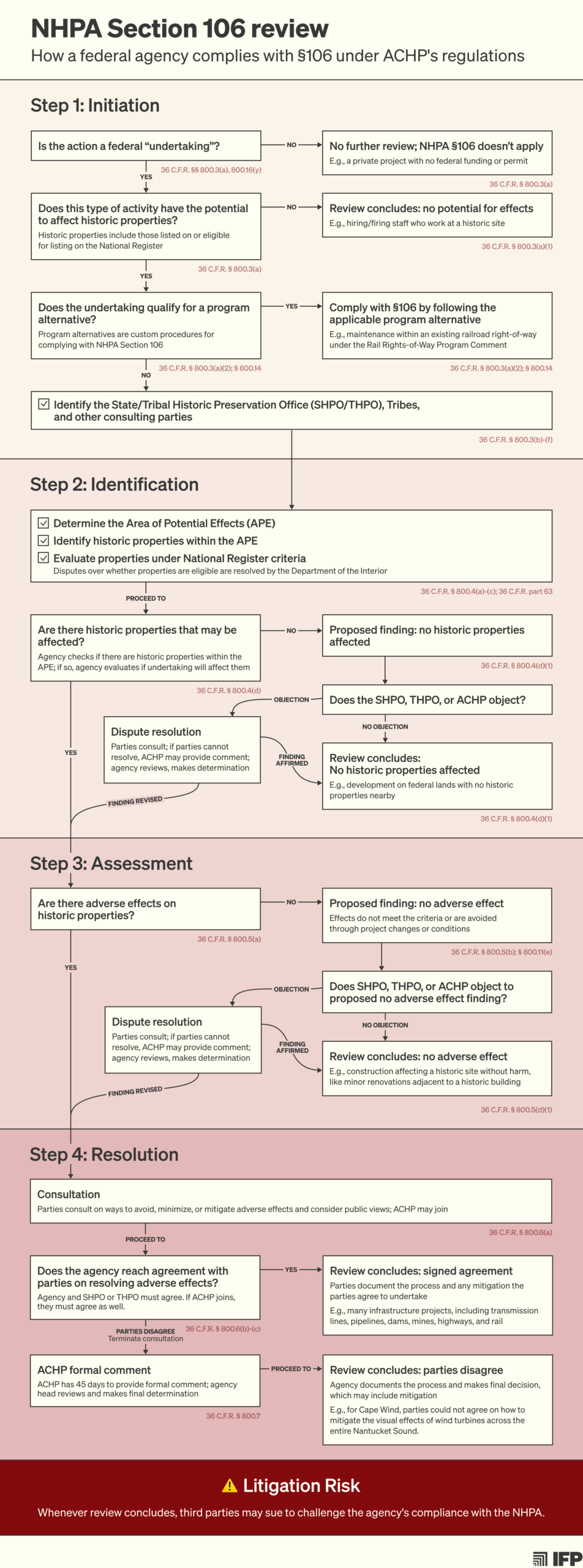
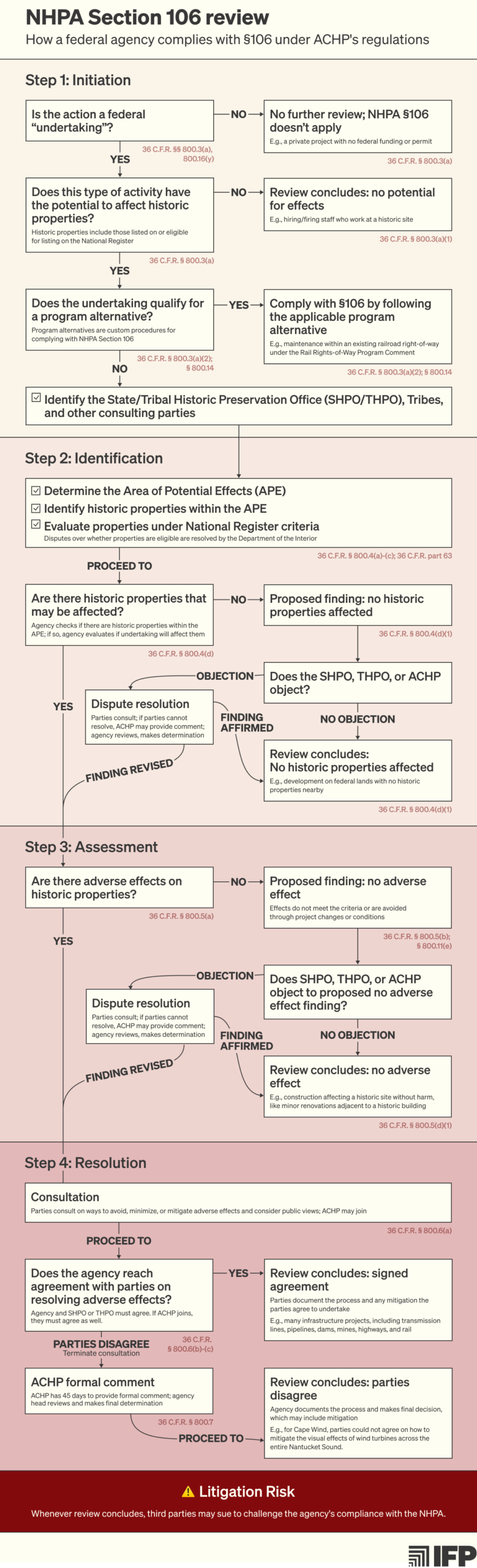
- Initiation
At the initiation stage, the agency must first decide whether the proposed federal action is an “undertaking,” which, as discussed above, is defined broadly and includes essentially any federal approval or grant.11
If the agency determines that the action is an undertaking, it next must assess whether the undertaking is a type of activity that does not have the potential to affect historic properties — even assuming historic properties are present.12 For example, actions that are either not physical — like hiring or conducting studies — or actions that are too minor to affect the historic property — like minor transportation improvements in previously disturbed rights-of-way — typically would not have the potential to affect historic properties.13 If the undertaking fits into this category, then the Section 106 process is complete.
If the undertaking does have the potential to affect historic properties, the agency next considers whether the undertaking is already governed by one of the five Program Alternatives. Program alternatives are alternative compliance mechanisms approved under the Section 106 regulations that allow a federal agency to satisfy its obligation to take effects on historic properties into account through a distinct process, rather than the default procedures in the regulations.14 The five program alternatives are:
- Programmatic Agreements (PA), which govern Section 106 compliance for a federal agency program, a complex or phased undertaking, or a class of undertakings where effects are similar and repetitive, multi-state or regional, not fully known before approval, delegated to nonfederal parties, or associated with routine management activities.15 A PA substitutes agreed upon procedures for the standard Section 106 process for covered undertakings. For example, the Army’s Interiors Prototype Programmatic Agreement provides bespoke procedures for compliance with NHPA for interior spaces in the Army’s historic buildings.
- Exempted Categories are categories of undertakings that ACHP exempts from further review if the undertakings would otherwise be subject to Section 106, but (1) their effects on historic properties are foreseeable and likely minimal or not adverse; and (2) the exemption is consistent with the purposes of the NHPA.16 For example, ACHP approved an Electric Vehicle charging station exemption for qualifying electric vehicle charging infrastructure, recognizing that many such installations occur in existing parking lots, involve limited ground disturbance, are reversible, and are unlikely to adversely affect historic properties.
- Standard Treatments, which define standard methods for handling a category of historic properties, undertakings, effects, or treatment options, intended to help agencies satisfy Section 106 steps rather than to replace the Section 106 process entirely.17 Standard treatments are often incorporated into a Memorandum of Agreement (MOA) or PA, or used to support “no adverse effect” determinations. For example, ACHP has considered standard treatments for recurring questions such as rehabilitation of historic exterior masonry.
- Program Comments, wherein ACHP comments on a category of undertakings in lieu of conducting individual ACHP review for each undertaking in that category.18 Program comments are useful for agencies with large numbers of similar undertakings or large inventories of similar historic properties. For example, ACHP’s Program Comment for Communications Projects on Federal Lands and Property provides a unique process for covered communications infrastructure projects on federal lands and property.
- Alternate Procedures, which establish agency-specific procedures, approved by ACHP and adopted by the agency, that substitute in whole or in part for the default Section 106 regulations.19 They are the broadest form of program alternative because they allow an agency to build a bespoke Section 106 compliant process around its own programs and decision-making structure. For example, the Army Alternate Procedures provide a streamlined procedure Army installations may elect to use to satisfy Section 106 in lieu of the ordinary Part 800 process.
If an agency finds that an undertaking is a type of activity that has the potential to affect historic properties and is not covered by a program alternative, the agency proceeds to the second step, identification.
- Identification
At the identification stage, the agency defines an Area of Potential Effects (APE), “the geographic area or areas within which an undertaking may directly or indirectly cause alterations in the character or use of historic properties.”20 The size of the area may vary by type of effect — courts have upheld a “variable APE” that uses different geographic perimeters for visual, auditory, and physical impacts.21
Concurrently, the agency identifies consulting parties: the SHPO, any relevant THPOs, Indian Tribes or NHOs with religious or cultural ties to the area, local governments, project proponents, and members of the public such as nearby landowners who have a legal or economic relationship to the undertaking or a concern with its effects on historic properties.22 Surveys, archeological investigations, and consultation with Tribes about traditional cultural properties typically occur at this step.
Then, working with the SHPO and any relevant THPOs, the agency identifies and evaluates properties listed on or eligible for listing on the National Register23 or any National Historic Landmarks within the APE under a “reasonable and good faith effort” standard.24 The National Park Service’s Keeper of the Register makes final eligibility determinations when federal agencies and State Historic Preservation Officers disagree. Undertakings that affect a National Historic Landmark are subject to a stricter standard than those affecting properties included on or eligible for inclusion on the Register.25 Section 110(f) of the NHPA directs that where an undertaking may “directly and adversely affect” a landmark, the agency must “undertake such planning and actions as may be necessary to minimize harm to such landmark . . . to the maximum extent possible,” and must invite both the ACHP and the Secretary of the Interior to participate in the consultation.26 This is the only place in the NHPA where the statute speaks in substantive terms about minimizing harm to properties — and it applies only to National Historic Landmarks, not to the much broader category of Register-eligible properties.
If the agency finds that there are no historic properties within the APE, then it must document that finding, send the documentation to the SHPO or THPO, notify the other consulting parties, and make the materials available to the public before approving the undertaking.27 If the SHPO or THPO does not object within 30 days, the agency has completed its Section 106 responsibilities.
If the SHPO/THPO objects, the agency may try to resolve it through consultation or ask ACHP to review the finding. ACHP generally has 30 days to provide its opinion; if it does not respond, the Section 106 process is complete. If ACHP provides an opinion, the agency must consider it and provide a written explanation of its consideration. After it does so, if the agency affirms the finding that there are no eligible properties in the APE, its Section 106 responsibilities are complete.28 If the agency finds there are listed or eligible properties within the APE, it proceeds to the next stage: assessment.
- Assessment of adverse effects
At the assessment stage, the agency determines whether the undertaking will adversely affect any identified historic property — that is, whether it will alter “any of the characteristics of an historic property that qualify the property for inclusion in the National Register.”29 The regulations enumerate seven aspects that the agency must consider — location, design, setting, materials, workmanship, feeling, and association — and direct the agency to consider both direct and indirect effects, including reasonably foreseeable effects “that may occur later in time, be farther removed in distance or be cumulative.”30
Where the agency finds its undertaking will have no adverse effect, the regulations give the SHPO/THPO 30 days to object. Absent objection, the Section 106 process is complete at this stage.31 If the SHPO objects, the dispute may be referred to the ACHP to issue an opinion. Even where the ACHP disagrees with the agency, however, its position is not controlling — the agency can still proceed with its preferred course after reviewing ACHP’s comment.32 As in the identification dispute resolution process, the principal constraint on agency discretion is process-based and documentary: the agency must support its finding with adequate evidence, because as discussed more below a court may set aside a finding that is arbitrary and capricious, or one that lacks supporting documentation.33
If the agency finds its undertaking will cause an adverse effect, it proceeds to the resolution stage.
- Resolution
If there is an adverse effect, the agency consults with the SHPO/THPO, the ACHP, and other consulting parties to “develop and evaluate alternatives or modifications to the undertaking that could avoid, minimize, or mitigate adverse effects.”34 The regulation frames mitigation in permissive terms, and courts have confirmed that NHPA does not require avoiding adverse effects. Consulting parties can agree to mitigate adverse effects in many ways, including simply by documenting the affected property before its destruction.35 The consultation over adverse effects typically results in a Memorandum of Agreement (MOA) or a Programmatic Agreement (PA) that governs the undertaking and includes a description of the undertaking, the APE, the steps taken to identify properties, the characteristics qualifying them for the Register, the effects, the rationale for the adverse-effect determination, and the views of consulting parties and the public.36 If consultation fails to produce agreement, however, the agency head (the decision is not delegable) can terminate the process and request formal comment from ACHP, which it must provide within 45 days.37 The head of the agency themselves must then consider ACHP’s comment, and document the consideration before making an ultimate decision.38
Section 106 in court
The nominal end of the Section 106 process is, in many cases, not really the end; litigation often follows — at least in large-scale projects with many impacted parties.
NHPA claims can only be brought under the Administrative Procedure Act’s (APA) waiver of sovereign immunity.39 Under Section 706 of the APA, courts review agency action under the “arbitrary and capricious” standard, which asks whether the agency considered the relevant factors, avoided a clear error of judgment, and articulated a rational connection between the facts found and the choice made. Under this standard, courts are not meant to substitute their judgment for that of the agency, but rather to evaluate whether the agency’s decision falls within a “zone of reasonableness.”
In NHPA cases, this APA standard applies to procedural questions such as whether the agency appropriately defined and documented the area of potential effects; made a reasonable and good-faith effort to identify historic properties; consulted adequately with SHPOs, THPOs, Tribes, NHOs, applicants, local governments, and other consulting parties; evaluated National Register eligibility; assessed adverse effects; addressed objections or contrary evidence raised during consultation; and adequately documented its no-effect, no-adverse-effect, or adverse-effect findings and any avoidance, minimization, or mitigation measures the agency chose to adopt in an MOA, PA, or other resolution document. While mitigation measures are not legally required, an agency could still be found arbitrary and capricious in deciding not to adopt a mitigation measure that was proposed but that the agency declined to adopt without a reasonable explanation.
What does a court do if they find a NHPA violation?
If a court finds that an agency has been unreasonable40 in carrying out the Section 106 process, the court is empowered by the APA to “hold unlawful and set aside” the underlying agency action (in the NHPA context, the “undertaking”).41 The APA’s “set aside” language has traditionally been interpreted to require vacatur — nullification of the agency’s decision — as the default remedy.42 When a court vacates an agency’s action on the basis of non-compliance with NHPA, it is not “setting aside” the NHPA analysis itself but rather the decision that prompted the NHPA analysis. In other words, if the project requires a federal permit, vacatur on NHPA grounds means the permit itself is no longer valid, and any permitted work (say, construction on federal land, or that requires a federal permit) should stop.
Vacatur is the “ordinary” remedy in NHPA cases and others brought under the APA.43 However, courts do not always vacate agency action based on NHPA errors. Courts have discretion to instead remand without vacatur, directing the agency to reconsider its analysis without revoking the permit or other approval, thus allowing the permitted work to continue.
How do courts decide whether or not to vacate?
In making the decision whether or not to vacate, like any other decision, courts look to the precedent in their circuit. A leading and oft-cited case courts look to for guidance is Allied-Signal, Inc. v. U.S. Nuclear Regulatory Commission, which instructs courts to weigh two factors in deciding whether vacatur is appropriate: whether the error was significant enough to call the agency’s decision into question, and whether vacating the agency decision would have disruptive consequences.44
How do courts decide whether to issue injunctions?
Federal courts are not limited to vacatur or remand in NHPA cases — they can also grant injunctions. A court-issued injunction is a command that requires specific actions or, more commonly, prohibits certain actions.45
A party can seek an injunction at several stages during the life of a case. At any time before final judgment, a party may seek interim relief under Federal Rule of Civil Procedure 65: either a temporary restraining order (in exigent circumstances, potentially without notice to the other party) or a preliminary injunction after notice and hearing.
NHPA cases sometimes begin with a plaintiff’s request for a preliminary injunction. A preliminary injunction is “extraordinary” relief intended to preserve the parties’ positions pending adjudication, not a final merits determination. To obtain an injunction a plaintiff has to demonstrate four factors, articulated in Winter v. Natural Resources Defense Council: (1) a likelihood of success on the merits; (2) a likelihood of irreparable harm absent an injunction; (3) that the balance of equities tips in the plaintiff’s favor; and (4) that an injunction is in the public interest.46 In the NHPA context, plaintiffs typically seek preliminary injunctions to stop construction from beginning (or continuing) until a court can determine whether the agency’s Section 106 process was adequate.
After final adjudication (in NHPA cases this typically means after summary judgment) a prevailing party may seek a permanent injunction, which requires satisfaction of the traditional equitable factors described in Winter as well as demonstrating actual success on the merits.
Finally, after an appealable order or judgment, a party may seek injunctive relief pending appeal: first in the district court under Federal Rule of Appellate Procedure 8(a), and, where appropriate, through Federal Rule of Civil Procedure 62(d), which permits a court to suspend, modify, restore, or grant an injunction while an appeal is pending, with the inquiry governed by the traditional factors.47
3. Challenges and opportunities to reform Section 106
The costs of Section 106 compliance are not limited to the direct expense of archeological surveys or consultant reports. For major infrastructure projects, the larger costs arise from uncertainty: how far the Area of Potential Effects extends, how far visual or landscape-scale impact must be studied, how long consultation will take, what mitigation will be demanded, and whether a court will later find the agency’s process insufficient. These burdens shape project design, financing, routing, construction schedules, and settlement behavior even when there is no litigation. They also shape which projects are proposed, financed, and built at all. In this way, Section 106’s procedural command to “take into account” effects on historic properties can become a significant substantive constraint on the ability to build, at least for certain classes of projects.
Section 106’s friction points track its four regulatory stages. A range of reforms at each stage of the process would allow for a better balance between the goals of historic preservation and building the infrastructure our country needs.
Challenges and reforms at the initiation stage
Right-size the undertaking
Section 106 applies to a “federal or federally assisted undertaking.” The term “undertaking” in the statute calls to mind a discrete action: the agency’s grant of a license, permit, or approval, or decision to provide funding. However, federal agencies often take an expansive view of the “undertaking” subject to Section 106 review, one encompassing nonfederal segments of a project — for example, privately owned portions of a transmission line, pipeline or road that connect to federal lands or jurisdictional waters. Preservation agreements are sometimes drafted to include such nonfederal segments, subjecting them to the same consultation requirements that apply to the federal action that triggered the statute.
Where the federal nexus is limited — for example, a right-of-way across federal land, a Corps permit for a jurisdictional-water crossing, or a federal approval for one segment of an otherwise private transmission line, pipeline, or road — treating the entire private project as the “undertaking,” and then drafting an MOA or PA to cover nonfederal segments can subject large amounts of private or state-controlled infrastructure to the same consultation, survey, APE, eligibility, adverse-effect, and mitigation process as the federal action itself. That increases costs by expanding surveys onto lands the federal agency does not control, multiplying consulting-party disputes, enlarging visual and indirect-effects analysis, and creating opportunities for route redesign or mitigation demands unrelated to the specific federal approval.
An overly broad understanding of “undertaking” can thus allow a narrow federal approval to serve as a hook for more federal control over a project than is justified by the statute, and require agencies to negotiate over project features they may lack authority to approve or deny. It may also make MOAs or PAs function as project-wide regulatory instruments rather than procedures for resolving the discrete effects of the federal undertaking on historical properties.
This understanding of “undertaking” is also inconsistent with the statute. In “NHPA Case Law Needs a ‘Course Correction’ — and NEPA Case Law Can Help,” former Department of Justice Assistant Section Chief Stacey Bosshardt describes how an “undertaking” is, by statutory definition, a finite event — the agency’s grant of a license, permit, approval, or funding. Earlier ACHP regulations defined “undertaking” to include “continuing projects, activities, or programs,” but when Congress codified the statutory definition in 1992, it omitted that continuing-activity language, and the regulations were amended to conform. Courts or agencies that nevertheless treat post-decisional implementation of a preservation agreement as itself a reviewable “undertaking” misunderstand the statute as well as the APA’s “final agency action” limitation.
Congress should amend 54 U.S.C. § 300320 to clarify that an “undertaking” subject to Section 106 review is limited to the specific federal licensing, permitting, or funding decision and does not encompass nonfederal activities, including nonfederal segments of a linear project, that the agency has no legal authority to approve or deny. Congress should also clarify that an “undertaking” is a discrete licensing or funding event, not a “continuing activity” that permits perpetual judicial oversight of a project’s post-approval implementation and that courts are only empowered to review the discrete final agency action that constitutes the undertaking. Alternatively, Congress could direct ACHP to use rulemaking clarifying the scope of “undertaking” consistent with the statute’s text, though legislation would be more durable and less susceptible to subsequent reversal.48
Harmonize NHPA “exempted categories” and NEPA categorical exclusions
One challenge that arises when an agency implements the NHPA alongside other permitting statutes, especially the National Environmental Policy Act (NEPA), is that the statutes do not always operate together efficiently. Specifically, NEPA and Section 106 require largely overlapping processes for small, routine, or repeat actions that are not expected to have significant effects.
NEPA allows for agencies to use categorical exclusions (CEs) for categories of actions that normally do not significantly affect the human environment, avoiding the need for more comprehensive environmental review (an environmental assessment or environmental impact statement) absent extraordinary circumstances.49 However, an agency may conclude that a routine action qualifies for a CE under NEPA and still have to complete the Section 106 process: define the undertaking and APE, identify historic properties, consult with the SHPO, THPO, Tribes, Native Hawaiian organizations, and other consulting parties where appropriate, assess effects, and resolve any adverse effects. ACHP and CEQ encourage agencies to coordinate NEPA and Section 106, but the two processes remain separate legal obligations with different triggers and processes.50 This creates obvious inefficiencies for small or routine undertakings that do not affect historic properties but nonetheless require agency time and energy.
Agencies can use the existing regulations to create exemptions on an ad hoc basis. For example, as mentioned above, because many federally assisted electric vehicle charging installations are small, routine, and likely to have minimal historic-property effects when placed in existing parking lots, garages, or rights-of-way, ACHP adopted an EVSE Exemption under 36 C.F.R. § 800.14(c), exempting qualifying EVSE undertakings from ordinary Section 106 review. A statutory change that automatically applied NEPA CEs to NHPA would make this kind of efficiency the rule rather than the exception.
Congress could thus simplify NHPA compliance by amending the Act to establish that an agency action that qualifies for a CE under NEPA is deemed to be within an “exempted category,” and requires no further NHPA review.51 Alternatively, Congress could establish a statutory program alternative for actions that qualify for a CE by amending 54 U.S.C. § 306108 or ACHP’s program-alternative authority in 54 U.S.C. § 304108 to provide that, if an undertaking is covered by CE, it is also covered by a nationwide Section 106 programmatic agreement (or by a statutory program alternative with the same legal effect) and compliance with the terms of that alternative satisfies Section 106. The statute should then also direct ACHP to issue conforming regulations or a nationwide programmatic agreement identifying CE-covered undertakings, the documentation required to invoke the alternative, and any reasonable exclusions.
Challenges and reforms at the identification stage
Ensure timely participation by consulting parties
Section 106 consultation can become especially difficult when a consulting party does not participate in a timely manner, or withholds site-specific objections until late in the process. The NHPA places the compliance obligation on the federal agency, not on consulting parties.52 But the regulatory process is designed to be consultative and iterative, and parties do not always agree on what a consultation should look like, or even whether it has occurred. When a consulting party does not timely or fully engage — particularly where it has unique information about properties of religious, cultural, or historic significance — the agency may be forced to proceed on an incomplete record, while still facing later claims that the record was inadequate. That creates structural litigation risk: the agency has a duty to gather information, but discharging that duty may depend on participation by parties the agency cannot compel to consult.
Courts typically — though not universally — apply issue-exhaustion or laches principles in such a case, requiring that a party raise its objection during the administrative process while the agency can still address it.53 So a plaintiff may have difficulty litigating a claim based on objections or site-specific information it failed to present when the agency provided a meaningful opportunity to consult.
SunZia provides an illustration. There, the plaintiffs argue that BLM authorized construction before adequately identifying, evaluating, and resolving adverse effects to the San Pedro Valley, a potential historic property. BLM and SunZia argue that consulting parties had numerous opportunities to identify eligible properties and that plaintiffs did not timely provide the specific information needed to establish the entire valley should be evaluated as a historic property.54
Congress should codify the requirement to participate in consultation into the NHPA by amending the statute to add an issue exhaustion rule for Section 106 claims. The provision could provide that a consulting party may not obtain judicial relief for an alleged failure to identify a historic property, define the area of potential effects, assess effects, consider mitigation, unless the objection was presented to the agency with reasonable specificity, at a time when the agency could meaningfully consider it, through the consultation opportunities provided in the statute or implementing regulations.55
This bar should not apply where the agency failed to make the “reasonable and good faith” efforts required to identify consulting Tribes or historic properties; failed to provide the “reasonable opportunity” for participation required by 36 C.F.R. §§ 800.2(c)(2)(ii) and 800.3(f); the objection was not reasonably knowable during consultation; disclosure was constrained by confidentiality concerns protected under 54 U.S.C. § 307103 and 36 C.F.R. § 800.11(c); or the agency already possessed information sufficient to trigger further inquiry.
Congress should also direct the ACHP to conform its regulations and guidance so that agencies provide clear written notice of consultation milestones, comment deadlines, confidentiality procedures, and the consequences of failing to raise objections in time. That would convert the current laches and issue exhaustion doctrines into a predictable statutory rule: agencies would still have to conduct meaningful consultation, and parties would be incentivized to participate and not withhold concerns until litigation.
Right-size the area agencies must study
The APE is the geographic framework for Section 106 review: it defines the area within which the federal undertaking may affect historic properties and therefore where the agency must focus identification, evaluation, and effects analysis. Where there is an “undertaking,” agency officials, in consultation with the SHPO/THPO, must “determine and document” the APE.56
Under current law and regulations, the APE is not necessarily coextensive with the project footprint, right-of-way, federal land boundary, permit area, or even the outer limits of the agency’s property or regulatory jurisdiction. If the undertaking may cause effects outside those limits — such as visual, auditory, atmospheric, setting-related, or other indirect effects — those areas may need to be included in the APE, even if they are outside of federal land or jurisdiction, or risk litigation over this issue. Nor, if two agencies have jurisdiction over different portions of a project, is it clear which agency defines the APE for the project as a whole — leading to inconsistencies and confusion.
Designate a lead agency to determine the APE
Agencies inconsistently designating Inconsistency in APE interpretation was detailed in October 2025 Senate testimony. The Montana-Dakota Utilities company described a three-mile distribution line rebuild where roughly half of the line crossed federal lands managed by two different agencies. According to the testimony, one agency limited the APE to the land it managed, while the other required the APE to extend three miles away, including private land for which federal approval was not required.
Section 106 has no statutory mechanism that reliably resolves inconsistent APE determinations across agencies, regions, or offices — but NEPA does.57 An easy fix would be to simply rely on this existing NEPA mechanism in NHPA cases as well. Congress should thus amend NHPA to require that whichever agency is lead for NEPA purposes is also lead for NHPA purposes. The lead agency would be solely responsible for setting the APE and making other NHPA decisions, in consultation with other federal agencies and consulting parties. This would eliminate the risk of parallel and occasionally inconsistent APEs and other Section 106 processes for the same undertaking.
The “enormous APE” problem
The scope of the APE can also drive litigation risk, uncertainty, and unwarranted costs if the review area balloons to hundreds or even thousands of square miles — a particular problem for large projects such as transmission lines that are both tall and hundreds of miles long.
For instance, the APE for the Sunzia transmission line covered a width of between 600-1,200 feet along the >500 miles of line, depending on the geography.58 We estimate that the APE for direct effects was approximately 40,000-80,000 acres — roughly the size of Washington, D.C.59 For wider-reaching visual effects, the APE was five miles on either side — an area we estimate to be roughly 5,200 square miles (~3.3 million acres), or more than double the size of Delaware.60 Similarly, the 732-mile TransWest Transmission line surveyed 60,000 acres of land as part of its NEPA and NHPA compliance; about four times the size of Manhattan.61 When the APE is this large, identifying every property potentially eligible for listing on the National Register can take years. For instance, it took over five years to complete preliminary eligibility studies for the 300-mile Boardman to Hemingway transmission line.62
To address this problem, Congress should amend the NHPA, or, alternatively, direct ACHP to adopt a program alternative under 36 C.F.R. § 800.14, establishing a brightline limit on visual-effects APE — for example, three miles from the undertaking. There is precedent for this approach. The FCC’s ACHP-approved Nationwide Programmatic Agreement for communications towers establishes presumed visual APEs based on tower height: one-half mile for towers 200 feet or less, three-quarters of a mile for towers over 200 but not more than 400 feet, and 1.5 miles for towers over 400 feet.
Challenges and reforms at the assessment stage
Limit effects to those directly caused by the undertaking
The overbreadth problem that arises from how agencies define the “undertaking” discussed in the Initiation Phase, above, can also manifest in how they define the “effect” of that undertaking.
The NHPA’s plain text requires an agency to evaluate the effect of its undertakings — it does not direct agencies to analyze the combined effects of other past, present, or future actions by other federal agencies, state or local governments, or private parties.63 But under the current regulations, effects are not so limited. Rather, the current regulations define an effect to occur when an undertaking, “directly or indirectly,” affects qualifying characteristics of a historic property in a way that diminishes integrity, and may include “reasonably foreseeable effects caused by the undertaking that may occur later in time, be farther removed in distance or be cumulative.”64 The regulations still require causation — the effect must be caused by the undertaking — but the inclusion of indirect, later-in-time, farther-removed, and cumulative effects can make the analysis expand well beyond the federal action that triggered Section 106 review. That expansion is especially costly for long and tall infrastructure, where agencies may be pushed to analyze visual, atmospheric, audible, and landscape-scale effects across federal, state, Tribal, and private lands, even when the federal approval is narrow and the effect on any particular historic property is attenuated.
Once indirect and cumulative effects are treated as ordinary Section 106 effects, agencies and applicants may have to survey more land, model more viewsheds, evaluate more eligible properties, consult with more parties, negotiate broader treatment plans, and accept mitigation for attenuated or incremental effects. That increases delay, litigation risk, and financing risk, and it can turn Section 106 from a requirement that agencies consider the effects of a federal undertaking into a quasi-regional planning exercise.
Congress should amend the NHPA to make explicit that the “effect” cognizable under Section 106 must be direct, proximate, and causally attributable to the discrete federal undertaking under review.
Congress should also exclude cumulative-effects analysis from Section 106. Cumulative effects analysis under NHPA drew from NEPA precedent: the 2013 Council on Environmental Quality (CEQ) and ACHP handbook stated that, although the Section 106 regulations do not define “cumulative effects,” the former CEQ definition of “cumulative impact” was “analogous and instructive.”65 But CEQ’s prior NEPA regulations have since been rescinded, and the Supreme Court in Seven County Infrastructure Coalition v. Eagle County recently emphasized that environmental review is focused on the project before the agency, not separate projects outside the agency’s authority. Section 106 should be similarly bounded. A conforming amendment should direct ACHP to revise the regulations to remove cumulative-effects analysis, narrow the APE to areas where the federal undertaking itself will proximately alter qualifying characteristics of historic properties, and clarify that effects analysis does not include the additive, regional, or indirect consequences of independent, non-federal actions.
Limit visual effects analysis, which disproportionately burdens tall and long infrastructure projects
ACHP regulations treat the “[i]ntroduction of visual, atmospheric or audible elements” that diminish a property’s significant historic features as a potential adverse effect.66 Visual impacts, like all other effects, are evaluated through the same four-part process described above. In practice, evaluating visual impacts requires viewshed studies, photo simulations, line-of-sight analysis, and analyzing whether the affected view or setting is itself a defining feature. If adverse visual effects are found, mitigation can include design modifications, alternative siting, height or massing reductions, screening, color and materials treatments, lighting controls, setbacks, undergrounding, or rerouting. Alternatively, parties often agree to compensatory mitigation such as documentation, interpretation, preservation funding, landscaping, or other measures tailored to the historic properties that are visually affected.67
The challenge of analyzing visual impacts scales with a project’s height and footprint. Taller infrastructure can be seen from farther away, and thus has the potential to affect the viewshed from a greater distance. This is evident when comparing transmission lines to pipelines — a typical APE for a large interstate transmission line has a width of ~300-1,200 feet for directly analyzed land and a width of 10 miles (five on either side of the line) for visual impacts.68 In contrast, for large interstate pipelines, the width of the APE for direct impact is typically around 300 feet and one mile at most for visual impacts (and often much smaller).69
Wind farms also have disproportionately large visual-effect APEs due to their height, movement, and large footprint.70 As one example, the Bureau of Land Management (BLM)’s Nevada office used a template for visual effects APE that recommended a 12-mile radius for 400-foot turbines. Modern wind turbines are often much taller (up to 750 feet). Were the height to APE ratio in BLM’s guidance applied to such turbines, the visual APE radius could be up to 22.5 miles depending on the terrain and line of sight.71
Other infrastructure does not have as significant a challenge. Pipelines are hidden after construction; the only visible structures are service stations and the maintained right-of-way. Direct effects of construction can typically be mitigated or the route alignment slightly modified to avoid historic buildings, or developers can fund refurbishment to offset the disruptive costs of temporary construction. But there is little developers can do to mitigate visual effects of 200-foot transmission lines or 750-foot wind turbines beyond using less reflective materials.
The Lava Ridge Wind Project exemplifies the pitfalls of visual impacts analysis. The proposed Idaho wind farm would have been visible from the Minidoka National Historic Site — a former Japanese internment camp that is now maintained as a small museum. Historic preservation groups argued the proposed turbines would diminish the sense of isolation at the historic site. The BLM chose an alternative in the Final Environmental Impact Statement (FEIS) that reduced the generation capacity of Lava Ridge by ~40% (1,200-2,094 MW down to 723-1,205 MW), noting the adjusted configuration meant the “closest turbine to the Minidoka National Historic Site would be nine miles away, helping to preserve the visitor experience.”72 Even so, the Idaho SHPO terminated consultation with BLM citing public opposition and the project’s visual impacts. The termination process created a long enough delay that the project did not break ground before January 2025, and the incoming Trump administration cancelled the project.73
Minidoka’s isolation — though an important part of its character — is not as it was in the 1940s; power lines, houses, and farms are much closer and more visible than the proposed wind farm. The images below demonstrate the minimal visual impact of the proposed wind farm, compared to existing infrastructure.
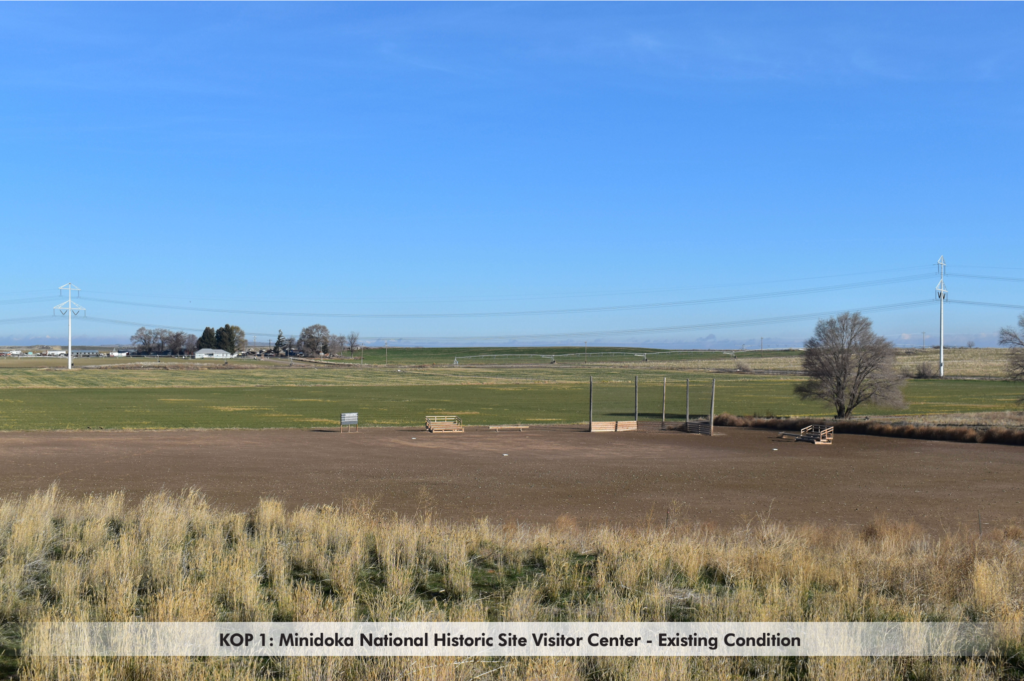
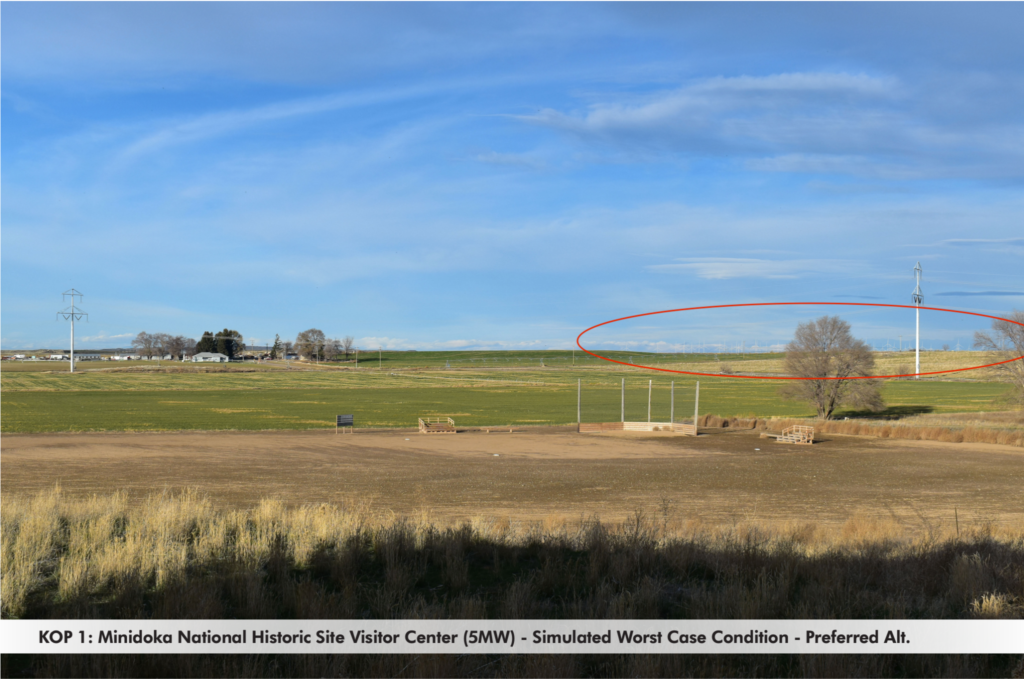
Congress should adopt two related but legally distinct reforms to the treatment of visual effects under Section 106.
First, Congress should establish an express materiality threshold for adverse visual effects. Section 106 itself requires an agency to “take into account” an undertaking’s effect on properties listed in or eligible for the National Register, but it does not define when an effect becomes adverse.74 The current ACHP regulation supplies that standard: an adverse effect exists when an undertaking may alter a characteristic that qualifies a historic property for the National Register “in a manner that would diminish” the integrity of its location, design, setting, materials, workmanship, feeling, or association.75 It identifies as examples changes to contributing physical features within a property’s setting and the introduction of visual, atmospheric, or audible elements that diminish the integrity of significant historic features. Thus even small visible instructions — like wind turbines barely visible on the horizon, as above — can be found to alter a characteristic in a manner that would diminish the integrity of a historic site, because the regulation contains no express modifier (such as “materially” or “substantially”) on the adverse effect.
Congress should provide that a visual change is adverse only when it materially diminishes the integrity of one or more documented characteristics that qualify the property for the National Register. “Materially” should be defined to mean a meaningful, nontrivial reduction in the property’s ability to convey its historic significance — not merely that new infrastructure would be visible, noticeable, modern, or aesthetically different from its surroundings. At the same time, Congress should make clear that material diminution need not be so severe that the property would become ineligible for the National Register; that would set the threshold too high. Under current practice, an agency may find an adverse effect even while concluding that the project would not diminish the property’s integrity enough to destroy its continued eligibility.76
Second, Congress should prescribe the baseline against which a possible diminution of setting is measured. This is a separate question from how serious the effect must be. National Register “integrity” means the property’s ability to convey its significance, and “setting” is only one of seven aspects of integrity recognized by the National Register criteria.77 Congress should require agencies to compare the property’s actual visual setting immediately before the undertaking with the reasonably foreseeable post-project setting. Existing buildings, roads, utility structures, communications features, vegetation, topography, lighting, and other visual intrusions would be part of that baseline. The agency should then determine whether the undertaking’s incremental change from the existing baseline would materially impair those particular attributes that contribute to a properties eligibility for listing on the National Register. Mere visibility from a historic property, interference with a view that is scenic but not historically critical, or generalized incompatibility with the surrounding landscape would not itself establish an adverse effect. Conversely, a project could still cause an adverse effect where the record demonstrates that a particular view or spatial relationship is integral to the property’s significance and the project materially impairs what remains of it. This approach resembles the property-specific analysis upheld in Preservation Society of Newport County, where BOEM considered whether particular seaward views contributed to eligibility and evaluated actual visibility in light of distance, topography, vegetation, atmospheric conditions, nonhistoric structures, and existing turbines.78
To implement these reforms uniformly, Congress should direct the ACHP to promulgate conforming regulations. Congress could additionally direct the ACHP to develop standardized procedures for recurring visual effects associated with transmission lines, wind and solar facilities, communications infrastructure, and other critical infrastructure.
Establish conditions on effects for landscape-wide properties
Historic property is defined in the NHPA to include prehistoric or historic districts, sites, buildings, structures, or objects included in or eligible for the National Register.79 This definition encompasses landscape-scale resources. For instance, in the Cape Wind project, the Keeper of the National Register determined that the entire Nantucket Sound — 500–600 square miles of ocean — was eligible for listing on the Register; the Department of the Interior ultimately terminated the Cape Wind Section 106 consultation after the consulting parties could not reach consensus on mitigation measures. While mitigation of effects on a building is possible and routine, there is no clear way to mitigate the effects of development on an entire waterbody.
SunZia also encountered this issue. In January 2024, a coalition of Tribes and NGOs sued BLM, alleging that the agency violated Section 106 by authorizing construction before adequately evaluating whether the San Pedro Valley as a whole is eligible for listing, rather than limiting its analysis to discrete archeological sites within the project area.80 The Ninth Circuit reversed the district court’s dismissal and remanded, holding that plaintiffs had plausibly alleged a NHPA claim. The case is now before the district court. SunZia has been in development and permitting since 2006; as of April 2026, the project is complete and providing power to the grid. However, the lawsuit continues with the parties most recently filing cross-motions for summary judgment and the plaintiffs have requested vacatur of BLM’s authorizations, which could threaten its operation.
The problem of overbroad scope is apparent. NHPA can become a de facto landscape-preservation mandate if entire natural features like mountains and valleys get treatment under Section 106, requiring avoidance or mitigation at a scale that is often impractical for large infrastructure projects. ACHP guidance on traditional cultural landscapes recognizes this tension, explaining that Section 106 reviews increasingly involve “large scale historic properties” made up of “multiple, linked features” that form a cohesive landscape of Tribal significance, and that such properties pose challenges for agencies and consulting parties in identifying, evaluating, and addressing effects.
Caselaw provides a reasonable middle ground Congress can adopt. In Te-Moak Tribe of Western Shoshone of Nevada v. U.S. Department of the Interior, the Ninth Circuit accepted that National Register-eligible properties of cultural and religious importance could encompass large areas, but held that the NHPA did not require protection of every part of those areas. The court upheld BLM’s use of exclusion zones and discovery protocols because the measures protected the discrete features that made the properties Register-eligible.81
Congress should amend the NHPA to follow this approach to landscape-scale historic properties, requiring agencies and consulting parties to identify the specific character-defining features, contributing areas, cultural-use locations, and access points that make the property Register-eligible, and limit adverse-effect findings to material impairments of those documented features that are directly and proximately caused by the federal undertaking. Historic eligibility of a broad landscape should not, by itself, expand the undertaking, enlarge the APE to the full landscape, require exhaustive survey of every acre, or authorize mitigation unrelated to the specific qualifying characteristic affected.
Challenges and reforms at the resolution stage
At the resolution stage, Section 106 in some cases can operate less like a procedural requirement to consider effects and more like a substantive negotiated mitigation regime. Where an agency finds an adverse effect, ACHP’s regulations require the agency to consult to “develop and evaluate alternatives or modifications to the undertaking that could avoid, minimize, or mitigate” those effects.82 If the parties reach agreement, the resolution is typically embodied in a Memorandum of Agreement (MOA) or Programmatic Agreement (PA) that evidences the agency’s compliance with Section 106 and governs implementation of the undertaking.83
Some courts have read a greater mitigation requirement into the text. In Mid States Coalition for Progress v. Surface Transportation Board, the Eighth Circuit suggested that an agency must either adopt a preservation agreement or “develop measures to ‘avoid, minimize, or mitigate’ adverse effects and then bind itself to these measures in a record of decision.”84 That reading turns NHPA’s “stop, look, and listen” mandate into a substantive preservation statute, contradicting its text. The case is an outlier, but the specter of litigation if the parties do not reach agreement nonetheless influences mitigation behavior.
In straightforward cases, mitigation can be obviously protective and closely tied to the affected resource, such as a design or construction method change so the project does not affect the historic property, remediation of unavoidable damage caused during construction, or documentation of an archeological site. But because the regulations give the consulting parties latitude and do not require a nexus or proportionality rule, negotiations can also produce measures that are only distantly related to the core historic-preservation harm the statute seeks to prevent.
Some recent agreements illustrate the problem:
- Empire Wind agreed to fund installation of a fitness lane near the Ocean Grove boardwalk to mitigate harms to the Ocean Grove Camp Meeting Association Historic District.
- The Susquehanna-Roseland transmission-line approval required the applicant to fund podcasts.
- The Donlin Gold PA required building and maintaining “safety cabins” and trails.
- Ocean Wind 1 agreed to pay to improve “visitor experience” for Lucy the Margate Elephant, a roadside attraction and Airbnb approximately 20 miles away from the offshore wind farm.

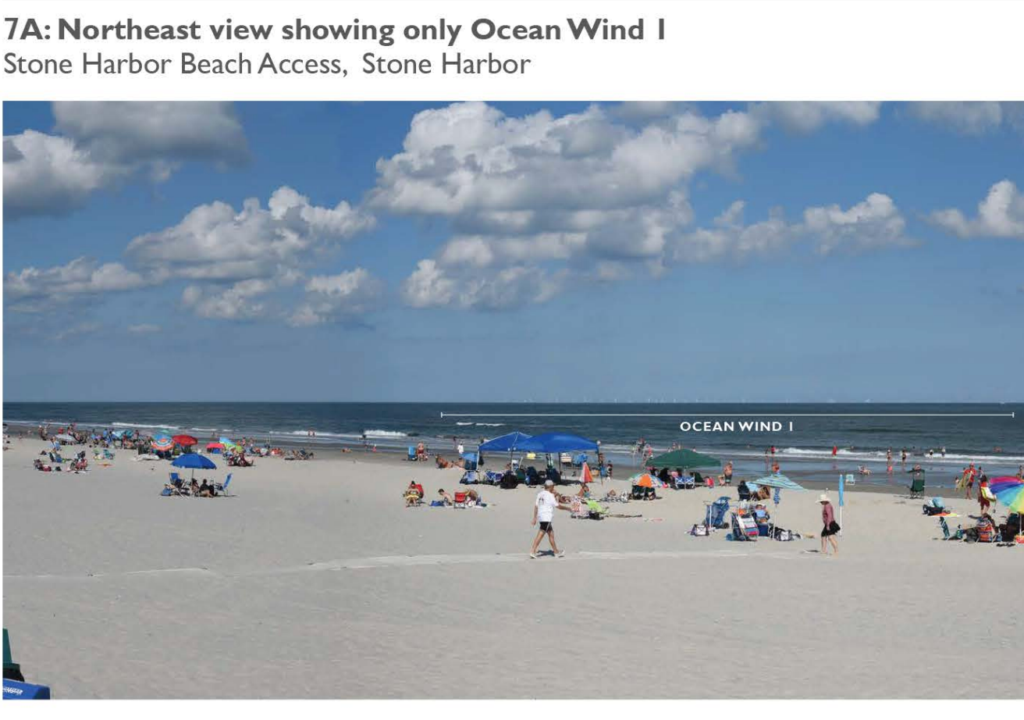
Some of these measures may have some public value and offset loss of information or public understanding. But as mitigation becomes more attenuated from the actual adverse effect, Section 106 begins to resemble a negotiated community-benefits process rather than a procedure for considering effects on historic properties. That raises infrastructure costs, extends consultation, and gives consulting parties leverage to seek collateral commitments, and makes the consultation process’s time, complexity, and resolution depend in part on ad hoc bargaining over benefits that may have only a loose connection to the historic property actually affected.
Congress should make explicit that Section 106 does not require mitigation of adverse effects to historic properties. The text already implies this: Section 106 contains no mitigation language, in contrast to Section 110, which explicitly requires minimizing harm to National Historic Landmarks.86
Challenges and reforms at the litigation stage
Large projects with multiple interested parties and an involved NHPA process often end up in court. Even where the government ultimately prevails, as it typically does, litigation imposes costs, and litigation risk gets priced into financing, construction schedules, contingency budgets, and investor expectations.
A particularly concerning cost of litigation is that it can delay or even lead to the cancellation of projects. The Imperial Valley Solar Project is one example that shows how even a temporary Section 106 injunction can be fatal. In December 2010, a federal court issued a preliminary injunction after finding that BLM had failed to adequately consult the Quechan Tribe before approving the project. Within two months, the project developer and its supplier, Stirling, filed for Chapter 7 bankruptcy. Falling photovoltaic prices and lost financing were major causes of the collapse, but the NHPA injunction added delay and uncertainty at a critical moment, contributing to the project’s failure.
The Cardinal-Hickory Creek transmission line, a 345-kV transmission line proposed to connect Iowa and Wisconsin, also illustrates the risks of litigation and how NHPA can indirectly impact a project. After the federal agencies approved the line’s route in their January 2020 record of decision (while conditioning the Rural Utilities Service’s environmental approval on completion of the NHPA process) the Section 106 process continued to affect the project’s alignment.87 The Section 106 process contributed to a route modification, which was coupled with a proposed land exchange and the revocation of an earlier right-of-way. The land exchange then became a major litigation flashpoint: a federal district court preliminarily enjoined the exchange and construction through the Refuge, but the Seventh Circuit stayed the injunction, allowing the exchange and construction to proceed while the merits litigation continued. The episode illustrates how Section 106 and project redesign can interact with separate land-authorization and environmental-review requirements, producing additional consultation, site visits, easement negotiations, supplemental analysis, and potential grounds for litigation.
Litigation risk not only affects projects that are actually sued, but also changes behavior upstream. Developers avoid certain routes, undertake extensive studies, or accept mitigation packages they view as excessive because the cost of fighting in court may be greater than the cost of settlement. Avoidance and mitigation is of course an intended result of NHPA, which was meant to reduce unnecessary harms to historic sites by encouraging that very behavior. But avoidance and mitigation is not universally positive or costless: if a pipeline or transmission line opts for a longer route to avoid historic sites, that often means impacts on other resources, and a higher cost that is later passed on to consumers and ratepayers; if a wind project reduces its footprint to lessen its visual impacts, that means fewer megawatts of clean electricity on the grid. Several reforms to how NHPA cases are heard in federal courts can significantly reduce the litigation burden on critical infrastructure projects from the law.
Reform reviewable actions and judicial remedies
The litigation costs described above are aggravated by two features of how courts adjudicate Section 106 claims: what counts as a reviewable agency action, and what remedy follows a violation.
First, the scope of review. Because the NHPA creates no private right of action, plaintiffs must proceed under the Administrative Procedure Act, which authorizes review of a discrete “final agency action.” In a large project, however, Section 106 compliance is not a single decision but an extended course of conduct — a Programmatic Agreement (PA) that governs implementation for years and generates a stream of inventory reports, treatment plans, eligibility determinations, and construction authorizations. When courts treat those downstream steps as independently reviewable, the underlying approval never reaches repose: a project can be challenged, and its authorizations set aside, long after the record of decision is final and even after the project is largely of even entirely built.
The second is the remedy. When a court does find a Section 106 violation, the default consequence is vacatur of the challenged approval, even for a procedural error the agency could cure on remand without changing the result. As discussed above, vacatur nullifies the permit and typically halts the permitted work; for a project dependent on financing and schedule certainty, that can be fatal.
The SunZia litigation again illustrates the problem.88 There, the Ninth Circuit revived a challenge to BLM’s authorization of SunZia construction through the San Pedro Valley, holding that plaintiffs plausibly alleged that BLM violated the PA agreement by authorizing construction before properly consulting on whether the Valley should be treated as a traditional cultural property and before ensuring that adverse effects would be avoided, minimized, or mitigated. The court held that BLM’s notices to proceed were independent final agency actions under Bennett v. Spear because they consummated BLM’s post-ROD decisionmaking and conferred on SunZia the right to begin construction. But treating alleged noncompliance with a post-decisional programmatic agreement as the substantive illegality that makes each later construction authorization reviewable is problematic on several levels. As discussed above, because NHPA creates no private right of action, Section 106 claims must proceed through the APA’s waiver of sovereign immunity and cause of action.89 The APA permits review of an identified, discrete “final agency action” and authorizes a court to “hold unlawful and set aside” that action; it does not generally authorize continuing judicial supervision of an agency’s performance of an open-ended project agreement.90 Allowing PA compliance to be reviewable in court goes well beyond Section 106’s statutory directive and coverts the procedural “take into account” directive in Section 106 into a freestanding substantive federal obligation. Congress should clarify that noncompliance with a PA alone is not legally reviewable. A court’s review should be only of the final licensing, funding, or construction-authorization decision — not continuing judicial enforcement of the agreement itself.
Finally, Congress should address the issues that arise in NHPA litigation by limiting judicial remedies for procedural NHPA errors, absent extraordinary circumstances or substantive errors, making the default remedy remand without vacatur (leaving the challenged agency action in place) while the agency conducts additional NHPA process that a court has found is required.
Cross-cutting reforms
Set time limits for each step of the Section 106 process
Section 106 and its implementing regulations contain no overall timeline for the process; rather, they require the agency to complete the Section 106 process “prior to the approval of the expenditure of any Federal funds on the undertaking or prior to the issuance of any license,” and to initiate the process early enough in planning to allow consideration of alternatives.91
Within that sequence, however, certain review periods are fixed: if the SHPO/THPO fails to respond within 30 calendar days to a request for review of a finding or determination, the agency may proceed to the next step or consult with the ACHP in lieu of the SHPO/THPO;92 a “no historic properties affected” finding generally becomes final if the SHPO/THPO (and the ACHP if participating) does not object within 30 days of receiving adequate documentation;93 and a proposed “no adverse effect” finding is subject to a 30-day SHPO/THPO and consulting-party review period.94
If there are disputes over whether an undertaking causes adverse effects, the ACHP has 15 days, extendable by another 15 days, to review certain no-adverse-effect disputes;95 the ACHP has 15 days to decide whether to participate in adverse-effect consultation;96 and, if consultation is terminated or otherwise fails to resolve adverse effects, the ACHP generally has 45 days to transmit formal comments.97
By contrast, many of the most time-consuming steps — defining the undertaking and APE, identifying consulting parties, conducting tribal consultation, making a reasonable and good-faith identification effort, evaluating National Register eligibility, developing avoidance or minimization options, and negotiating an MOA or PA — have no fixed duration or timeline.
ACHP guidance makes clear that the 30-day periods apply only at specified review points and begin only upon receipt of adequate documentation, not at the start of consultation generally, and that the regulations do not mandate a single timeframe within which an agency must complete the entire Section 106 review.
The Fiscal Responsibility Act of 2023 introduced statutory deadlines for NEPA reviews: two years for an environmental impact statement and one year for an environmental assessment, subject to extensions and judicial schedule-setting provisions.
Section 106’s lack of a comparable statutory deadline creates a mismatch between two statutes that could ideally operate in tandem. NEPA may now move on a more defined timeline, while Section 106 remains open-ended at critical stages: defining the APE, conducting surveys, evaluating eligibility, resolving adverse effects, and negotiating agreement terms. As NEPA duration improves, Section 106 has the potential to become the binding constraint on the permitting of some critical infrastructure.
A proposed amendment, the National Historic Preservation Act Amendments of 2006, H.R. 5861, would have created a 30-day deemed-no-objection rule for adequately documented “no historic properties affected” and “no adverse effect” findings — that is, SHPO silence after 30 days would be treated as concurrence, thus moving the process forward after that time. But this would have addressed only part of the timing problem. A deemed-no-objection rule for adequately documented “no historic properties affected” and “no adverse effect” findings would prevent SHPO/THPO delay from stalling the process at two formal decision points, but it would not address the parts of Section 106 that can take considerable time in large infrastructure reviews. Congress should go further and amend 54 U.S.C. § 306108 to require a project-specific Section 106 schedule for each covered undertaking, with default deadlines for the steps that lack them today: establishing the undertaking and APE under 36 C.F.R. §§ 800.3–800.4, identifying consulting parties, initiating tribal consultation, completing the reasonable-and-good-faith identification effort, evaluating National Register eligibility, assessing adverse effects, and negotiating an MOA or PA under 36 C.F.R. §§ 800.5–800.6.
Increase SHPO/THPO capacity and modernization
An effective NHPA process depends on well-resourced federal agency staff, SHPOs, and THPOs. Historic Preservation Offices vary enormously in their funding and use of modern information systems, and review times vary accordingly. The National Conference of State Historic Preservation Officers (NCSHPO) has called for increased investment in SHPO capacity and digital tools, and identified SHPO funding and staffing shortfalls — particularly the lack of e-submission portals and functional GIS survey data — as one of the largest sources of avoidable delay in the existing system. The National Trust for Historic Preservation echoed this finding, and H.R. 5861’s House report acknowledged that THPOs in particular often lack the resources to respond on the timelines that streamlining reforms would require.
There is reason to believe that these efforts could improve the process significantly. For example, Utah’s fully digital SHPO has run on GIS since 2017; the office reports that roughly 98% of reviews are completed within seven days. Washington’s WISAARD platform enables a three-to-four-day turnaround. The ACHP’s 2024 Permitting Council–funded AI siting tool depends on state databases of this kind. The states without modernized data systems cannot move at this speed even when the underlying statute and regulations permit it.
Congress should fund SHPO/THPO modernization, staffing, and capacity building efforts, directing either Historic Preservation Fund money or an additional appropriation to a national SHPO and THPO modernization initiative, with federal technical assistance and minimum data standards.
4. Conclusion
While some of the problems with the National Historic Preservation Act are unique to the Act, they are also emblematic of a broader change in America’s permitting system, our approach to litigation, and erosion in trust in government since the 1960s. The law originally anticipated that bureaucrats would work efficiently and in good faith with local partners to do as Congress instructed and consider historic preservation in executing their statutory obligations. After the 1960s, the US became more litigious and bureaucracy adapted in response. Today, agency staff are not merely trying to execute Congress’s mandate and the NHPA in good faith, but also to document their work and make it litigation-proof, because in high-profile cases, litigation is expected.
Reforming the NHPA as described above can incrementally move the US permitting system away from litigation-enforced compliance and toward a government and system more aware of the costs of delay and procedure, with stronger state capacity and less litigation.
The reforms proposed here are relatively modest, faithful to the NHPA’s text, and consistent with the statute’s original design. They would reduce litigation risk, lower costs for infrastructure projects, and ensure that the Section 106 process serves its intended purpose: informing agency decisions, not blocking them entirely. Congress should take action to restore NHPA to its roots, and strike a more appropriate balance between preserving the past and building the infrastructure America needs to thrive into the future.
-
Unless otherwise indicated, this paper uses “Tribes” as shorthand for both federally recognized Indian Tribes and Native Hawaiian Organizations (NHOs). The convention reflects that the NHPA and the Section 106 regulations generally address Tribes and NHOs in parallel when requiring agencies to identify and consult with Indigenous communities that attach religious and cultural significance to affected historic properties. See 54 U.S.C. § 302706(a)–(b); 36 C.F.R. §§ 800.2(c)(2), 800.3(f)(2), 800.4(a)(4). The shorthand is stylistic only: NHOs are legally and culturally distinct from Indian Tribes.
-
In their February 2026 meeting, ACHP noted various problems with the existing regulations, including: “lengthy and protracted reviews; confusion on addressing indirect and cumulative effects; burdensome requirements for long, linear projects; difficulty reaching agreement on routine effects to historic properties; and the unnecessary delay to critical projects that serve the American people.” ACHP also initiated a formal review of the Section 106 regulations. Any forthcoming changes ACHP may propose to the Section 106 regulations are beyond the scope of this article, which focuses on actions that can be taken by Congress.
-
For more examples, see ACHP, Program Comment on Certain Housing, Building, and Transportation Undertakings.
-
See 54 U.S.C. § 306108 and 36 C.F.R. § 800.14.
-
See 36 C.F.R. § 800.14(d) and ACHP, Standard Treatments Guidance.
-
See 36 C.F.R. § 800.14(a) and ACHP, Alternate Procedures.
-
See 36 C.F.R. § 800.2(c).
-
The Secretary of the Interior maintains the National Register of Historic Places, and the Department of the Interior’s regulations at 36 C.F.R. § 60.4 define criteria for properties (more specifically, “any district, site, building, structure, or object”) to be eligible for inclusion on the National Register of Historic Places.
-
A National Historic Landmark is a property designated by the Secretary of the Interior under the Historic Sites Act of 1935 as having national, rather than regional or local, significance.
-
See 54 U.S.C. § 306107 and 36 C.F.R. § 800.10.
-
36 C.F.R. § 800.5.
-
See Vieux Carre Property Owners, Residents and Associates, Inc. v. Brown, 948 F.2d 1436 (5th Cir. 1991) (“[The] Advisory Council's comments are advisory only and do not bind the [agency] to a particular course of action.”).
-
See, e.g., Coalition of 9/11 Families, Inc. v. Rampe, 2005 WL 323747 (S.D.N.Y. 2005) (photographic documentation as adequate mitigation for World Trade Center remnants).
-
The requirement in 36 C.F.R. § 800.7(c)(4) to have the head of a federal agency themselves consider ACHP’s comments is unusual and creates practical difficulties because cabinet-level agency officials (e.g., Secretary of the Interior, Secretary of the Navy) are typically quite busy.
-
The doctrine of sovereign immunity bars suits against the government without consent. Congress has waived sovereign immunity for certain claims in the APA, but there is no waiver in the NHPA, so NHPA claims are brought under the APA’s waiver. See generally Kovacs, Kathryn E. “Scalia’s Bargain.” Ohio State Law Journal 77, no. 5 (2016) (discussing the history of the APA’s waiver).
-
Technically, agency exercises of judgment or discretion are reviewed under the “arbitrary, capricious, abuse of discretion” standard. Under this standard, an agency determination will be upheld if it is rational, based on consideration of the relevant factors, and within the scope of the authority delegated to the agency by statute. For more information see this overview of judicial review under the APA created by the Administrative Conference of the United States.
-
5 U.S.C. § 706(2).
-
But see Devlin, Dea. “Fixing the Fix: The Case for Unifying the Remedial Framework of APA Rulemaking Challenges”, Fordham Law Review 94, no. 1 (2025); Chen, Brian. “APA Vacatur and the Complete-Relief Principle”, Yale Journal on Regulation, February 24, 2026; see United States v. Texas, 599 U.S. 670 (2023).
-
Federal courts derive their authority to issue injunctive relief from Article III of the Constitution and the Judiciary Act of 1789, which empowers courts to issue traditional “equitable” remedies, of which injunctions are a type.
-
It is worth noting that the Supreme Court's decision in Loper Bright Enterprises v. Raimondo, 144 S. Ct. 2244 (2024), which overruled Chevron deference, provides an additional reason for Congress to act. Under Loper Bright, courts are no longer required to defer to the ACHP's interpretation of ambiguous statutory terms. The question whether a nonfederal segment of a linear project falls within the statutory definition of "undertaking" is a legal question that courts must resolve using the traditional tools of statutory interpretation. Because the ACHP's expansive reading of "undertaking" may not survive scrutiny under Loper Bright, the better course for Congress is to resolve the ambiguity directly rather than waiting for case-by-case litigation to narrow the definition.
-
See ACHP’s Integrating NEPA and Section 106 and CEQ & ACHP’s NEPA and NHPA: A Handbook for Integrating NEPA and Section 106.
-
See above; 54 U.S.C. § 306108; 36 C.F.R. §§ 800.1–800.2.
-
Issue exhaustion concerns whether a party timely presented a particular argument or objection during the administrative process; failure to do so may preclude the court from considering that issue on judicial review. Laches, by contrast, is an equitable defense based on an unreasonable and prejudicial delay in seeking judicial relief, regardless of whether the plaintiff previously raised the relevant issue before the agency. See Apache Survival Coalition v. United States, 21 F.3d 895 (9th Cir. 1994).
-
A related issue arose in the Standing Rock Sioux Tribe litigation. There, the court found that the Tribe had largely declined to participate in the Corps’ narrower site-specific consultation because it sought a broader survey of the entire nearly 1,000-mile-long pipeline route, only a small portion of which was at issue in the water-crossing permit the Army Corps was considering. On that record, the court found the Tribe’s limited participation did not bar the claim, but was relevant to the equitable preliminary injunction consideration. See Standing Rock Sioux Tribe v. U.S. Army Corps of Eng’rs, 239 F. Supp. 3d 77, 100 (D.D.C. 2017).
-
This mirrors the preservation rule that applies in NEPA cases. See Vermont Yankee Nuclear Power Corp. v. NRDC; Department of Transportation v. Public Citizen.
-
The Fiscal Responsibility Act of 2023 added a new NEPA § 107 that formalizes how the lead agency is selected in multi-agency reviews. Where “two or more participating Federal agencies” are involved, those agencies must designate the lead agency “by letter or memorandum,” based on five statutory factors such as the magnitude of each agency’s involvement. If no lead agency has been designated, an interested party may submit a written request for designation to a participating federal agency, which must transmit the request to the other participating federal agencies and to CEQ. If the participating federal agencies cannot agree within 45 days, the requester may ask CEQ to designate the lead agency.
-
Directly analyzed land is manually reviewed by archeologists and surveyors; the broader corridor of (mostly visual) effects is analyzed through a combination of manual review and GIS data. The 600–1,200 figure comes from an immediate area measure of 400–1,000 ft plus a 100-foot buffer on either side. The APE for direct effects also covered access roads, staging areas, and tensioning sites, and the area around the endpoints of the line. See page 4 of the Programmatic Agreement for more information.
-
Washington, D.C. is 43,766 acres, but only 39,136 acres are land (the remainder is water owned by the District). For our calculation, we considered a lower bound of 600 feet multiplied by the length of 520 miles: 600 × 520 × 5,280 ÷ 43,560 = 37,818 acres (43,560 sq. ft. per acre; 5,280 ft. per mile), rounded up to ~40,000 acres to accommodate access roads, tensioning stations, staging areas, and the end of each corridor (see footnote 51). The upper bound uses the same process but with the higher width of 1,200 feet: 1,200 × 520 × 5,280 ÷ 43,560 = 75,636 acres, rounded up to ~80,000 acres for the same reason.
-
Visual impacts analysis outside the APE for direct effects is completed with GIS analysis rather than field studies. The only exception is for buildings and sites whose historic character depends in part on visual elements that may be affected by the undertaking. Those properties, like the Minidoka National Historic Site, are identified and thoroughly analyzed for impacts.
-
The 60,000-acre figure refers to the acres surveyed for direct impacts, which was smaller than the broader corridor surveyed for visual impacts.
-
Class I literature review began in 2011, and Reconnaissance Level Survey and Intensive Level Surveys ended in 2015 and 2017, respectively. However, the project still used a phased approach and deferred supplemental eligibility work until after the ROD, meaning the studies may have actually taken more than five years.
-
APE sizes vary across projects and agencies. For example: SunZia had a 600–1,200-foot direct APE and a five-mile broader visual APE; TransWest had a 500-foot direct APE and a 3–5-mile broader visual APE (visual effects were also modeled up to 20 miles away for indirect effects analysis under NEPA); Boardman to Hemingway had a 500-foot direct APE with a five-mile broader visual APE (5 miles or the visual horizon, whichever is closer); Cardinal Hickory Creek had a 400-foot direct APE with a 2,000-foot broader visual APE (indirect effects analysis under NEPA also evaluated visual impacts within one mile of the right-of-way).
-
For example, the Alaska LNG pipeline had a 300-foot APE for directly analyzed impacts and a one-mile visual APE; the cancelled Atlantic Coast Pipeline had a 300-foot APE for directly analyzed effects and a visual APE defined as “line of sight”; the Mountain Valley Pipeline had a 300-foot APE for direct impacts and a variable visual effects APE of 0.25–1 mile depending on elevation (see page 4-432); the El Paso Natural Gas Mainland Expansion Project had a 300-foot APE for direct impacts and an unspecified visual APE. Many pipelines define the visual APE as “within the sightline,” which is heavily limited for pipelines that are either buried or lie close to the ground.
-
The base of a wind turbine takes up a relatively small amount of land, and the surrounding area can be used for agriculture or other purposes. But because turbines must be spaced apart, the total size of a wind farm can be large.
-
The 2020 BLM template has since expired and has not been replaced with new guidance. The 22.5-mile estimate was calculated by applying the 400-foot-to-12-mile ratio to 750 feet, representing the upper bound of onshore turbine height in the United States.
-
See page 63, table 2.4-1 in the Lava Ridge Wind Project, Final Environmental Impact Statement, Volume 1.
-
The DEIS (January 2023) anticipated a final EIS by summer 2023. However, the actual FEIS was not finalized until June 2024. Public opposition to the project focused on historic and visual impacts. The agency received more than 600 comments, requiring over 110 pages of responses from the federal agency. The FEIS and eventual ROD both highlighted concerns about historic preservation and how the BLM accommodated those concerns through its selected alternative. We therefore infer that a substantial portion of the delay was likely due to the time required to consider these comments, adjust alternatives to address opposition and/or prepare for post-decision litigation. Comments from the SHPO and conservationists likely contributed to the year-long delay of the FEIS beyond its expected release date. Then, the SHPO’s termination of consultation in August 2024 caused several additional months of delay: the BLM had to formally terminate consultation as well and then request formal comments from the ACHP, which did not respond until late October 2024. Once those comments were submitted, the BLM had to review and respond to them, a process that continued until November 2024. The ROD was published in December 2024, suggesting that the NHPA Section 106 review was one of the final issues delaying the project between the FEIS and the ROD. It is possible that the Trump administration could have cancelled the project even if construction had already begun. However, recent offshore wind lawsuits have shown that cancelling a project well into construction is significantly more challenging than cancelling a project that has completed permitting but has not yet begun construction.
-
National Park Service guidance defines setting as the property’s physical environment and its relationship to surrounding natural and human-made features, but it also explains that the importance of each aspect of integrity depends on why, where, and when the particular property is significant. See National Register Bulletin 15, How to Apply the National Register Criteria for Evaluation, pp. 44–45.
-
This reform should be paired with changes to “cumulative” effects for visual impacts as discussed below; otherwise, agencies and courts may continue to disagree over whether the relevant comparison is the undertaking’s incremental change from present conditions or its contribution to a broader aggregation of past, present, and reasonably foreseeable visual change. See 36 C.F.R. § 800.5(a)(1).
-
See plaintiff’s complaint, Case 4:24-cv-00034-JGZ. The plaintiffs argued that the five-mile APE was not broad enough because the visual effects impacted the valley beyond the five-mile limit and asked the court to require that the BLM conduct a Cultural Landscape Study for the entire San Pedro Valley in addition to the existing Class III Intensive Field Inventory survey.
-
In that case, they were specific geographic features such as Mt. Tenabo, the White Cliffs, caves, and burial locations, as well as perennial water sources and medicinal and edible plants.
-
See 36 C.F.R. § 800.6(b)–(c); ACHP, Achieving a Resolution; ACHP, Guidance on Agreement Documents.
-
Appendix M, Ocean Wind 1 DEIS.
-
Section 110(f) directs agencies to undertake “such planning and actions as may be necessary to minimize harm” to National Historic Landmarks. See 16 U.S.C. § 470h-2(f).
-
In 2023, the Rural Utilities Service explained that a route modification, B-IA3, arose from ongoing consultation under the project’s NHPA Programmatic Agreement: consulting parties had requested reconsideration of the segment to reduce impacts to cultural resources, and, after site visits and negotiations concerning a conservation easement and private-property access, the Ho-Chunk Nation THPO reaffirmed that B-IA3 was the preferred alignment because it would allow removal of an existing 161-kV line crossing cultural resources.