-
- Summary
- Strategic goals
- Program constraints
-
Recommendations for export packages to prioritize
- 1. Include US-operated cloud services as an eligible export “deployment” model
- 2. Encourage industry to vary the contents and scale of export packages to reach a broad range of customers and markets
- 3. Where necessary, accommodate foreign partners’ ‘sovereignty’ concerns by prioritizing in-country infrastructure and confidential computing in export packages
- 4. In consultation with CAISI, package exports with sovereign evaluation capabilities to build trust in American AI stacks
-
Recommendations for effective export promotion
- 5. Focus international messaging of the Exports Program on addressing countries’ concrete issues with pragmatic industry solutions
- 6. Implement baseline security guardrails in export packages that involve providing foreign countries with direct access to substantial quantities of advanced AI compute
- 7. Establish benchmarks to measure the success of the Exports Program and steer future policy decisions
- 8. Remove the consortia requirement for American companies seeking to participate in the Exports Program without foreign partners
- Recommendations for priority export destinations
- Appendix A: Recommendations for export promotion guardrails
- Appendix B: Recommendations for US government metrics to assess Exports Program success
- Acknowledgments
Editor’s note: This publication is IFP’s response to the Department of Commerce’s request for information (RFI) on establishing America’s AI Exports Program. Minor edits have been made to reflect changes in policy decisions and other world events since the RFI was submitted in December 2025.
Summary
On July 23, 2025, the Trump administration issued Executive Order 14320 on “Promoting the Export of the American AI Technology Stack,” launching the United States’ AI Exports Program. The program aims to bolster the United States as the global supplier of AI, bring partners into an American-led AI ecosystem, and counter China’s rising technological influence abroad.
The Exports Program represents a genuine opportunity to strengthen the United States’ position in the AI supply chain, ensuring that the most transformative technology of the 21st century is built and deployed in a way that enables — rather than smothers — human flourishing. The US government has diplomatic, regulatory, and economic levers at its disposal that are unavailable to the private sector. If deployed strategically, these levers can lower market barriers and shape industry incentives, aligning them with the shared interests of the United States and its partners.
But to succeed, the program must overcome multiple obstacles. The US government does not have the diplomatic or technical capacity to strike deals and shape foreign regulatory environments in every market. Its financial resources for this program are modest — nowhere near enough to support industry expansion everywhere. And it must navigate a fundamental tension at the program’s core: the United States seeks to exploit a temporary window of opportunity to persuade countries to adopt the American AI technology stack before China’s, yet many importers may perceive attempts to craft long-term strategic partnerships as coercive. Many so-called “swing states,” countries like Brazil, Indonesia, and Nigeria, have strong incentives to hedge between Washington and Beijing in the pursuit of technological sovereignty and flexibility. Success will thus require US policymakers and companies to tread a delicate diplomatic and commercial line.
Three strategic decisions will determine the program’s trajectory:
- What kinds of export packages the United States should prioritize,
- How to promote these packages effectively, and
- Which countries to partner with first
This report unpacks the Exports Program’s strategic goals, constraints, and timeline, and offers recommendations for the US government on each of these three questions.
Recommendations for export packages to prioritize
- Recommendation 1: Include US-operated cloud services as an eligible export “deployment” model. The Department of Commerce (Commerce) and the White House Office of Science and Technology Policy (OSTP) have yet to clarify what constitutes export “deployment” under the program — whether it is direct sales of AI hardware to foreign customers, the provision of US-operated cloud services and applications, or some combination thereof. Compared to hardware-only sales, cloud services are typically faster to deploy, more scalable, more secure, and generate more “stickiness” through providing recurring value across the stack. Given these advantages, Commerce and OSTP should explicitly include, and ideally prioritize, in-country or overseas US-operated cloud services as a valid export model to capture maximum commercial and national security advantages for exports to countries that are not close American allies.
- Recommendation 2: Encourage industry to vary the contents and scale of export packages to reach a broad range of customers and markets. An approach limited to data center-scale packages will exclude many important customers. Many developing countries may need smaller-scale solutions or lack clarity on their AI priorities, but remain strategically important as future customers and potential footholds for Chinese competitors. Commerce should encourage industry to offer diverse applications and flexible package sizes tailored to different markets by clarifying that the “full AI stack” referenced in the executive order “includes but is not limited to” the components explicitly listed, allowing flexibility in how industry designs export packages. It should review industry consortia submissions for evidence of sustainable demand at the proposed project scale and ensure that geopolitical signaling does not override commercial viability. At the same time, American industry should calibrate deployments with real demand — as demonstrated by the reportedly stalled 1 GW Microsoft-G42 data center in Kenya — offering smaller solutions where appropriate to avoid costly investments that fail to generate adoption.
- Recommendation 3: Where necessary, prioritize Export Program resources towards packages that address partner sovereignty and data privacy concerns, such as packages that include in-country infrastructure and confidential computing. Some key partners may have sovereignty concerns when procuring American AI export packages. To address sovereignty concerns where they arise, Commerce, OSTP, and the Department of State (State)1 can highlight in-country data centers and confidential computing (a hardware-based technology that protects data while it’s being processed) as options to customers. Together, these measures can give partners the jurisdictional control and privacy guarantees they demand while nonetheless attracting countries to the American tech ecosystem.
- Recommendation 4: In consultation with the Center for AI Standards and Innovation (CAISI), package exports with sovereign evaluation capabilities to build trust in American AI technologies. Partners may hesitate to adopt American AI if they feel they lack impartial evaluations to assess model performance and local regulatory compliance. To address this, OSTP, Commerce, and State — working with CAISI — could prioritize packages with “sovereign evaluations toolkits”: combined hardware and software packages that allow partners to independently evaluate and build trust in American models over competitor models.
Recommendations for effective program design
- Recommendation 5: Focus the messaging of the Exports Program on addressing countries’ concrete problems with pragmatic industry solutions. Language that resonates in Washington around American technological “dominance” will not land in many overseas markets and may be counterproductive for promoting American tech adoption abroad. Instead, Commerce and State should let industry take the lead on program messaging by demonstrating they can meet customer needs with tailored, price-competitive products.
- Recommendation 6: Specify baseline security measures to include in all export packages that involve providing foreign countries direct access to substantial quantities of advanced AI compute. As the AI Action Plan recognizes, large quantities of advanced AI computing power could enable novel military capabilities. The administration must promote American industry without ceding the United States’ lead in frontier AI development or enabling technology diversion to foreign adversaries. Baseline security measures could include customer verification, cybersecurity requirements, and anti-chip smuggling measures. Such measures, outlined by Commerce, would help future-proof the program against changes in export controls, helping to avoid imposing unexpected costs on industry. A list of recommended security measures is provided in Appendix A of this report.
- Recommendation 7: Establish benchmarks to measure the success of the Exports Program and steer future policy decisions. Press releases advertising large investment or capacity figures mean little if data centers never become operational or sit idle once built. Instead, Commerce, OSTP, and State should establish benchmarks to track metrics of program success, including time-to-operations of project data centers, data center utilization rates, cloud contract renewals, and private capital mobilized by US federal financing. A list and discussion of recommended program metrics is provided in Appendix B.
- Recommendation 8: Remove the consortia requirement for American companies seeking to participate in the Exports Program without foreign partners. Many large American companies will be able to offer full-stack AI packages without needing to join a consortium. Furthermore, as the program’s RFI correctly indicates, the consortia approach creates uncertainty around leadership and accountability, raising questions about which company should serve as lead and how risk and costs should be shared among members. Commerce and OSTP should remove the consortia requirement, allowing American companies to access US government support individually when they are operating alone. Still, they should continue to require the consortia model if foreign entities are involved, mandating that the majority of consortia representatives are American companies such that American taxpayer dollars do not subsidize solely or majority foreign-represented companies.
Recommendations for priority export destinations
- Recommendation 9: Prioritize program resources, such as financing, for emerging strategic markets where American presence is contested or weak. These should be emerging or potential regional AI hubs such as Brazil, Egypt, and Indonesia where American and Chinese firms are competing to establish AI influence. Commerce, OSTP, and the EDAG should avoid subsidizing further consolidation in markets where American industry already has strong partnerships, like the European Union, or where campaigns to expand American influence are well underway, like the Gulf.
Strategic goals
The Exports Program was established in an executive order signed by President Trump in July 2025, directing the Department of Commerce to create a government-backed initiative supporting the global deployment of American AI technology packages. The program will solicit proposals from industry consortia offering “full-stack” AI solutions — including computer hardware, models, applications, and cybersecurity measures — with selected packages receiving federal financing, expedited export licensing, and diplomatic support.
The program aims to position the United States as the global partner of choice for AI technology adoption. To achieve this, it should pursue three objectives:
- Promote: Maintain and increase American global market share across the AI technology stack while ensuring adoption extends to developing markets where American companies may be under-incentivized to deploy quickly enough to meet American geopolitical objectives.
- Protect: Prevent unauthorized foreign adversary access to frontier compute capabilities and misuse of American AI for activities counter to American national security interests.
- Cooperate: Facilitate government-to-government partnerships and technical assistance to secure deals, develop beneficial AI applications, and establish American and allied-led standards.
As the executive order establishing the program recognizes, industry will lead this effort by financing and operating overseas data centers, exporting advanced hardware, and promoting the adoption of American AI models. Indeed, this is already the case: as of 2025, American companies commanded more than 50% of total investment value in AI data centers built outside the United States and directly operate more than a quarter of these facilities. Meanwhile, American AI labs are already driving adoption through government agreements and pricing plans, without waiting for US government support.
Yet even with this momentum, American companies face significant headwinds in some foreign markets. Many governments enforce strict data protection and localization laws that restrict cross-border data flows, limiting the reach of cloud services hosted outside of the country. In many developing economies, foundational infrastructure such as stable electricity and internet connectivity remains insufficient for widespread AI adoption. Even where infrastructure exists, governments may lack a clear sense of their strategic and economic AI priorities, slowing decisions to adopt American AI technology. Meanwhile, American companies with limited government support must compete against well-resourced, state-backed Chinese firms.
Program constraints
Policymakers will need to navigate several critical constraints as they pursue the goals of the Exports Program:
Limited financial firepower with which to steer American industry deployments
Even with the recent reauthorization of the US International Development Finance Corporation (DFC), which significantly expanded the agency’s lending capacity to $205 billion, the government’s financial tools with which to direct industry investment decisions are limited. Together, DFC and the Export-Import Bank of the United States (EXIM) — the two likely financing sources for this program — have approximately $305 billion in authorized funding to dispense over the next six years.2 Though substantial, this financing is less than half of the $650 billion that US hyperscalers are expected to invest into AI in 2026 alone.
DFC and EXIM’s combined funding must also cover all other transportation, energy, and other projects independent of the Exports Program’s goals. For example, EXIM leadership has signaled plans to deploy up to 100% of its remaining $100 billion in energy and critical minerals projects. If true, the US government would have even smaller financial incentives to offer already well-resourced American companies to participate in this program.
Partner resistance to technological dependency
Prospective partner countries explicitly seek to avoid technological lock-in. The rise of “sovereign AI” initiatives reflects mounting anxiety about foreign control. Most countries want American technology, but not American dependency; the program must thread this needle carefully in its messaging and approach to foreign partnerships, or it risks alienating the very partners it seeks to attract.
The challenge is compounded by the fact that the United States seeks to promote turn-key, full-stack AI export packages while avoiding picking American industry winners, which could depress competition and innovation over time. The Exports Program seeks to lock out Chinese competitors while maintaining openness and competition within an American and allied tech stack.
Unclear customer demand for AI
Many governments claim high-level ambitions for AI adoption, but lack a clear understanding of their AI needs and specific use cases. On the supply side, this presents a challenge for American industry that could result in poor product-market fit and infrastructure that goes underutilized — contributing nothing to long-run ecosystem integration and demand for American AI products. On the demand side, technological uncertainty may lead to unnecessary delays by partner governments in adopting American AI technology that would serve their needs. More broadly, uncertain or low customer demand for AI limits the number of countries with which American industry can forge partnerships, as American AI deployments ultimately must be commercially viable long-term.
Limited diplomatic capacity
While the May 2025 Gulf AI deals highlight how the United States can deliver ambitious international agreements with foreign partners, these were negotiated with a small number of wealthy countries that already have favorable regulatory environments. And these deals did not happen overnight; the US government dedicated a year of intensive high-level engagement to UAE AI agreements prior to President Trump’s visit to the region, for instance. Commerce, State, and OSTP cannot replicate this approach at scale across dozens of markets simultaneously.
Despite these constraints, strategic government support can make a difference in contested markets. Even modest interventions can unlock significant value. EXIM loan guarantees lower borrowing costs for importers and can reassure American exporters. DFC political risk insurance covers expropriation, currency, and conflict risks, mobilizing private capital that would otherwise remain sidelined.3 Technical assistance and feasibility studies help partners scope solutions to their specific needs — the United States Trade and Development Agency’s audited data shows every dollar spent in fiscal year 2024 generated $231 in American exports.
Likewise, diplomatic engagement can secure high-value government contracts that companies couldn’t win alone, while the Office of the United States Trade Representative (USTR) can help reduce trade barriers in critical markets. The key is deploying these tools strategically — targeting markets where small government investments can tip competitive dynamics in the United States’ favor, particularly where Chinese state-backed firms currently hold advantages. Partners pursuing sovereign AI may distrust American advice, but carefully calibrated support can still make the difference between American or Chinese technology taking root.
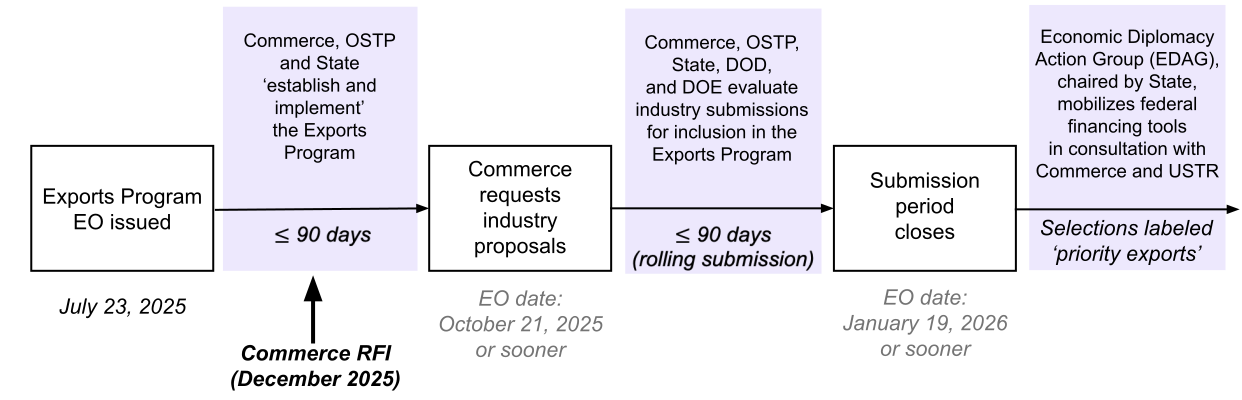
However, time to establish the Exports Program is tight. The initial program milestones set by the executive order have already slipped — Commerce’s plan to issue industry requests for proposals, originally due by October 21, is now months behind schedule. Sustaining program momentum and American industry support nevertheless depends on operationalizing projects quickly.
Figure 1: Illustration of Export Program timelines and federal agency responsibilities
Recommendations for export packages to prioritize
1. Include US-operated cloud services as an eligible export “deployment” model
The executive order does not define what constitutes export “deployment” or “engagement” under the Exports Program — whether it is direct sales of AI hardware to foreign customers, the provision of US-operated cloud services and applications, or some combination of the two. While cloud services are listed as one component of the AI stack,4 the executive order leaves ambiguous whether deployment entails transferring physical ownership of American infrastructure to customers abroad (even if American companies still provide some cloud services or other applications), or delivering compute as part of a bundle of managed American services.
OSTP and Commerce should resolve this ambiguity by clarifying that US-operated cloud services, whether hosted in-country or abroad, are an eligible “deployment” model for export of American AI compute. Cloud services have several properties that make them an ideal export model for the goals of the program:
- Speed: Hardware-based deals, especially for new data centers, can take years to deploy and realize value from. Cloud services, on the other hand, can often readily be deployed out of existing data centers either in-country or abroad. This speed advantage helps achieve the Export Program’s goals of diffusing the American technology stack as quickly and widely as possible. In cases where the data centers providing cloud services are hosted abroad, add-on features such as confidential computing can be used to mitigate data localization or related concerns.
- Scalability: American cloud service providers already have the operational experience, trusted brands, and economies of scale to service local AI needs in most regions worldwide. Cloud also offers flexibility to scale to customer demand as it grows; cloud providers can still service customers from offshore data centers prior to clear demand for new in-country facilities, for instance.
- Stickiness: Unlike one-off hardware sales, cloud deployments generate recurring value across the stack through compute leasing, platform services, and managed applications. This creates continuous, subscription-based revenue streams that align commercial success with long-term dependence on American infrastructure. Because of their full-stack nature, cloud deployments make it harder for Chinese competitors to establish a foothold in contested markets — to provide equivalent offerings, they must not only compete at the hardware level, where American companies excel, but also at the platform and application layers. Hardware-only sales, by contrast, provide Chinese competitors an opening to deploy their own platform and application software on top of American hardware.
- Security: For countries that are not close American allies, and where alignment with American export control policy is more uncertain, US-operated cloud services also offer national security advantages that direct chip shipments do not. Because infrastructure remains under American control, providers can enforce customer identification requirements (such as Know Your Customer controls), maintain documentation of basic compute usage patterns, and revoke access if necessary — capabilities that reduce misuse risks and prevent chip diversion to China.5 By contrast, direct chip sales surrender both visibility and control the moment hardware crosses borders.
2. Encourage industry to vary the contents and scale of export packages to reach a broad range of customers and markets
The program’s executive order currently envisions full-stack AI exports as a package of AI hardware, software, and applications deployed at the scale of data centers. While this model may suit AI-ready environments (see Recommendation 9), the United States also needs a strategy to attract smaller, less developed markets and kickstart demand. Many of these places may lack a clear vision for AI (or even the infrastructure to support it), but their rapidly expanding populations and economies could make them important customers over time. Moreover, countries with more limited AI needs create openings for China, which, despite lagging far behind the United States in large-scale chip deployment, may be able to compete by bundling modest chip offerings with other tech infrastructure. Serving these smaller markets is important for ensuring American AI diffusion is truly global, thus building trust and developing joint standards based on American technology.
Offering a variety of applications and package sizes ensures that the United States has something to offer partners at different stages of digital development, from governments seeking advanced AI platforms to communities only beginning digitization — expanding the Exports Program’s reach. Commerce should encourage industry to:
1. Vary the kinds of applications and infrastructure components included in export packages
Including, where relevant:
- Culturally and geographically agnostic tools that companies offer American customers, such as coding LLMs, customer service chatbots, and AI-enabled weather forecasting or cybersecurity services.
- Tailored software-based applications, such as medical applications that comply with national data laws and regulations, AI tutoring platforms customized for local languages and curricula, or AI tools that can digitize government records.
- AI-enabled physical tools and AI-enabling physical infrastructure that match countries’ economic or development priorities, such as medical diagnostic equipment, and foundational AI infrastructure like fiber optic cables and power generation equipment. This could broaden participation in the Exports Program to include companies like Qualcomm and Siemens.
Offering this range of applications, including development-focused tools and basic infrastructure, would demonstrate the Exports Program’s commitment to meeting partner needs and delivering tangible, visible benefits. To do so, Commerce should clarify that the full AI stack “includes but is not limited to” the components listed in the executive order to increase the scope of stack inputs eligible for the program. This clarification in the upcoming Request for Proposals (RFP) would help the program remain flexible to changes in customer needs as well as to new technological innovations that industry may want to include in full-stack AI exports in the future.
2. Vary the size of export package deployments
Not every customer requires large, data center-scale infrastructure, nor is it a sound investment to build such capacity where demand for it is weak. The planned 1 GW Microsoft-G42 data center in Kenya illustrates this risk: announced in May 2024 with significant backing from both the US and Kenyan governments, the 1 GW facility aimed, in part, to showcase American leadership in building African AI infrastructure. Yet more than a year later, construction had reportedly not begun by September 2025, in part due to insufficient commercial demand. This not only delays American returns on the diplomatic and financial capital invested in securing the deal, but also postpones delivery of American AI services to meet what demand there is.6 If similar setbacks occur under the Exports Program, they may undermine the program’s credibility, prompting partners to question whether the United States can deliver, and potentially opening the door for Chinese competitors to present themselves as more pragmatic alternatives.
The United States should learn from the stalled Kenya data center example by avoiding gigawatt-scale projects where they lack commercial sense and instead promote smaller deployments that can expand as demand grows, including cloud services delivered from nearby regions (see Recommendation 1). As one example, for customers with modest or uncertain demand, industry consortia could consider small “AI in a box” solutions — integrated hardware-software packages that can operate air-gapped or at the edge. These “boxes” can serve strategic government agencies, heavily regulated industries, and critical infrastructure operators while requiring less upfront investment than full data center buildouts. For markets that present lower AI demand and thus less promising investment opportunities, smaller deployment options like these can be an avenue for opening up smaller markets, building proof-of-value for foreign partners and serving as the basis for future standards cooperation. Export deployments can be scaled to larger data center-scale infrastructure from there.
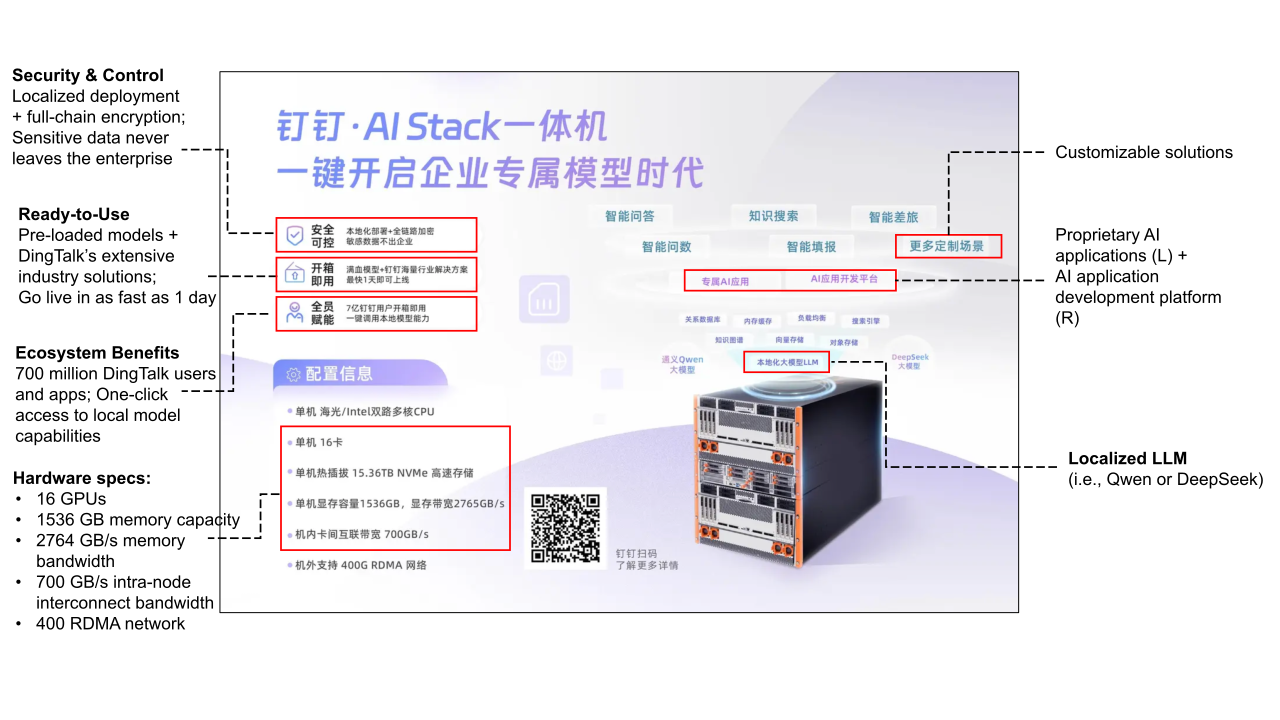
China is already moving in this more modular direction. A growing number of Chinese companies sell “all-in-one” (AI一体机) stacks that bundle hardware, software, and open-source models like DeepSeek and Qwen as standalone or connectable modules.7 Companies market these stacks as ready-to-use private cloud services that keep workloads encrypted and on-premises, appealing to organizations prioritizing security and control (see Figure 2 below). While the vast majority of these stacks are sold to domestic Chinese customers, one Huawei and iFlytek stack advertises sales destinations to nearly 70 foreign countries.8
Figure 2: Annotated example of a Chinese “all-in-one” AI stack built for domestic enterprises (Alibaba Cloud x DingTalk)
While this business model has its limitations,10 the United States should not let China monopolize the international market for these products. Commerce should make these packages eligible by removing the requirement that all proposals include data center storage in export proposals. More broadly, Commerce should review industry consortia’s submissions for evidence of sustainable demand at the proposed project scale and avoid letting geopolitical signaling override sound business logic.
3. Where necessary, accommodate foreign partners’ ‘sovereignty’ concerns by prioritizing in-country infrastructure and confidential computing in export packages
As the world’s leading provider of compute, the United States has the leverage to set deployment terms with foreign partners. The Bureau of Industry and Security (BIS) and SemiAnalysis estimate that domestic Chinese production reached between 200,000 and 805,000 AI chips in 2025 — far below its domestic needs. By contrast, American vendors produced roughly 4.8 million AI data center chips in 2023 alone. In 2025, this figure will likely be closer to 11 million.11 Even if China’s production grows by an order of magnitude, it will struggle to balance domestic demand with international exports at scale. This asymmetry gives the United States an opportunity to not only shape global markets but to influence how foreign countries access American AI infrastructure for years to come.
Yet the program should still take foreign partners’ AI sovereignty concerns seriously.12 Governments may worry about foreign operational control over critical infrastructure and sensitive data — particularly if that data is stored in overseas facilities, creating friction with national data localization requirements. These concerns could be especially acute for governments and regulated sectors for whom foreign cloud reliance could be seen as challenging national security and strategic autonomy. More broadly, the global cloud market’s concentration may further intensify anxieties about vulnerability to outages or geopolitical leverage.
OSTP Director Michael Kratsios acknowledged such concerns at the August 2025 APEC Meeting. He told delegates:
“We know you want what’s best for your country […] We want you to have the AI sovereignty, data privacy, and technical customization that you so rightly demand on behalf of your peoples. We are committed to finding a way to enable America’s private companies to meet your national technological needs.”
To make this happen, OSTP and Commerce should channel Export Program resources towards solutions that address partner sovereignty and data privacy concerns, such as packages that include:
- In-country data centers. Only 33 countries host any public cloud AI computing capacity as of mid 2025.13 For the vast majority of countries, simply gaining access to US-operated AI cloud infrastructure within their borders would satisfy key sovereignty demands: meeting data localization requirements, enabling governments to assert jurisdictional oversight, and reducing dependence on overseas facilities.
- Confidential computing: For governments requiring stronger technical assurances of sovereignty, confidential computing — a hardware-based technology that protects data while it’s being processed — offers an additional privacy and security layer that is already widely available on modern AI accelerators, and offered as a service by many American cloud computing providers. Confidential computing lets partners run sensitive workloads with privacy guarantees while ensuring American companies maintain control over provisioning, scaling, and monitoring of overall compute capacity, thus preserving both economic benefits and national security safeguards.
Together, these measures offer a workable compromise: foreign partners gain credible sovereignty assurances while critical American infrastructure remains under American operation. Even if some foreign partners would prefer outright hardware ownership, the commercial and national security upsides of US-operated cloud services make it worth nudging customers toward the cloud, including by providing preferential treatment to cloud-based exports using federal financing tools.
4. In consultation with CAISI, package exports with sovereign evaluation capabilities to build trust in American AI stacks
To build confidence in American technology, industry consortia should enable partners to independently verify American models’ security and performance. This could help to counter suspicion that American companies may overstate their model capabilities and help to position American systems as more transparent and trustworthy than their competitors.14
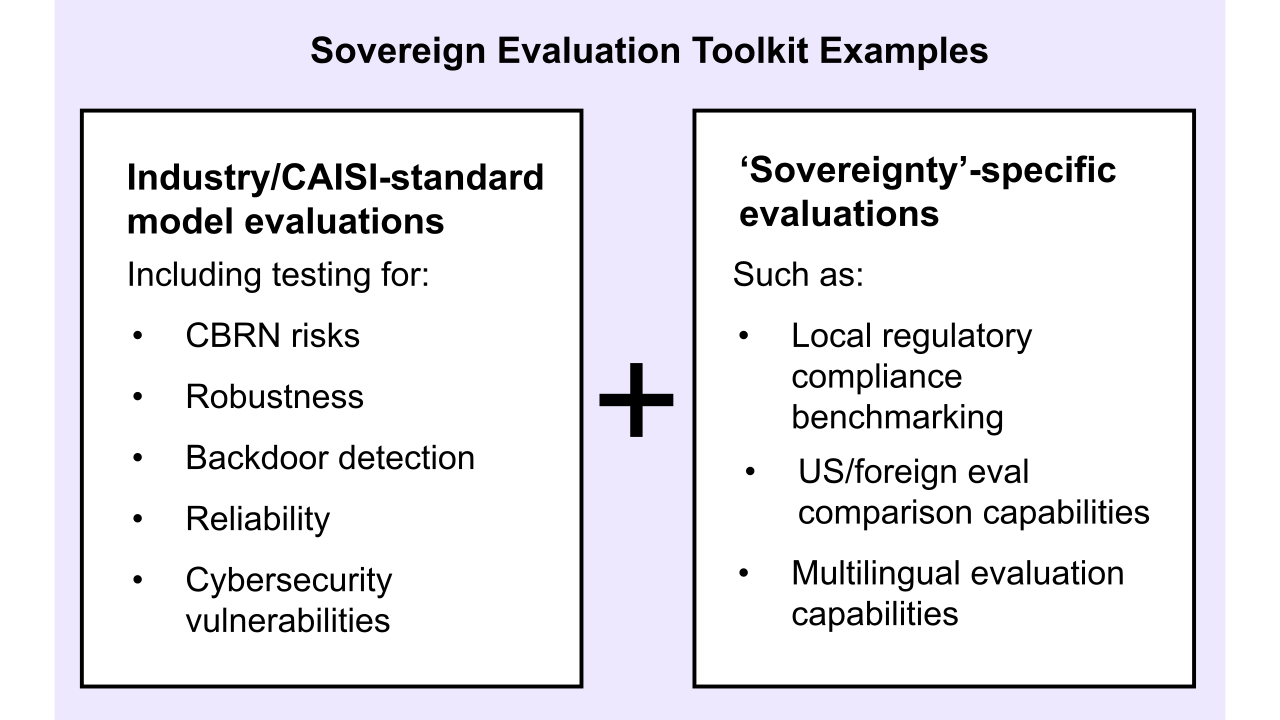
The Exports Program could offer a “Sovereign Evaluations Toolkit” so that partners can conduct both industry-standard assessments (CBRN, robustness, jailbreak risks) and country-specific compliance checks. Toolkits could include easy-to-use software pipelines for running state-of-the-art evaluation suites, as well as hardware for model hosting, inference, and fine-tuning — useful for building trust that the version of the model under evaluation is indeed the model that will be deployed. With confidential computing, partners could run these evaluations on-premises on closed-source models without direct access to the proprietary model weights, maintaining American IP protection while enabling independent verification.15 These toolkits could be designed to align with National Institute of Standards and Technology (NIST)/CAISI standards for model evaluation, effectively exporting American standards alongside American technology.
Figure 3: Example evaluation tests in a “Sovereign Evaluations Toolkit”
OSTP could direct CAISI to scope and lead the development of a design specification for this sovereign evaluation toolkit, and prioritize export packages that include it. This could involve CAISI offering an evaluation platform similar to the UK’s Inspect and coordinating the development of more tailored evaluations by industry and academia. It would directly support the AI Action Plan’s goals of advancing American technological standards and developing evaluation capabilities of adversarial AI models. If DFC, EXIM, and other financing agencies secure additional funding from Congress for the Exports Program in the future, OSTP and Commerce could direct additional resources to help promote and integrate the evaluation toolkit into their export offerings.
Recommendations for effective export promotion
5. Focus international messaging of the Exports Program on addressing countries’ concrete issues with pragmatic industry solutions
Foreign governments increasingly resist dependence on American technology, and commentators warn of “America’s AI colonialism,” citing American calls for global ‘dominance’ in AI supply chains as a “potent tool for coercion.” If the program is designed well, these fears can be mitigated — the United States has a genuine interest in spreading AI technologies that support democratic principles and tangibly improve lives. Still, the US government and American companies must continuously show that this is the case. Overcoming partners’ skepticism is one of the central challenges the Exports Program will face — even if countries buy American products, they may avoid embedding them in critical operations if they fear future weaponization.
Addressing these concerns will require careful messaging by American diplomats when promoting the program overseas. Language that resonates in Washington around competing with China and ensuring American technological “dominance” will not land in markets where governments are unmotivated by American geopolitical concerns and have consistently resisted picking sides in US-China competition despite years of coaxing.
OSTP, Commerce, and State should focus the Exports Program’s international messaging squarely on addressing countries’ concrete problems with American offerings. Industry consortia should take the lead by showing countries that they can provide targeted, pragmatic solutions to foreign partners’ issues, working with businesses and governments to tailor products that meet their needs: improving healthcare delivery, modernizing financial systems, and enhancing agricultural productivity, for example.
6. Implement baseline security guardrails in export packages that involve providing foreign countries with direct access to substantial quantities of advanced AI compute
As the AI Action Plan recognizes, advanced AI compute will enable novel military capabilities. As these capabilities evolve, some potential markets for the Exports Program could become subject to new export controls. While new restrictions might be critical for protecting America’s national security, a sudden change in control status could delay deployments and impose unexpected costs, undermining the Export Program’s goals.16 To minimize these negative effects, the administration should align export promotion and control strategies from the start, rather than treating them as separate levers.
Commerce should specify baseline security measures to include in all export packages that involve providing foreign countries with direct access to substantial quantities of advanced AI compute. These measures should aim to minimize the risk of diversion of advanced AI chips to foreign adversaries and protect any sensitive American IP hosted abroad, such as frontier model weights. These measures could also help enable exports to already export-controlled countries where China currently has advantages due to limitations on American companies’ ability to export AI chips.
BIS’s Data Center Validated End User program offers a useful template. Its security requirements are straightforward measures that responsible firms already implement: customer verification, usage documentation, and compliance reporting.17 For high-risk destinations — such as known transshipment points like Malaysia and Indonesia, or countries with a track record of working with Chinese military and intelligence entities or using technology to support human rights abuses — additional measures may be warranted, including chip location verification (which NVIDIA has already implemented on its Blackwell-generation chips) and enhanced cybersecurity requirements. A list of these security measures, along with other possible guardrails, is provided in Appendix A of this report.
Policymakers should prioritize export packages that adopt these guardrails, incentivizing industry to meet them. For instance, BIS could prioritize or streamline license applications from companies whose AI packages meet baseline security criteria, reducing administrative friction for exporters who build compliance into their offerings. But small-scale exports (e.g., under a specified number of advanced AI chips per end user annually) should remain minimally restricted to enable rapid establishment of American AI partnerships worldwide.
7. Establish benchmarks to measure the success of the Exports Program and steer future policy decisions
The Exports Program’s success should be judged by operational deployments and sustained customer adoption, not by the dollar values or capacity figures announced at signing ceremonies. High-level agreements make for compelling headlines — a $5 billion deal or a promised gigawatt of capacity signals ambition and strategic intent. But these numbers are meaningless if the infrastructure never becomes operational, sits chronically underutilized, or fails to generate follow-on demand for American AI technology. A modest deployment that drives growing customer adoption delivers far more strategic value than a gigawatt facility that never breaks ground.
True program success requires evidence that deployed infrastructure is actively serving customers and creating enduring demand for the broader American AI ecosystem. To compile this evidence, Commerce, OSTP, and State should establish operational benchmarks for evaluating program outcomes. Program evaluation metrics could include:
- Time-to-operation of project data centers;
- Data center utilization rates;
- Cloud contract renewals and expansion; and
- Private capital mobilized by US federal financing.
A longer list and discussion of recommended program metrics is provided in Appendix B. Collection of evidence from these benchmarks could be supported by other government agencies and on-the-ground government assistance like the United States Trade and Development Agency, leveraging its market assessment and feasibility studies, as well as the US Commercial Service, whose officers are stationed at American embassies in prospective partner countries around the world.
Furthermore, agencies should prioritize program resources for consortia proposals that demonstrate realistic demand assessments and sustainable business models over those chasing the largest possible headline numbers. Where initial deployments succeed in generating strong customer demand, the program can then support expansion, letting actual market validation drive scale rather than leading with aspirational capacity figures.
8. Remove the consortia requirement for American companies seeking to participate in the Exports Program without foreign partners
The current consortia requirement outlined in the executive order does not specify how American companies are expected to organize into groups to qualify for the Exports Program. This lack of clarity has generated confusion among industry, as well as concern that American companies that are unable to identify consortium partners could be excluded from the program’s opportunities.
The consortia model introduces unnecessary coordination burdens among both American companies and between industry and government. Many large American companies will be able to offer full-stack AI packages without needing to join a consortium. Furthermore, as the program’s RFI correctly indicates, the consortia approach creates uncertainty around leadership and accountability, raising questions about which company should serve as lead, how risk and costs should be shared, and how liability would be allocated among members. These governance issues could deter participation from smaller or more specialized companies that lack the capacity to navigate complex multi-company partnerships.
To address these challenges, Commerce and OSTP should clarify that consortium formation is not required when American companies are exporting AI solutions without the participation of foreign companies. This clarification would promote flexibility for companies that wish to act individually through smaller, project-based collaborations, while still preserving the option for larger voluntary consortia when they offer clear scale or integration benefits. Removing the consortia requirements for American-only exports would help to reduce coordination costs, accelerate project timelines, and expand the program’s reach.
However, if foreign companies are permitted to be included in American industry proposals — as the program’s RFI suggests they could — they should be required to do so through a consortium that remains majority US-owned and led. This ensures that American taxpayer funds principally support American industry and that foreign companies cannot access the program’s resources independently.
Recommendations for priority export destinations
9. Prioritize emerging strategic markets where American market presence is contested or weak
Government agencies should not defer all country prioritization decisions to industry, given the Export Program’s geostrategic purpose. Commerce, OSTP, and the EDAG should instead identify key regions and markets, drawing on industry input and US government data to assess what makes a market “strategic” in commercial, geopolitical, and national security terms. As EDAG chair, State should guide how these three factors are balanced — pursuing commercially viable deals that expand the American AI ecosystem while safeguarding national security objectives such as preventing chip smuggling and adversarial military use of AI.
To start, the Exports Program should not subsidize markets where American industry already dominates or where major expansion efforts are underway. American companies already lead the European cloud market and dominate AI model usage in the region. Likewise, the Gulf states are receiving massive investments as part of the May 2025 Gulf deals. While American consolidation in these regions remains important, they should not consume scarce government resources that are best used in contested or underserved markets.18
Instead, Commerce, OSTP, and the EDAG should prioritize program resources, such as financing, for emerging strategic markets where American industry presence is contested or weak. These countries (with key options listed below) are emerging AI hubs that will shape AI diffusion, governance, and technical standards across their regions. Their projected economic growth and data center expansion make them commercially and geopolitically valuable. China is actively expanding its AI and critical infrastructure presence in these markets through smart city projects and 5G networks, while a weak American presence leaves openings for further Chinese entrenchment.
Figure 4 below presents a first-cut assessment of specific countries the Export Program could prioritize using three selection criteria:19
- Regional powers with economic clout — measured by countries with GDPs exceeding $150 billion and populations exceeding 50 million.20
- Countries at risk of becoming locked into China’s tech stack, estimated here by the rough proxy metric of any country with a score of 50% or above on the ‘Technology’ domain of the China Index, as a measure of Chinese influence.
- So-called “swing states” — countries hedging between the United States and China. This would exclude G7 and Five Eyes members (already close American allies), given the limited resources available to the program, and American adversaries.
This leaves a list of 11 states, nine of which should be priority targets for the AI Exports program, illustrated in Figures 4, 5, and 6 below.21
Admittedly, prioritizing these countries for exports is not risk-free. Several of these states are in Southeast Asia, which has served as a major transshipment point for chips to China.22 Many of these countries are deliberately hedging between Washington and Beijing. Indonesia, for example, relies on the US for security but depends on Chinese investment for infrastructure, including telecoms and subsea cables. Brazil has strengthened ties with China on AI while criticizing the United States.
Yet avoiding these markets would be a strategic error. For instance, Southeast Asian countries are home to roughly 700 million consumers, critical global shipping routes, and an AI investment boom valued at $60 billion. The region’s proximity to China has meant that Chinese firms have made a concerted effort to expand their presence in the area. The United States has an opportunity to contest rising Chinese influence, particularly in countries like the Philippines and Thailand, where total investments have been smaller and where the Exports Program could thus make a greater difference at the margin. The alternative, focusing on ‘safer’ countries like Costa Rica or Uruguay, means ceding major economies to China. The program should compete where competition is hardest, but the stakes are highest.
As Commerce selects countries to prioritize in the coming months, it should weigh the trade-offs between pursuing fewer, larger government-to-government (G2G) partnerships versus a higher volume of smaller deals:
- A concentrated strategy would pool the program’s initial resources to secure fewer but larger G2G deals with a select number of large “swing states” such as Brazil, Indonesia, or Malaysia. This export strategy would establish regional hubs with significant AI demands. Focusing on comprehensive agreements that embed AI into these and similar foreign partners’ national infrastructure could take advantage of governments’ typically long procurement cycles and limited budgets, generating durable long-term demand in critical markets. Still, concentrating resources on high-profile projects that sit idle or are underutilized risks undermining the program’s credibility and wasting precious program resources (see Recommendation 2).
- A diversified strategy would pursue more but smaller G2G deals to establish a wide array of American AI footholds globally with more modest export packages. Given that any deal will take time to materialize, pursuing more partnerships simultaneously could secure quicker wins for the program and inform the program’s approach to smaller developing countries in the future. Furthermore, failures in smaller deployments could be less damaging to the program’s overall credibility than a high-profile flagship one. Negotiating and monitoring a high volume of small deals, however, requires greater coordination than only a few large ones, and may exceed current government capacity.
Given these trade-offs, we recommend that Commerce initially pursue G2G partnerships with a narrow set of large, emerging AI hubs in addition to a few relatively smaller markets. Successful deployments in major emerging markets — such as Brazil or Indonesia — would provide tangible evidence of program effectiveness to Congress (key for future appropriations) and could attract interest from other prospective partners. These initial target markets are also commercial and geopolitical priorities where American companies already have stronger incentives to invest, improving the odds of sustainable commercial returns. Simultaneously, Commerce could pursue a handful of smaller partnerships — such as with Thailand or the Philippines — in order to secure wins for the program and jumpstart demand early on.
As the program matures, through successful initial partnerships and/or additional appropriations, Commerce should broaden its engagement to include smaller, less commercially attractive markets. This second phase would help to expand the American AI footprint in places especially vulnerable to Chinese alternatives in the absence of American engagement.
Appendix A: Recommendations for export promotion guardrails
To withstand changes in American export control policy and prevent American adversaries from accessing large quantities of advanced AI compute, Commerce should establish baseline security measures in the Exports Program that align with existing rules and could, if necessary, meet many future control requirements. BIS’ Data Center Validated End User program, which grants select end users access to export-controlled technologies under license exceptions, offers a useful model, particularly for large overseas data centers developed under the program. Relevant measures could include:
- An overview of the consortia’s security plans: Consortia must present security plans for their projects, including but not limited to personnel security, cybersecurity, and physical security measures (such as third-party monitoring, description of compliance with NIST cybersecurity standards, and incident reporting plans).
- End-use and end-user assurances: Consortia must certify that items granted “priority export” status will only be used for approved commercial purposes and will not be diverted for military, surveillance, or other use cases contrary to American national security interests.
- Resale and re-export restrictions: Export package hardware must remain within the approved location detailed by industry consortia in their response to Commerce’s RFP and subsequent formal agreements with the US government prior to export.
- Notification requirements: Consortia must promptly notify BIS of any material changes to ownership of AI hardware (such as the sale or resale of AI chips) or discovery of non-compliance or diversion risks.
- Record-keeping: Consortia must maintain records of all export transactions under the Export Program, including what exported items were received and when, and where they are located (for hardware).
- Verification/audit rights: BIS reserves the right to conduct checks and audits at approved export package facilities to confirm compliance, and can ask to see consortia records at any time.
For certain “high-risk” destinations, such as known chip smuggling hotspots, or countries with track records of using technology for surveillance and other rights abuses, policymakers may also consider more stringent requirements:
- Heightened AI-specific cyber/physical security measures: Require compliance with NIST SP 800-53, National Security Administration cybersecurity best practices, and FedRAMP High measures, in addition to Department of Defense Unified Facilities Criteria.
- Chip smuggling mitigation measures: Require American AI chip vendors to implement on-chip location verification mechanisms that allow industry consortia to attest that chips have not been diverted to export-controlled countries like China. Additionally, consider mandating that foreign partners take anti-chip smuggling enforcement measures as a condition of receiving American export packages.
Appendix B: Recommendations for US government metrics to assess Exports Program success
Commerce, OSTP, and State should use quantitative metrics to track program effectiveness and inform future policy decisions related to American AI exports.23 Given that the program will use taxpayer money to subsidize American industry, it should also use these metrics to prove its value in order to earn continued government and industry support.
Evaluators should adopt the simplest metrics necessary to track program milestones. Burdensome reporting requirements create red tape that may dissuade companies from participating, erode trust with foreign partners, and stretch government capacity. At the same time, metrics should be able to isolate the program’s role in advancing American AI diffusion abroad.
All reporting should rely on coarse, aggregated data already collected for operational reasons and should avoid any disclosure of proprietary company or customer information. Program evaluators should weigh increased visibility into the program’s impact — using more granular project statistics provided by American industry — with the tradeoffs of adding more reporting requirements on American companies.
We recommend tracking two broad categories of metrics:
- Operational metrics, which measure the delivery and scope of Export Program projects, and;
- Strategic metrics, which track whether projects contribute to the central objectives of the Export Program, such as promoting global adoption of American AI technologies and standards.
Suggested operational metrics
Project time-to-operation
This metric measures the time elapsed between construction start and when a data center begins servicing customers.24 Data center operators and construction vendors already track this measure, and project progress can also be easily verified by third-party organizations using satellite imagery.
Data center utilization rates
Utilization rates provide a simple, robust indicator of market demand for the program’s projects. These rates measure the percentage of available computing capacity actively used at any given time and can be reported to Commerce via data center operator records. Utilization correlates with customer demand and contract volume, making it a useful proxy for market interest in program-supported AI infrastructure.25
Data center capacity delivered versus capacity planned
This metric provides another indication of whether American vendors successfully complete projects associated with the program. It uses power capacity to track whether vendors complete a data center on the scale that was originally envisioned. Capacity can be measured by comparing project plans and relevant operational data. Program evaluators should distinguish between shortfalls caused by operational issues (such as construction delays or supply chain issues) and cases where projects were modified due to changing market conditions.
Financial sustainability of infrastructure projects
To prevent long-term dependence on federal support, projects should achieve profitability without continued government financing. Evaluators can track project profitability with standard metrics reported on corporate income statements and other financial disclosures. For example, EBITDA per megawatt (MW) tracks operational cash flow normalized by data center facility size, complementing utilization as an indicator of demand.26 Additionally, net margin, or profit as a percentage of revenue, measures the overall data center operational efficiency.27 As a measure of leverage, evaluators can also track additional private capital mobilized using standard development finance methodology.28
Suggested strategic metrics
Compute capacity built attributable to US federal financing tools
This metric captures the program’s role in increasing the market share of American AI infrastructure. It measures the total computational power of projects built using the program, in Floating Point Operations per Second (FLOP/s), per dollar of government spending. Data center FLOP/s can be calculated from technical specifications that companies will submit as part of standard program requirements, and government spending data should already be tracked for each project.
Because the program may support different projects to varying degrees — entirely facilitating completion in some cases but contributing only marginally in others — program metrics should reflect how much credit the government can claim for a project’s outcome (known as “additionality”). As an illustrative example, the program should not receive full credit for a $10 billion data center if it contributed only $1 to its financing. One simple approach to calculating additionality is to weight a project’s compute output by the share of government financing the program provided.
Program evaluators should draw on existing methodologies from development finance institutions such as DFC and EXIM to develop this additionality framework. These and similar international institutions already use structured impact frameworks that distinguish between financial, timing, technical, and catalytic contributions when assessing their role in a project, offering useful models for an Exports Program-specific approach.29
Cloud, model, and application customer retention
This can be measured by average contract length and contract renewal percentage at each layer. The program aims not only to promote short-term use of American AI infrastructure, but to make this use ‘sticky’ among partners. Average contract length and contract renewal percentage provide useful indications of trust in and stickiness of the American AI stack. Long contracts signal strong commitments to the American tech ecosystem and high renewal rates indicate that program-supported infrastructure meets customer needs. These outcomes can be assessed using vendors’ contract data.
Adoption of American AI security standards or international SDO standards by foreign partner organizations
This could include those outlined in the NIST AI Risk Management Framework, NIST SP 800-53, NIST cybersecurity standards, or ISO/IEC AI standards. Adoption can be tracked through direct surveys or by analyzing the number of partner organizations that publicly reference these standards.
Acknowledgments
The authors would like to thank Teddy Tawil at the Carnegie Endowment for International Peace for his research assistance.
-
Represented by the Economic Development Action Group (EDAG), chaired by State.
-
As of November 2025, EXIM had $100 billion of authorized funding remaining. EXIM is up for reauthorization in 2026, which could raise its lending cap from $135 billion to $205 billion as part of the new reauthorization package.
-
A 2023 third-party analysis found that political risk insurance contracts mobilized $2 billion of additional private capital that would not have otherwise been provided. For top projects, mobilized private capital exceeded DFC exposure by four to five times.
-
Along with chips, data center storage, and networking in §3(i)(A).
-
This does not mean that cloud services are free from diversion risks, as compute can still be accessed by Chinese entities remotely. Multiple policy efforts have taken aim at this loophole, including the bipartisan Remote Access Security Act, a bill introduced in April 2025 that would add remote access provisions to the 2018 Export Control Reform Act (ECRA); an (inactive) January 2024 proposed BIS rule to introduce requirements for American cloud infrastructure providers to roll out Customer Identification Programs, including the collection of “Know Your Customer” (KYC) information; and the Biden administration’s AI Diffusion Framework, which mandated systems to prevent unauthorized training of controlled models. None of these policies are currently in place.
-
The Kenyan government is intended to be a customer for the data center as it digitizes and integrates AI into its operations.
-
For instance, see Alibaba Cloud’s AI Stack (阿里云AI Stack), Sensecore’s ‘Large Model All-In-One Machine’ (大模型一体机), and iFlytek’s Spark All-in-One Machine. Some stacks listed on Huawei Marketplace, such as AIServer’s all-in-one stacks (数据中心级DeepSeek版AI一体机爱思微服), advertise racks of NVIDIA H20 chips for data center-scale operations that run both Chinese and American AI models including Google’s Gemini, Anthropic’s Claude, and OpenAI’s ChatGPT.
-
It is unclear how many, if any, iFlytek/Huawei stacks have actually been sold outside of China, though mainland China is notably not on the iFlytek’s public list of sales destinations. Furthermore, at just 16 GPUs per machine, iFlytek/Huawei sales of AI chips for these packages are likely in the few thousands even in the most optimistic scenario (assuming they sold one stack to all 70 listed destinations, this would equal only 1,120 chips, which are also well below the frontier. Even if they sold 100 times this figure it would still be a strategically insignificant amount).
-
Source. The hardware specifications listed in Figure 1 above indicate that the DingTalk AI Stack uses NVIDIA H20 chips to service customers in China. 1,536 GB (~1.5 TB) memory capacity ÷ 16 GPUs per stack = 96 GB per GPU. NVIDIA H20s have 96 GB (though their memory bandwidth is 4.0 TB/s). NVIDIA H100s are the second-closest with 94 GB with the NVL configuration and 3.9 TB/s bandwidth, though it is highly unlikely that they would be used for an inference-focused stack such as this and H100s are banned in China. No other chip from NVIDIA (Ampere series, other Hopper series chips), AMD (Instinct series), or Huawei (Ascends) matches the specifications listed above.
-
By some accounts, Chinese all-in-one machines have struggled to overcome scalability issues and vendor lock-in concerns in China. Still, sales of all-in-one machines are expected to surge fivefold in China, from 150,000 units in 2025 to 720,000 by 2027, with market value rising from 123.6 billion yuan ($17.3 million) to over 520.8 billion yuan ($73 million), according to data released by Zheshang Securities.
-
TSMC forecasts that demand for its AI accelerator fabrication will grow 50% per year, reaching more than 20% of TSMC’s total revenue by 2028. Assuming that this growth in fabrication results in equal growth in shipments (input supply constraints notwithstanding), 50% yearly growth from a starting point of 4.8 million (2023) indicates roughly 11 million AI accelerators produced in 2025, and roughly 40 million in 2030, with the vast majority going to American vendors if current market shares hold.
-
There is a fair amount of confusion as to what constitutes ‘sovereign’ AI, despite frequent use by American industry and foreign governments. While there is no single definition of AI sovereignty, it broadly captures a push by governments worldwide to develop and control their own AI capabilities, including AI infrastructure, data, and systems, thus reducing technological dependencies on foreign providers like the United States or China. The term often has different meanings for different actors — in the context of AI compute sovereignty, for instance, it can cover territorial and regulatory jurisdiction over data centers, the nationality of cloud providers, or even for some the nationality of compute vendors. AI sovereignty is closely related to ‘digital sovereignty’ and ‘data sovereignty’ concepts, but tailored for AI-specific contexts.
-
Note that this is not the same as public cloud regions, of which there are many more. The referenced study defines public cloud as cloud-based AI compute infrastructure made commercially available to users via providers’ platforms. It is ‘public’ in the sense of availability to the general public, not because it is operated by a government.
-
Users could potentially run the same evaluations across American and non-American (e.g., Chinese) models to compare results and highlight censorship behaviors and backdoor vulnerabilities.
-
See Google’s Distributed Cloud offering as an example of locally-hosting models while using confidential computing to limit direct users’ access to model weights.
-
Mounting bipartisan support for export control legislation in the House and the Senate adds to the likelihood that US export control requirements could change once more.
-
The bipartisan GAIN AI Act included a license exception provision for American companies that followed similar security measures, demonstrating existing Congressional support.
-
India is excluded as a priority destination in Figure 4 below for a similar reason — China is not a major competitor in Indian tech markets and top American AI companies have already announced large investments for expansion there. The authors expect that American expansion will continue independently from the Exports Program, though policymakers may consider program grants for smaller American companies that would otherwise struggle to enter the market.
-
Thanks to Teddy Tawil from the Carnegie Endowment for his assistance with this research.
-
To forecast national power in the near future, we used projected 2030 GDP figures from the IMF World Economic Outlook database.
-
Mexico and Pakistan were excluded from this list. While Huawei is active in Mexico and Alibaba is opening a data center in the country, the US generally enjoys strong leverage over the country due to proximity and trade ties. American tech giants have also made large investments outsourcing hardware manufacturing to Mexico, strengthening America’s position. Pakistan has gaps in AI readiness and its economic ties to China may be too strong — the China Pakistan Economic Corridor is the centerpiece of China’s Belt and Road Initiative.
-
See Recommendation 6 for proposed export security guardrails as part of the program.
-
This appendix is an extract of a longer memo on metrics for tracking the success of the AI Exports Program by Teddy Tawil and Sam Winter-Levy, available on request.
-
Data center operationalization sometimes occurs in phases, so time to full operation is often the most appropriate metric, though Commerce could additionally track these phases for more granular insight into project development.
-
To reduce sensitivity, utilization could be limited to annual reporting conducted in percentage brackets (e.g., 70-80%; 80-90%; 90-100%).
-
Utilization depends on pricing, so EBITDA/MW captures valuable additional information. Utilization, for example, could be high only because a data center operator slashed prices.
-
Net margin does not capture capital expenditures (CapEx) and therefore does not provide a complete picture. However, CapEx on chips and servers should be similar for similar projects, as they are bought from the same vendors, like NVIDIA.
-
See the World Bank Group, MDB methodology for private investment mobilization: Reference Guide (June 2018); McKinsey & Company, Capital Mobilization Impacts Resulting from DFC’s Political Risk Insurance Product: Impact Assessment Report (May 2023).
-
For example, see Multilateral Development Banks’ Harmonized Framework for Additionality in Private Sector Operations (September 2018).